Note: This article appears on the ETFtrends.com Strategist Channel
By Michael Jones
Thus far in 2016, investors in developed international markets have seen a stark contrast between the actions of the two most important central banks in these economies – the European Central Bank (ECB) and the Bank of Japan (BOJ). The ECB has used creative new stimulus strategies to compensate for earlier missteps, while the BOJ has compounded its errors through inaction.
In his most recent policy pronouncements, ECB President Mario Draghi has largely recovered from his “overpromise, under deliver” communication mistakes in late 2015. At its March meeting, the ECB upped its quantitative easing (QE) targets, began purchasing corporate bonds and implemented a creative use of negative interest rates. If European banks meet loan growth targets, then they can borrow from the ECB at negative interest rates, a policy that essentially pays banks to make loans and turns the normally negative bank earnings impact of negative rates into a potential positive. The cumulative weight of the ECB’s aggressive stimulus policies helped accelerate the Eurozone economy to an annual growth rate of nearly 2.5% in the first quarter of 2016, as compared to a mere 0.5% rate of growth in the US (see the 5/3/2016 Weekly View for more details about our positive European outlook).
Related: Frustrated by Diversification? Read on…
By contrast, in our view, the BOJ has spent 2016 making a series of policy and communication errors. We believe these policy mistakes make it possible that Japan will suffer a second quarter of negative growth and enter into another technical recession (back–to–back quarters of negative GDP growth is the standard definition of a recession). Prior to 2016, the BOJ was the one consistently successful element of Prime Minister Abe’s “three arrows” of economic stimulus (monetary stimulus, fiscal stimulus and structural reform). The BOJ’s disastrous policy decisions in 2016 risk undoing much of the progress made over the past three years, in our view.
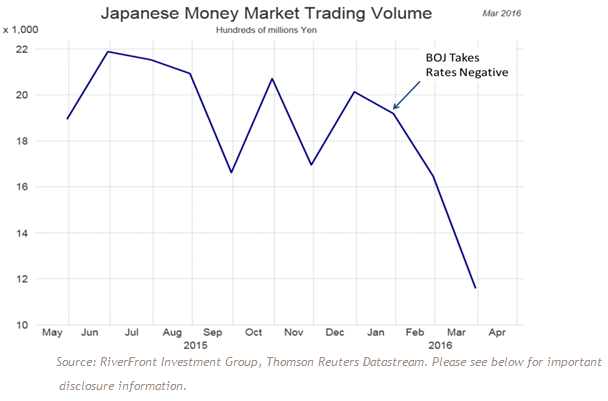
In their January meeting, the BOJ shocked investors and the Japanese banking system by adopting a negative interest rate policy (NIRP). The BOJ resorted to NIRP just days after resoundingly asserting that such a policy was not even under consideration. Unlike the ECB’s well–telegraphed and smoothly implemented move to NIRP, the BOJ’s surprise move set off a scramble in Japanese financial markets. As detailed in an April 14th Wall Street Journal article[1], the trading systems for most Japanese banks and securities firms could not accept a negative interest rate. This self-inflicted “Y2K” computer crisis meant that crucial money market instruments like commercial paper, CDs and bankers acceptances could not be traded for several weeks as computer systems were recoded. As shown on the chart below, these key money markets have still not recovered from these dislocations. The resulting collapse in money market liquidity helped set off a scramble for yen that caused the currency to appreciate more than 10%, exactly the opposite of what the BOJ was hoping to achieve.
Related: Eurozone – Ugly Headlines, Resilient Data
Investors were expecting BOJ Governor Kuroda to use its April policy announcement to compensate for the damage done by its earlier mistakes. Instead, the BOJ left policy unchanged. Kuroda’s botched implementation of NIRP and his failure to subsequently address the consequences of his mistakes has eroded confidence in his leadership. Investors are increasingly fearful that the BOJ is reverting back to the ineffective and indecisive policy responses that characterized its actions for much of the past 25 years.
Our portfolio strategy has adapted to the apparent disarray at the BOJ by decreasing our weighting in Japanese markets. We have increased our US weighting in interest rate-sensitive sectors like utilities and REITs, which we believe appear more attractive in a world with negative interest rates. We have taken advantage of stabilizing commodity markets and renewed “borrow and build” stimulus in China by increasing exposure to commodity-sensitive developed international markets such as Australia and Norway. In our longer term portfolios we have added emerging market exposure.
Our largest recent reallocation of funds was to European low volatility and small cap stocks. The ECB’s more aggressive QE policy means that about €80 billion in newly printed money will be injected into financial markets every month, and a comparable amount of safe assets like government bonds will be purchased and removed from financial markets. More money circulating in financial markets and fewer safe assets available for purchase tends to benefit low volatility equity assets, since the money has to go somewhere and low volatility stocks are often perceived to be the next safest alternative to bonds. We believe that additional financial market liquidity due to QE should also disproportionately benefit small cap European equities, as should the accelerating economic recovery suggested by Europe’s recent GDP statistics.
Related: Housing Recovery – The Next Generation Joins In
We continue to have significant Japanese exposure, but have focused on the one sector of the Japanese market that has benefited from Japan’s flawed implementation of NIRP – real estate. The Japanese government is borrowing at negative interest rates at maturities beyond 10 years. These negative rates have pulled mortgage rates in Japan down to about 1.5%. Since Japanese homeowners receive tax benefits equal to almost 1.5% of their mortgage balance, Japanese real estate can be financed at virtually no net interest cost. Real estate prices in the major Japanese cities are rising fast and finally getting back to the levels seen in 1989/1990. These price gains are fueling a construction and renovation boom that we believe will be sustained by negative rates even if the economy continues to struggle. According to a May 8th report from Evercore ISI, Japanese housing starts have risen 13.7% over the past two months.
Our other most significant Japanese position is in small cap Japanese stocks. Our due diligence trip to Japan in 2015 convinced us that smaller Japanese companies are innovating and outcompeting the established “Japan, Inc.” dinosaurs. We believe that process will continue irrespective of the monetary policy missteps of the BOJ.
We recognize that the BOJ’s inaction at its April meeting may have been motivated by the upcoming G-7 meeting and Japan’s desire to avoid being vilified at that gathering as a currency manipulator. The harsh rebuke for Japan’s currency policies in Treasury Secretary’s Lew’s recent congressional report and the tone of the current US presidential campaign would appear to validate these fears. Once this meeting concludes, Kuroda may try to get Japanese monetary policy back on track and the yen back down to a comfortable level for Japanese companies. However, after its recent mistakes we are not inclined to extend Japanese policy makers the benefit of the doubt. We will need to see both better policies and a positive market reaction to those policies before returning to a higher weighting in Japan.
Michael Jones is the Chairman and Chief Investment Officer at RiverFront Investment Group, a participant in the ETF Strategist Channel.
[1] “Japan’s Negative-Rate Experiment is Floundering.” Eleanor Warnock and Mayumi Negishi, WSJ.com (April 14, 2016). http://www.wsj.com/articles/japans-negative-rate-experiment-is-floundering-1460644639
Important Disclosure Information