When stocks exhibit volatility, there is a tendency for investors to rush into traditional safe-haven assets such as bonds. Recently, this was again evidenced following the Brexit referendum vote, when the high demand for bonds further pushed bond prices up, and bond yields significantly lower.
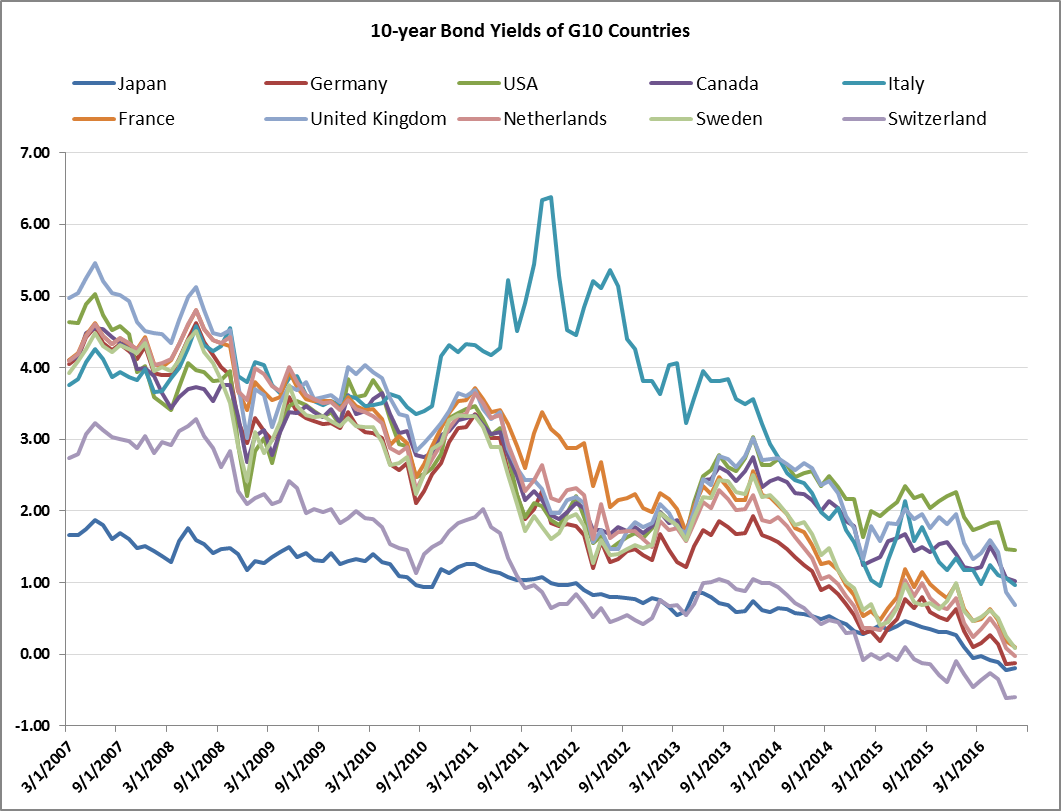
While equity volatility has since subsided, bond yields remain at multi-year lows, both domestically and abroad. In fact, many developed countries are currently issuing bonds at negative interest rates.
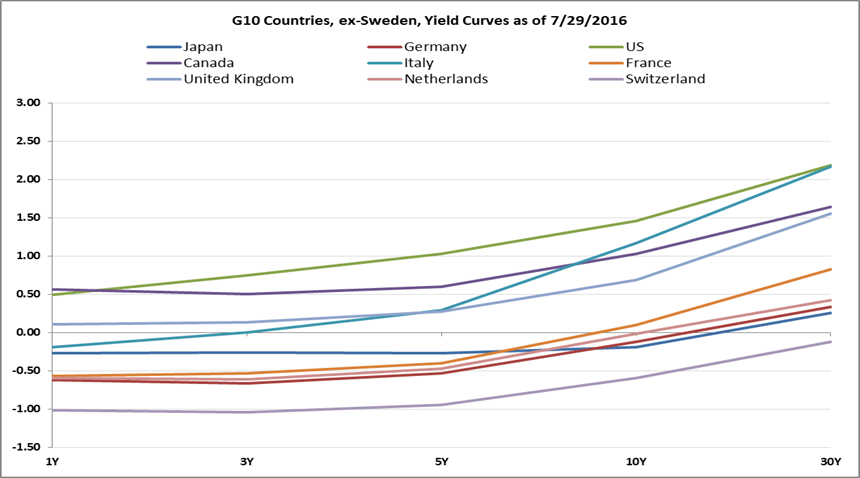
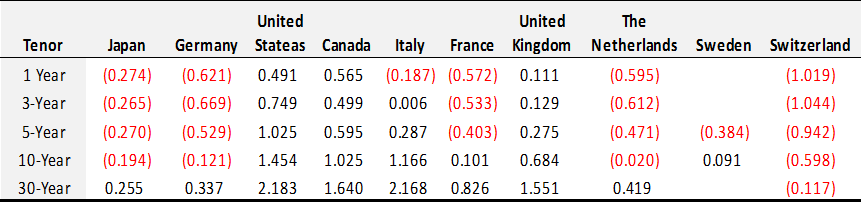
As shown below, the 10-year sovereign bond yields of Switzerland, Japan, Germany, and The Netherlands are all negative, based on market data as of July 29, 2016. Moreover, virtually the entire yield curve in each of these countries is in negative territory.
Click to enlarge:
Source: Bloomberg
Investors in these negative-yielding bonds are buying them expecting to get back less than they paid for them if they hold these bonds to maturity. It is a growing phenomenon that has many scratching their heads as Central Bankers around the world are resorting to unconventional and forceful monetary policy practices in an effort to stimulate growth within their economies. As of July 29, 2016, there were seven countries out the G-10 countries whose yield curves have dipped into negative territory, viz. Switzerland, Japan, Germany, The Netherlands, France, Sweden, and Italy.
Click to enlarge:
Click to enlarge:
As historically noteworthy as these negative sovereign yields are, there is a more pervasive problem along the same lines — ultra-low bond yields in general. If you are an investor buying bonds because you need income, you are doubtlessly tempted to boost yields by (i) going further out on yield curve to purchase bonds of longer duration than you would otherwise, and/or (ii) buying bonds lower down in the credit-quality spectrum. In both instances, you would be dialing up volatility, and risk departing from your investment mandate, in which bonds are typically held for stability and diversification purposes.
Nominal interest rates cannot stay low indefinitely, and when they begin their rise to more normal levels, the risks presented by these two tactics may become significant. Let’s examine these risks in some detail.
Longer Duration
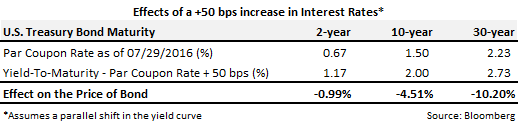
In going further out on the yield curve, investors need to be mindful of the impact on bond duration. Bond duration measures the price sensitivity of a fixed-rate bond to changes in prevailing interest rates. Longer-dated bonds have longer durations and thus more price sensitivity; that is, when interest rates increase, the price of bonds further out on the maturity time-line will decline more significantly than that of their shorter-maturity counterparts. Here’s an illustration of the effect of a 50 bps increase in interest rates to a 2-year, 10-year, and a 30-year U.S. Treasury bond.
Click to enlarge:
Additionally, the bond coupon rate also affects the duration of the bond, i.e. when comparing bonds of the same tenors, the lower the coupon rate of a bond, the longer its duration, and thus the higher its price sensitivity. The tables below show how interest rate hikes of +50 bps, +100 bps, and +200 bps will have an impact on the price of three 10-year U.S. Treasury Bonds with varying coupon rates of 1.50%, 5.00%, and 10.00%.
Click to enlarge:
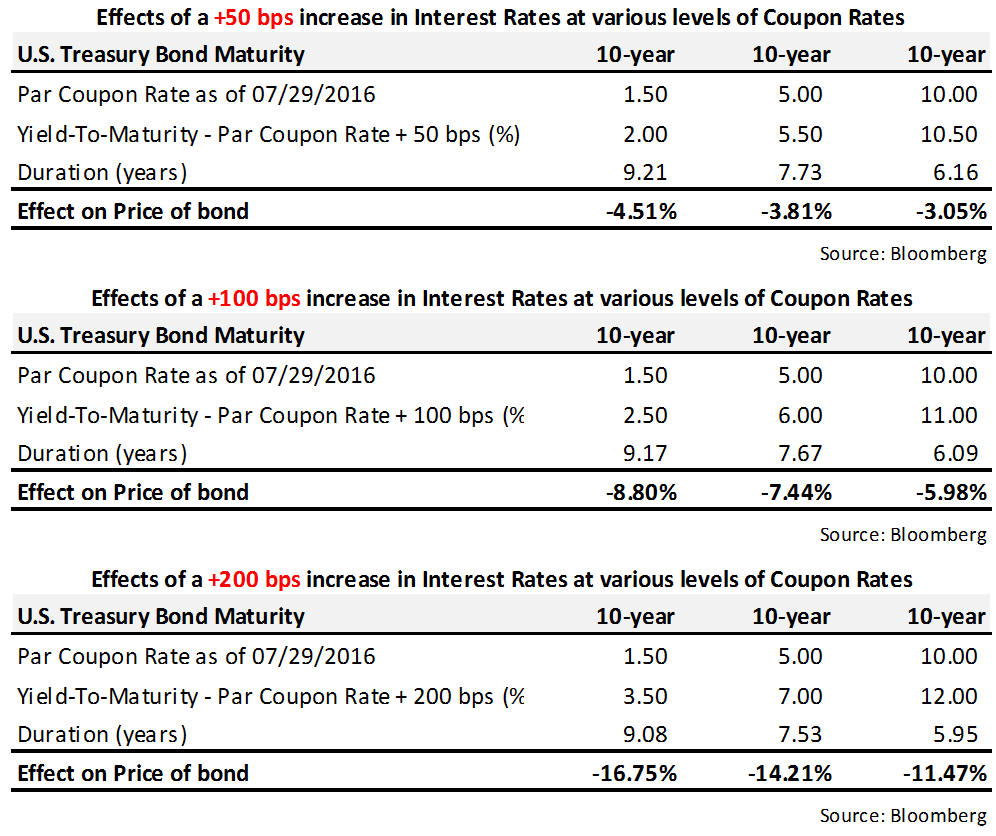
Hence, if you are considering investing in a very low coupon bond while attempting to push the maturity of that bond further out on the yield curve to obtain a higher yield, you should be mindful that it is a highly speculative trade and one that can quickly turn on you when interest rates start to rise. The combination of a low coupon rate and a long-dated maturity bond is highly price-corrosive. As a corollary, to avoid realizing a capital loss on the bond investment, the investor would have to hold the bond to maturity in exchange for an ultra-low coupon payment.
Lower Credit Quality
Bonds are rated according to their creditworthiness and their ability to pay principal and interest on time. Default risk is the chance that an issuer of the debt will be unable to pay its obligations when they fall due. Bonds that have a high risk of default are often referred to as speculative, non-investment grade, junk, or high-yield bonds.
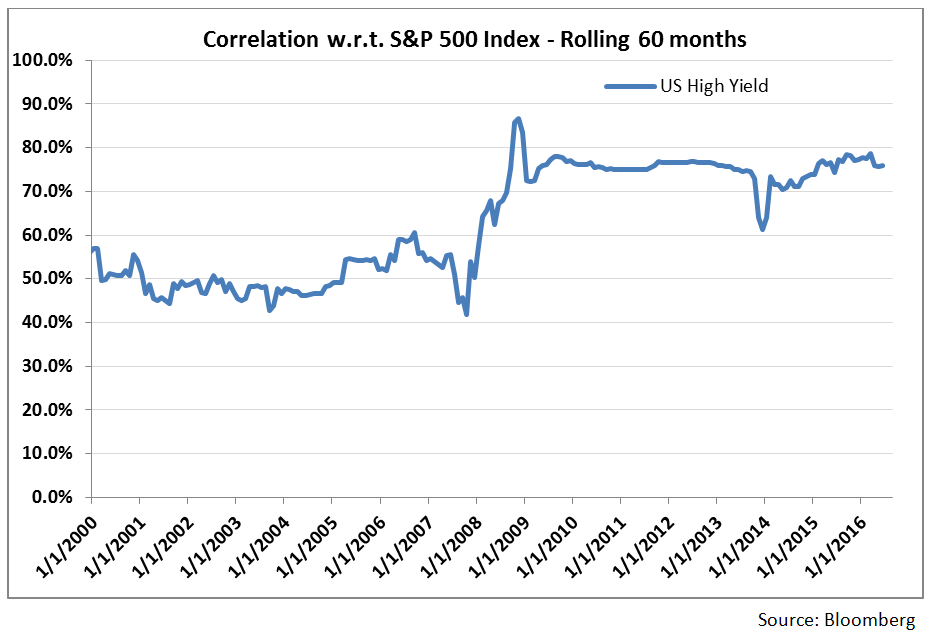
The lower the credit quality of the bond, the higher its sensitivity to default risk. Investors should expect a higher recompense (yield) from the bond issuer, the lower the credit quality. But spreads between high-yield bonds and their risk-free counterparts have narrowed substantially, distorting the risk-to-reward payoff, i.e., skewing the profile towards more risk and less reward. Hence, this is where most investors chasing yield may get themselves into trouble. In addition to increasing the risk of default, the investor would also be increasing the correlation of the bond portion of the portfolio to the stock market. As shown in the graph below, the correlation of high-yield bonds with the S&P 500 Stock Index is in the neighborhood of 80%. This high level of correlation can severely compromise one of the principal purposes for holding bonds in a portfolio — diversification.
Click to enlarge:
Diminishing Carry
With investors pushing out further on the yield curve, it has caused the bond yield curve to flatten. Spreads between different-tenored maturity bonds have narrowed dramatically in the U.S., and therefore, profiting from these bonds may be undependable as they roll down the yield curve. There is little appeal for investors in the “carry” of long-dated bonds as they roll down a flat yield curve within the context an ultra-low yield environment. It would take rates to go significantly lower to be able to come out ahead on the investment. The situation creates an unfavorable prospect for bonds and effects a vicious loop, i.e. to generate any gains from these long-dated bonds (whether it is from capital gains and/or total return), bond yields would have to fall lower and faster, and if bond yields were to fall lower, investors would have to venture further out on the yield curve to chase higher yields. Said another way, if long-term interest rates rose, the situation would swing from a positive “carry” or break-even on the bond to becoming an unprofitable investment.
Conclusion
Generally, fixed income securities such as bonds, which have traditionally had lower volatility than stocks and have provided a high diversification benefit to a portfolio, have become more speculative as investors reach for incremental yields in an ultra-low interest rate environment. In one of our earlier publications, RMI and Investing in a Rising Rate Environment, we highlighted the problem investors will encounter with fixed income investments in a conventional 60/40 mix portfolio, and how Risk-Managed Investing (RMI) can be an elegant solution to successfully manage equity risk explicitly and rely less on bonds to dampen portfolio volatility.
This article was written by Gladys Chow, Managing Director and Portfolio Manager, and Jerry Miccolis, Founding Principal and Chief Investment Officer, of Giralda Advisors, a participant in the ETF Strategist Channel.
This material is for informational purposes only. Nothing in this material is intended to constitute legal, tax, or investment advice. Investing involves risk including potential loss of principal.
Giralda Advisors, located in New York City, is an asset management firm that focuses on providing risk-managed exposure to the equity markets with a goal of limiting asset depreciation during both protracted and catastrophic market downturns while allowing substantial asset appreciation in up-trending markets. The Giralda Advisors team welcomes your inquiries. Call (212) 235-6801 or visit http://www.giraldaadvisors.com/.