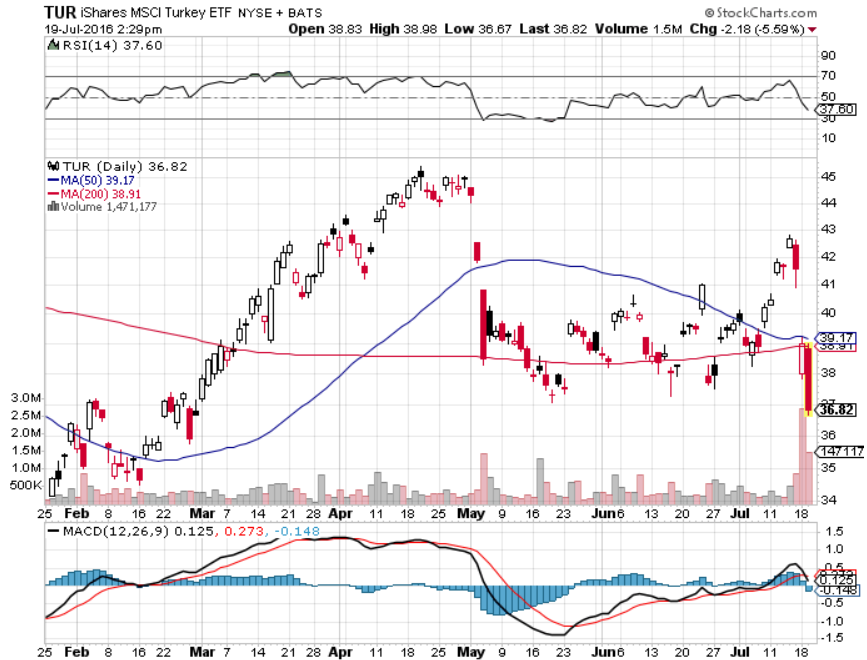
The iShares MSCI Turkey ETF (NYSEArca: TUR), the lone exchange traded fund dedicated to Turkish stocks, is once again a controversial ETF. As many investors by now know, TUR tumbled during last Friday’s after-hours session, a slide that led to declines of more than 6% Monday, following a failed coup against President Recept Tayyip Erodgan.
Looking to allay foreign investors’ concerns, Turkey’s central bank lowered interest rates by 25 basis points to 8.75% and said it stands ready to provide liquidity to the country’s banks, if needed, an important factor considering TUR’s weight to financial services stocks is almost 44%, or more than triple the ETF’s second-largest sector allocation.
Related: Turkey ETF Tumbles Following Failed Coup
However, TUR plunged again Tuesday amid fears the recent coup could stoke further political volatility and strain the country’s already tenuous grasp on its investment-grade credit rating.
“Late Monday, Moody’s put Turkey’s credit rating of Baa3 — one notch above non-investment grade — on review for a possible downgrade,” reports Dimitra DeFotis for Barron’s.
When Brazil lost its investment-grade rating almost a year ago, Turkey, along with South Africa, was widely viewed as one of the emerging markets that could be next to be downgraded to junk status. However, as emerging stocks rallied and the Federal Reserve has consistently passed on raising interest rates, talk of a junk rating for Turkey diminished.
[related_stories]Looking ahead, Turkey still faces growing risk from investment outflows as the U.S. Federal Reserve normalizes interest rates.
Turkey has been tackling a number of economic issues. The country has been suffering an economic downturn due to greater political instability, a struggle against threats from the Islamic State and a renewed war with Kurdish militants in its southeast, reports Michelle Mark for the International Business Times.
Related: More Tumult for Lone Turkey ETF
“SocGen doesn’t think Moody’s will lower Turkey’s debt to junk Aug. 5, the next review date, because it won’t have enough data. Analysts Phoenix Kalen and Roxana Hulea note that President Recep Tayyip Erdogan plans an announcement Wednesday, which could either be a referendum on expanding the constitutional power of the president, a snap election, or the reintroduction of the death penalty, which would jeopardize Turkey’s European Union aspirations,” according to Barron’s.
Currently, Turkey is experiencing rising inflation, slowing growth, increased fiscal expenditures, high unemployment and a dip in export competitiveness. The economy is expected to only expand 3% this year.
iShares MSCI Turkey ETF