
In Part 1, we began to take a look at various types of alternative weighting methods to a cap-weighted index, such as fundamental weighting, equal stock weighting, and equal sector weighting. Part 2 is a continuation in looking at the benefits of an equal sector approach.
We have focused on equal sector weighting as Swan believes there are numerous benefits to an equal-weighted sector approach to the S&P 500 (we’ll refer to it as EQW for short from here on out), when compared to other weighting methods.
We believe the argument for an equal-weighted sector approach to the S&P 500 is:
- Seeks to avoid the flaws of cap weighting (cap weighting only focuses on price and bubbles/overvaluation can form more easily)
- Applies a built-in “buy low/sell high” discipline that is based on the principle of mean reversion
- An equal weight approach is more value conscious and tilts to mid/smaller stocks
- Numerous studies across various assets indicate an equal-weight approach outperforms cap-weighted
Previously, we looked at the first two points. In this post we will take a look at the last two and how equal sector weighting can benefit from its tilt to value and mid-cap/smaller stocks as compared to the tilt to mega cap and growth stocks in a cap-weighted index.
As a reminder, an equal-weight approach is essentially factor neutral, despite its minor tilt to smaller size and value, and gives no credence to technical, fundamental, or price-driven factors. It is therefore less predictive in nature. At Swan, we believe predicting the market is difficult if not outright impossible. While some evidence can be generated to support any prediction, there is truly no way to know how technology, utilities, and materials will perform going forward.
But what about this slight tilt to value and smaller size with an equal sector weighting?
The biggest and most popular stocks and the hottest sectors drive cap-weighted indexes. A cap-weighted approach tilts to growth stocks, while EQW tilts toward value stocks. When a bear market begins, usually those sectors that led the rise in the market also lead in the decline (i.e., Tech stocks in 2000 and Financial stocks in 2008). Since an equal-weight approach will always be underweight the largest sectors, the gap of underperformance between equal-weight and cap-weighted will likely rapidly close during a bear market. In prior bear markets, this can be seen by spikes in outperformance in 2000 and 2007 for EQW as the bear markets began.
In the long-term, research has shown that biases toward value and small cap can be rewarding.
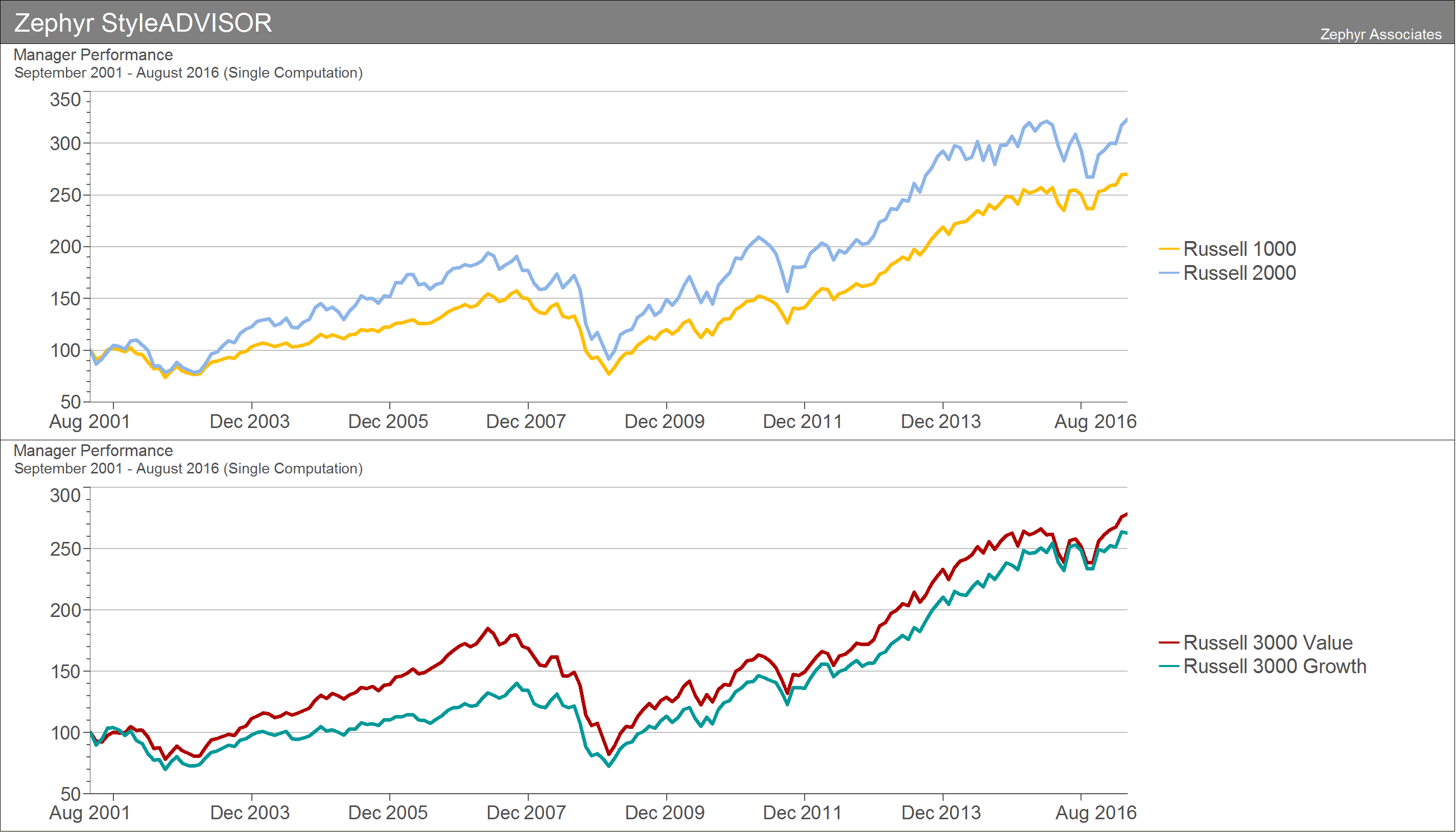
Source: Zephyr StyleADVISOR
Also, what about an equal-weight approach in other settings other than the S&P 500? Although these indexes take an equal-weight approach with individual stocks and not sectors, the concept of avoiding the flaws of a cap-weighted approach still apply and the benefits are consistently and readily seen across many assets:
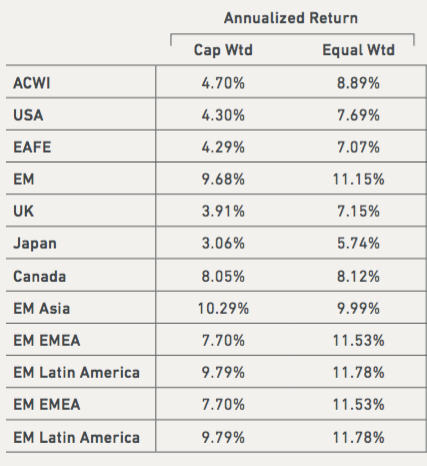
Source: MSCI; performance summary for selected MSCI indexes. Net Index Monthly Returns, January 29, 1999 to July 31, 2015. Past performance is not indicative of future results.
From December 2000 to July 2015, equal-weighted versions of MSCI flagship indexes delivered significantly higher returns than their cap-weighted counterparts, outperforming 11 out of 12 indexes. Equal weighting benefits investors who wish to reduce concentration of mega or large-cap stocks in their portfolio, obtain more exposure to smaller-cap and value stocks, take advantage of potential market price inefficiencies, and adopt a disciplined rebalancing process. In contrast, a market-capitalization approach is 100% dependent upon the whims of the market and no built in “sell high/buy low” discipline is in place. These advantages occur whether equal weighting sectors or stocks.
Another study using the long-term global equity market data built by Dimson, Marsh, and Staunton (this data set is available through Morningstar), makes a strong case for an equal-weight approach. Even though the study is referring to global portfolios, as seen above the concept of equal weighting applies just as well across multiple countries. In this global equity study, an equal-weighted portfolio of 20 major countries from 1900-2012 was compared to its cap-weighted counterpart. The difference is graphed out in the mountain chart below, as it tracks the long-term growth of $1 in the world equity portfolio (weighted by market cap) and an equal-weighted version of the world portfolio.
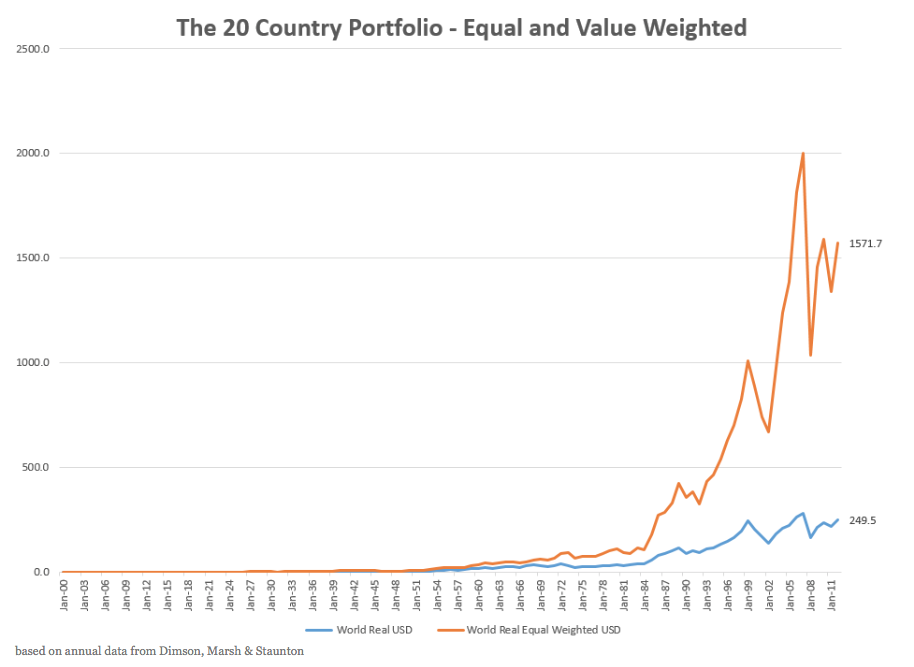
An astonishing difference to say the least, with the equal-weighted approach outperforming its market-cap counterpart by over 6 times!
One study on the returns of the equal-weight and cap-weight versions of the S&P 500 back to 1926 estimates that the equal-weight version returns outperforms the cap weighted version by 2.8% per year (Source: Mutual Fund Observer, September 2016 issue). S&P’s researchers have the advantage at around 180 basis points per year from one of their studies. These numbers are fairly close to the per year outperformance that has been seen since late 1998 when the SPDR Select Sector ETFs launched. (Source: Zephyr StyleADVISOR)
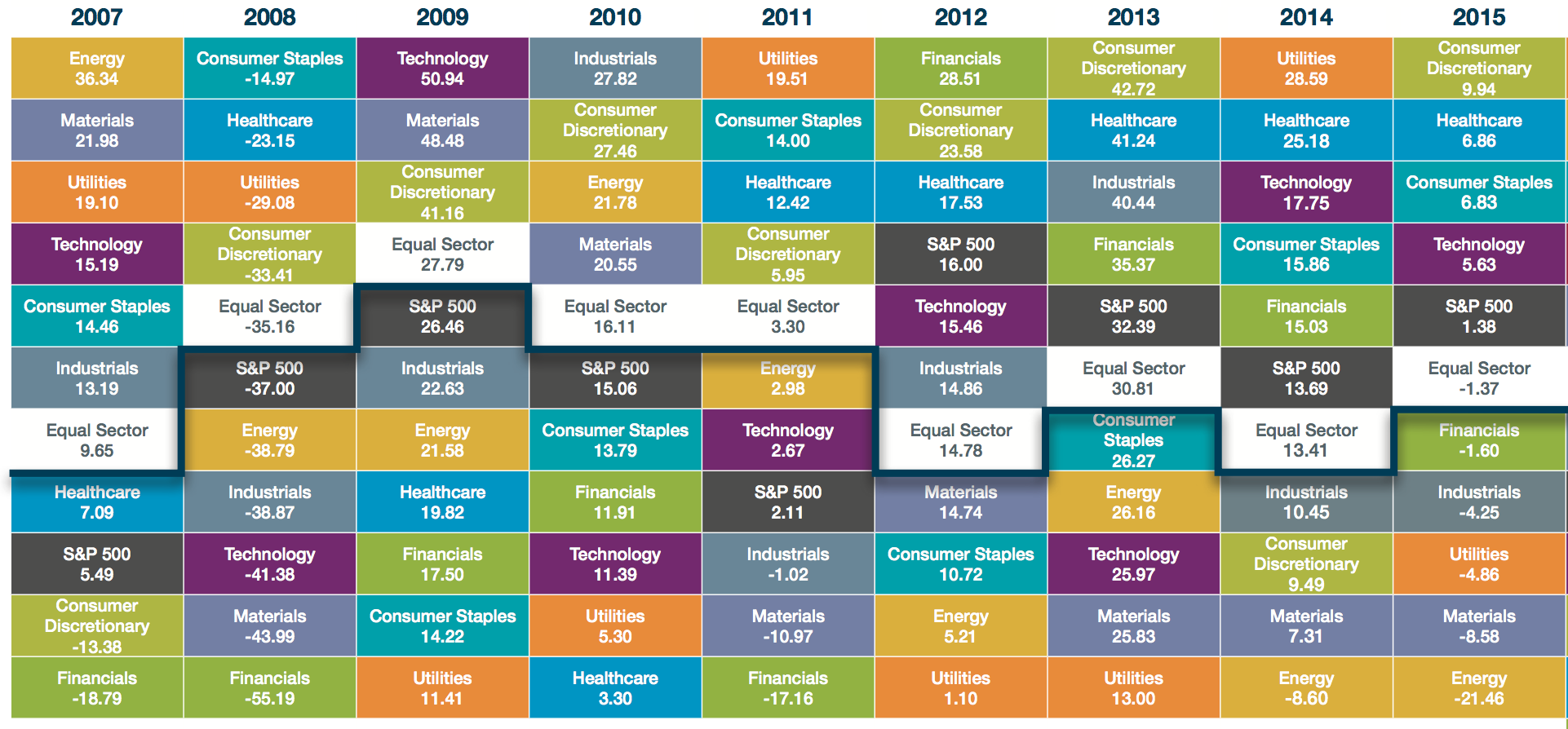
Source: Alps and Bloomberg
In summary, equal-weighting of the sectors provides for better diversification, lower volatility, and the potential for better long-term performance as compared to cap-weighted. These benefits are mostly driven by the periods of outperformance generated through and after bear markets as overvalued and overweighted sectors correct. Although no one can predict the market, long-term and short-term evidence points to an equal-weighted approach being a more prudent and potentially beneficial choice over cap-weighted. This is why at Swan we allocate our core equity component in our S&P 500 Defined Risk Strategy using the SPDR Select Sector ETFs in an equal sector weighting. We believe this core equity position coupled with a long-term hedge and our option income component, are the best way to achieve consistent long-term risk-adjusted returns in today’s risky market environment.
Micah Wakefield is Director of Research and Product Development at Swan Global Investments, a participant in the ETF Strategist Channel.