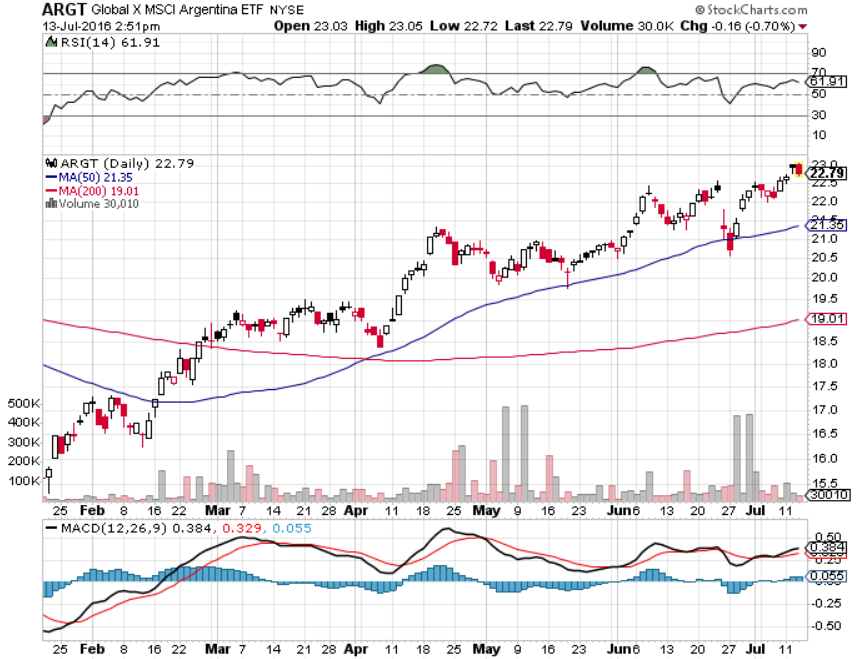
Argentina’s benchmark Merval Index is the best-performing equity bourse in the world this year, which has been a boon for the Global X MSCI Argentina ETF (NYSEArca: ARGT). The lone exchange traded fund tracking stocks in South America’s third-largest economy is up more than 26% this year, making it one of 2016’s best-performing single-country ETFs.
That is a positive and significant from the past couple of years of Argentine equity performance. In the 14 years after Argentina carried out the world’s largest default, the Nestor Kirchner and Cristina Kirchner implemented a number of outdated policies, including a heavily regulated foreign-exchange system, seizure of privately-owned assets and under-reported inflation.
Related: How Central Banks Affect LatAm ETFs
Market observers seem inclined to wager that Argentina’s newly elected Mauricio Macri could mean big changes in the economy after years of tepid growth. The pro-market Macri has pledged to quickly reverse much of the previous heavy-handed economic policies and open up the economy that has been posting back-to-back years of near stagnate growth, Bloomberg reports.
In the 14 years after Argentina carried out the world’s largest default, the Nestor Kirchner and Cristina Kirchner implemented a number of outdated policies, including a heavily regulated foreign-exchange system, seizure of privately-owned assets and under-reported inflation.
[related_stories]“Macri’s government delivered impressive results since taking office on Dec. 10 … [including]exchange rate unification, the elimination of most export taxes, an agreement with holdout creditors, and a mega-placement of government debt following the agreement,” according to a note by S&P Global Ratings posted by Dimitra DeFotis of Barron’s.
While global investors have displayed some enthusiasm for Argentine assets following Macri’s election, there are economic issues to consider. For example, per capita GDP growth in recent years has been scant. Additionally, Argentina’s domestic credit-to-GDP is well below the regional average while its consumer debt ratio is high.
Some market observers are concerned that Argentina’s economy could be pinched as the new president implements tough measures, such as cuts to the budget and devaluation of the peso, that could further weigh on consumers. Oxford Economics projects gross domestic product could contract over the next two years before returning to growth of more than 5% by 2019.
Related: Brazil ETFs Roar Back as Government Incompetence Ends
“The next important challenge for the administration, in our view, is the reduction of a colossal primary deficit in the fiscal accounts left by the previous government. However, the stance adopted on fiscal issues is lax, which creates doubts about the future of the economy, particularly in relation to disinflation and growth sustainability,” according to the S&P note posted by Barron’s.
Global X MSCI Argentina ETF