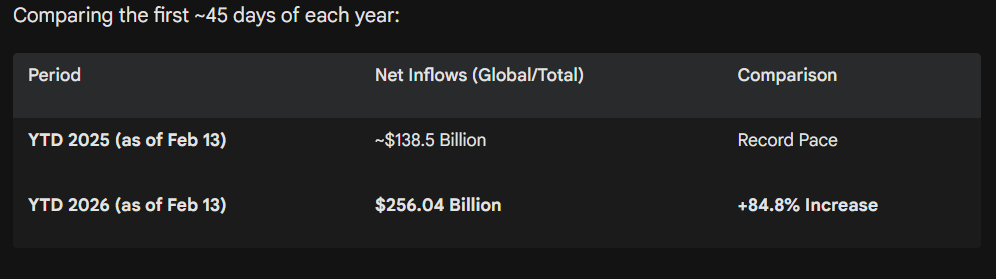
The exit velocity from 2025 is continuing into 2026. Exchange-traded funds (ETFs) have already gathered over $250 billion in inflows in the first six weeks of the new year, proving that demand for the investment vehicle remains robust despite a volatile start.
Based on the latest data from VettaFi research as of February 13, the ETF industry reached $256.04 billion in net year-to-date (YTD) inflows. ETFs attracted around $1.5 trillion inflows in all of 2025 and given the strong momentum to start 2026, it could be another record-breaking year.
Asset Class Breakdown
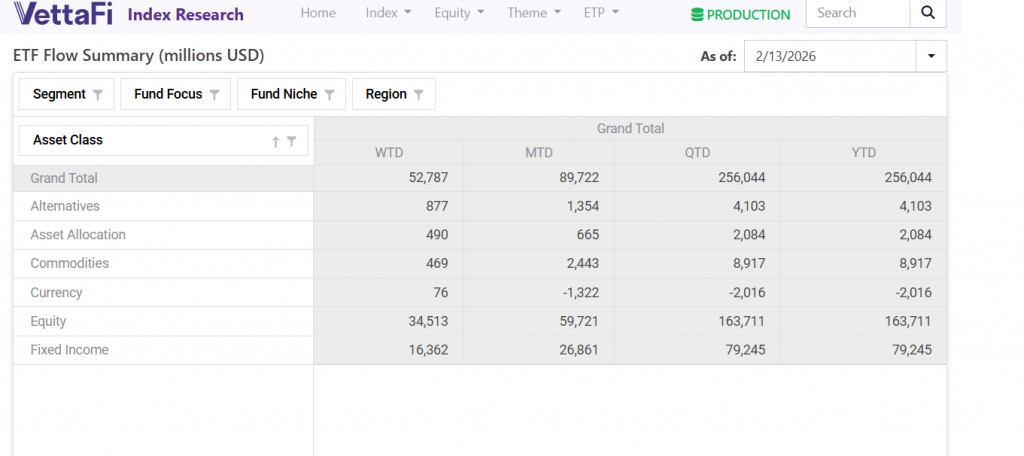
The rapid accumulation was seen across various asset classes as both retail and institutional investors continue to prefer the ETF wrapper for its cost-efficiency, transparency, and flexibility. Again, this occurred despite the CBOE S&P 500 Volatility Index rising over 40% for the year.
Given the heavier market fluctuations, asset allocations could reflect strategic defensive moves. Equities still maintained their dominance, capturing $163.7 billion or 64% of new money.
Though the artificial intelligence (AI) hype continues to captivate investors, there are questions on whether certain stock prices reflect underlying fundamentals. As such, investors have been piling into bonds as a defensive maneuver amid the increased volatility with the fixed income asset class garnering $79.2 billion inflows. The expectation of more rate cuts may also be fueling momentum into ETFs that target other income sources outside of bonds.
Commodities strength couldn’t come at a better time as investors sought uncorrelated assets relative to the broader market amid the volatility. As a result, commodities ETFs saw $8.9 billion inflows.
International Markets, Bonds, and Energy
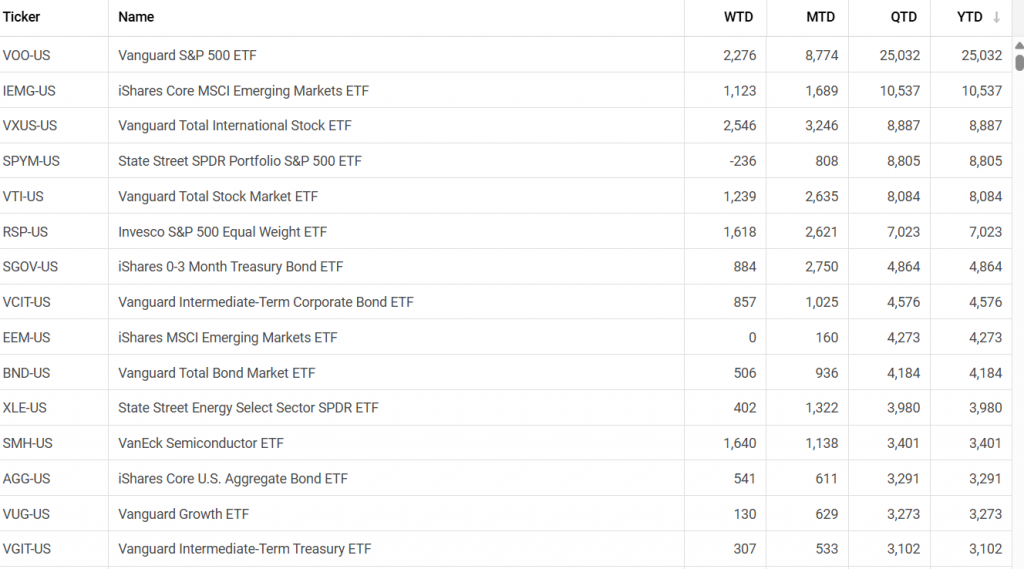
In terms of individual ETFs, it was no surprise to see the Vanguard S&P 500 ETF (VOO) at the top of the leaderboard with $25.03 billion inflows. Rounding out the U.S. core equites category was the State Street SPDR S&P 500 ETF (SPY) with about $8.8 billion inflows. Interestingly, the Invesco S&P 500 Equal Weight ETF (RSP) saw just over $7 billion inflows, which could be an escape from volatility by mitigating concentration risk.
International diversification remains a key theme that is carrying over from last year amid weakness in the U.S. dollar. The iShares Core MSCI Emerging Markets (IEMG) secured $10.5 billion, coming in second place while the Vanguard Total International Stock ETF (VXUS) gathered almost $9 billion—both outpacing SPY.
As mentioned, a theme to start the year has been bonds serving as a ballast due to the increased volatility. This was apparent via inflows into funds like the iShares 0-3 Month Treasury Bond ETF (SGOV) with $4.9 billion and Vanguard Total Bond Market ETF (BND) with $4.2 billion.
In terms of sector-specific equities, energy was the best performer in January. As such, the Energy Select Sector SPDR (XLE) took in nearly $4 billion, proving that traditional energy sources like oil and gas remain essential despite a shift to alternative sources.
For more news, information, and strategy, visit ETF Trends.
