Editor’s note: Any and all references to time frames longer than one trading day are for purposes of market context only, and not recommendations of any holding time frame. Daily rebalancing ETFs are not meant to be held unmonitored for long periods. If you don’t have the resources, time or inclination to constantly monitor and manage your positions, leveraged and inverse ETFs are not for you.
Investing in the funds involves a high degree of risk. Unlike traditional ETFs, or even other leveraged and/or inverse ETFs, these leveraged and/or inverse single-stock ETFs track the price of a single stock rather than an index, eliminating the benefits of diversification. Leveraged and inverse ETFs pursue daily leveraged investment objectives, which means they are riskier than alternatives which do not use leverage. They seek daily goals and should not be expected to track the underlying stock’s performance over periods longer than one day. They are not suitable for all investors and should be utilized only by investors who understand leverage risk and who actively manage their investments. The Funds will lose money if the underlying stock’s performance is flat, and it is possible that the Bull Fund will lose money even if the underlying stock’s performance increases, and the Bear Fund will lose money even if the underlying stock’s performance decreases, over a period longer than a single day. Investing in the Funds is not equivalent to investing directly in TSLA.
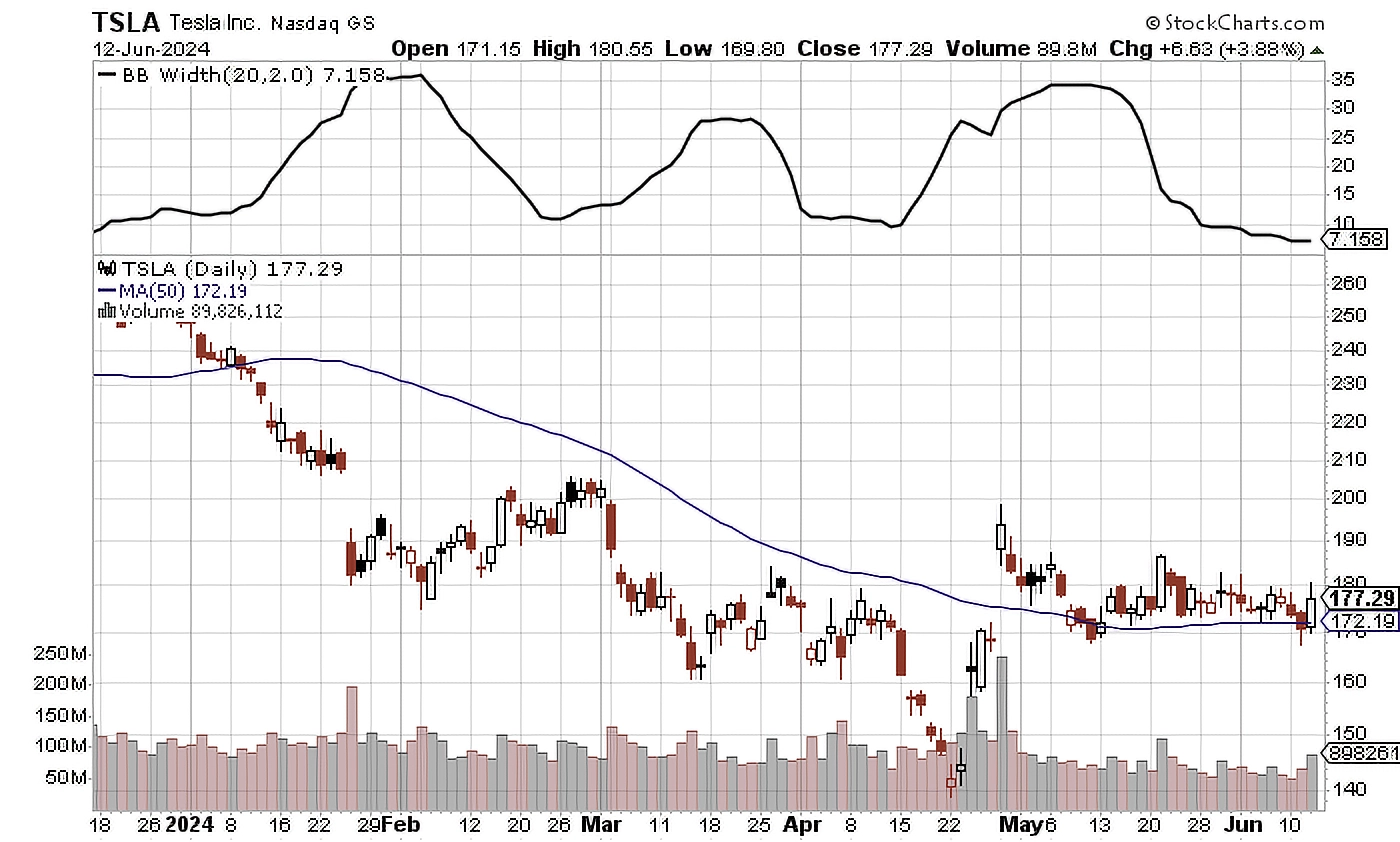
Shares of Tesla, Inc. (Ticker: TSLA) have been stuck in a very tight range lately. Since early May, the stock has mostly traded between $170 and $180. It’s also hovered just above the closely watched 50-day moving average, which itself has flattened out.
When a stock experiences this kind of range compression, range expansion is often around the corner. In other words, low volatility can set up a big move one way or the other. Tesla’s upcoming second-quarter earnings report could be one of the sparks.
Of course, Tesla’s CEO Elon Musk is always in the headlines. Musk said that Tesla shareholders approved his $50 billion pay package, CNN reported. That overhang may be mostly played out for now.
Tesla is tightening up after a rough start to 2024 that has seen it lagging tech and AI plays. If the embattled stock is able to rebound, it would have a long way to catch up to the other members of the so-called Magnificent 7. TSLA has been left in the dust lately and arguably shouldn’t even be on the list anymore.
Now let’s take a closer look at some of the bullish and bearish arguments for TSLA.
Below is a daily chart of TSLA as of June 12, 2024.
Source: StockCharts.com, June 12, 2024.
Candlestick charts display the high and low (the stick) and the open and close price (the body) of a security for a specific period. If the body is filled, it means the close was lower than the open. If the body is empty, it means the close was higher than the open.
The performance data quoted represents past performance. Past performance does not guarantee future results.
EV Competition is Fierce—Especially in China
When people think of electric vehicles (EVs) they often think of Tesla. But the field is getting increasingly crowded. And nowhere is that more apparent than in China, which just so happens to account for around 22% of Tesla’s global revenue. There are now over 120 EV makers in China (no, that’s not a typo). This saturated market seems to have been behind Tesla’s April decision to slash prices for its models in a bid to maintain market share. Even with the price cut, the company’s China sales in May fell over 6% year-on-year.
For TSLA bulls, this trend is potentially a big problem. Either the company loses a large slice of the market, or it sacrifices gross margin to fend off the competition. Neither option looks great.
Another oft-repeated knock on Tesla, and perhaps another reason investors haven’t been kind to Tesla’s stock lately, is that Musk is distracted by his other companies, including X (Twitter), SpaceX, and The Boring Company.
Now for Some Good News
From a visual perspective, Tesla’s Cybertruck is just plain weird. But who cares about looks if it sells, right? And in some good news for TSLA, there does seem to be considerable demand for this new model. For thing one, even though commercial production of the Cybertruck only started last November, sales have eclipsed that of the GMC Hummer and Rivian R1T.
TSLA bulls will be hoping for even greater adoption of this unique vehicle. From a sentiment perspective, the stock could really use a catalyst that makes people forget about Tesla’s China woes.
Earnings on Deck
Even after the weakness in Tesla shares, the elevation is still fairly elevated with a Price/Earnings (P/E) ratio* of about 68, according to Morningstar.
Traders should therefore keep an eye on TSLA’s second-quarter earnings, which are expected to be released on July 17. The consensus forecast is for profit of $0.47 a share (vs. $0.78 reported in the same quarter last year). Tesla’s revenues have been declining on lower average selling prices, softer demand, and other challenges.
Still, the stock rallied after first-quarter numbers were released. Even though both profits and sales fell short of expectations, news that the Model 2 was coming sooner than expected gave a lift to the stock.
Bulls obviously want a beat on July 17, but failing that, they’ll hope for some encouragement from management that the outlook for the coming quarters is rosier than it may appear.
TSLA Bull or Bear, Here’s How to Play It
Aggressive bulls on TSLA can turbocharge potential gains with the Direxion Daily TSLA Bull 2X Shares (Ticker: TSLL). This leveraged ETF seeks daily investment results, before fees and expenses, of 200% of the performance of Tesla, Inc. common shares. Bears on TSLA, meanwhile, can express their pessimism with the Direxion Daily TSLA Bear 1X Shares (Ticker: TSLS). This leveraged ETF seeks daily investment results, before fees and expenses, of 100% of the inverse (or opposite) of the performance of Tesla, Inc. common shares.
*Definitions and Index Descriptions
Originally published 28 June, 2024
For more news, information, and analysis, visit VettaFi | ETF Trends.
