2025 was a significant year for international investing. Many portfolios keep international exposure in a core sleeve. However, single-country ETFs can work as targeted satellite allocations and can lead to exciting, niche opportunities. South Korea has been one of the countries drawing outsized attention, and the performance numbers explain why. The iShares MSCI South Korea ETF (EWY) returned over 100% in 2025. And many of the tailwinds from 2025 are expected to carry over into 2026. Below is what advisors and investors should know before investing in South Korea, including the main ETF tools to get exposure.
What’s Happening in Korea?
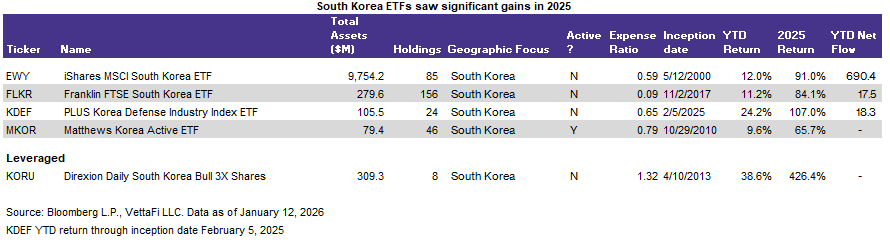
Performance is a big reason Korea has been on investors’ radar. In 2025, many Korea-focused ETFs were up 90%–100% (in other words, they approximately doubled). But much of the surge was tied to two tech-heavy giants: Samsung Electronics and SK hynix, both of which are major players in the global chip supply chain. Samsung is best known as a consumer brand (e.g., smartphones and televisions). However, it also excels in memory chips (the storage/working memory that sits inside most electronics) and in foundry services (manufacturing chips for other companies). SK hynix is even more directly a memory specialist. It makes memory chips, including high-bandwidth memory (HBM: a type of ultra-fast memory increasingly paired with AI chips in data centers). They performed well because the AI boom boosted demand for advanced memory. When demand rises for a high-value component, pricing and profits can improve fast — especially for companies that sit at the center of that supply chain.
Korea’s global manufacturing footprint extends beyond chips into autos and industrials. For example, Korean ETFs also hold automakers like Hyundai Motor and Kia Corp. And more recently, Korea’s defense manufacturers like Hanwha Aerospace have also been a visible growth pocket inside Korea equity exposure. Hanwha positions itself across land/sea/air defense and aerospace.
Korea remains a cultural hub, but the ETF wrapper didn’t always translate into durable assets. The JAKOTA K-Pop and Korean Entertainment ETF (KPOP) liquidated around April 2025. That’s a useful reminder that thematic narratives can be compelling, but ETF outcomes still depend on liquidity, investor adoption, and other underlying fundamentals.
The Push for Developed Market Status
I expect the growth trajectory at both the company and sector level to continue, but an even bigger catalyst could come from index classification. South Korea is still classified as an emerging market by MSCI, which can feel counterintuitive given Korea’s economic status. The key issue, however, is market accessibility, and MSCI has pointed to Korea’s currency-market frictions as a sticking point (in MSCI’s framework, developed-market currencies trade globally 24 hours).
That’s why Korea’s latest push matters. The government has launched an initiative aimed at inclusion in the MSCI Developed Markets Index, including moving the FX market from extended hours to a 24-hour trading system.
South Korea: ETF Opportunities
Most broad Korea equity exposure is top-heavy. Performance is often driven by a handful of megacaps — especially semiconductors.
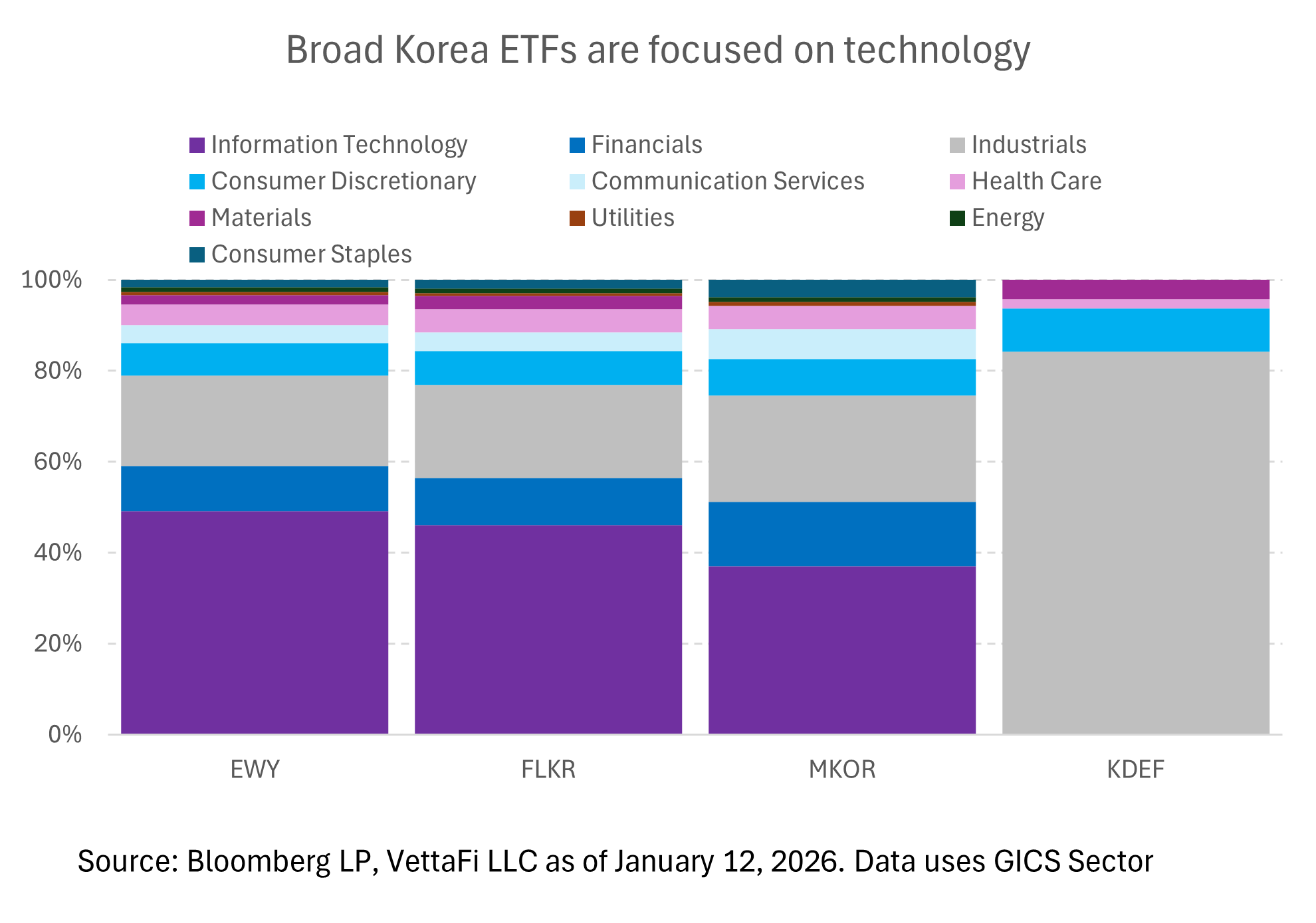
Investors have several ETF options:
- The iShares MSCI South Korea ETF (EWY) offers broad, core exposure to South Korean equities. It tracks the MSCI Korea 25/50 Index, a top-heavy market-cap weighted index. Samsung and SK hynix together make up around 45% of the ETF’s weight. This ETF is the largest of its peers with almost $9.5 billion in assets. Its expense ratio is 0.59%.
- The Franklin FTSE South Korea ETF (FLKR) offers a similar solution as EWY (large- and midcap Korea exposure) with a different underlying index. FLKR follows the FTSE South Korea RIC Capped Index. It has a significantly lower expense ratio than EWY (9 bps vs 59 bps).
- The Matthews Korea Active ETF (MKOR) provides active Korea exposure. While Samsung and SK hynix are still weighted at the top of the holdings list, the ETF has more flexibility to deviate from market cap relative to an indexed ETF like EWY and FLKR.
- The PLUS Korea Defense Industry Index ETF (KDEF) stands out from the group as a more focused thematic/industry play on the Korean defense sector. Exposure to Asian defense can complement U.S. and European exposure, especially given Asia’s tech innovation in cybersecurity and other defense technology. Recently, I wrote about the surging interest in international defense ETFs which included the launch of KDEF and the WisdomTree Asia Defense Fund (WDAF). WDAF is broader than KDEF, but still has South Korea as around 35% of its weight.
- Direxion Daily South Korea Bull 3X Shares (KORU) seeks 300% daily return of the MSCI Korea 25/50 Index (which is the same index followed by EWY). Leveraged ETFs are typically used for short-term positioning and not a buy-and-hold allocation.
Bottom Line
South Korea could continue to provide an exciting international satellite opportunity in 2026. Korea’s rally has been tightly linked to a small set of megacap exporters — especially semiconductors. Samsung’s positioning in memory/foundry and SK hynix’s push into next-gen memory help explain why Korea exposure can move fast when the AI cycle accelerates.
For more news, information, and strategy, visit ETF Trends.
