The Q2 earnings season is still in its early days, but it’s already handing us a reality check: growth is broadening out. These conditions are putting one tried-and-tested segment of smart beta ETFs, the equal-weighted strategies, into sharp focus. And investors are taking notice.
Key Takeaways:
- Earnings growth is broadening, with S&P 500 on track for a strong 24% YoY earning expansion in Q2.
- The “S&P 493” catch-up is gaining momentum with analysts expecting these stocks to outpace the Mag 7 in Q2.
- Equal-weighted ETFs are standing out as a way to mitigate tech/AI concentration risk and capture gains across broader market leaders.
Broadening Market Leadership
According to FactSet data, not only is earnings growth on track for 24% year over year in Q2, but the underlying fundamental strength is broadening out across most corners of the market. Ten sectors are on track for positive earnings growth (healthcare being the exception), and all 11 sectors are expected to show revenue growth.
Consider, too, that midway through July, about two-thirds of the S&P 500 are showing serious momentum, with stocks trading above their respective 50-day moving averages. (Data point courtesy of Cameron Dawson, CIO at NewEdge Wealth).
Equal Weight vs Market-Cap Weight
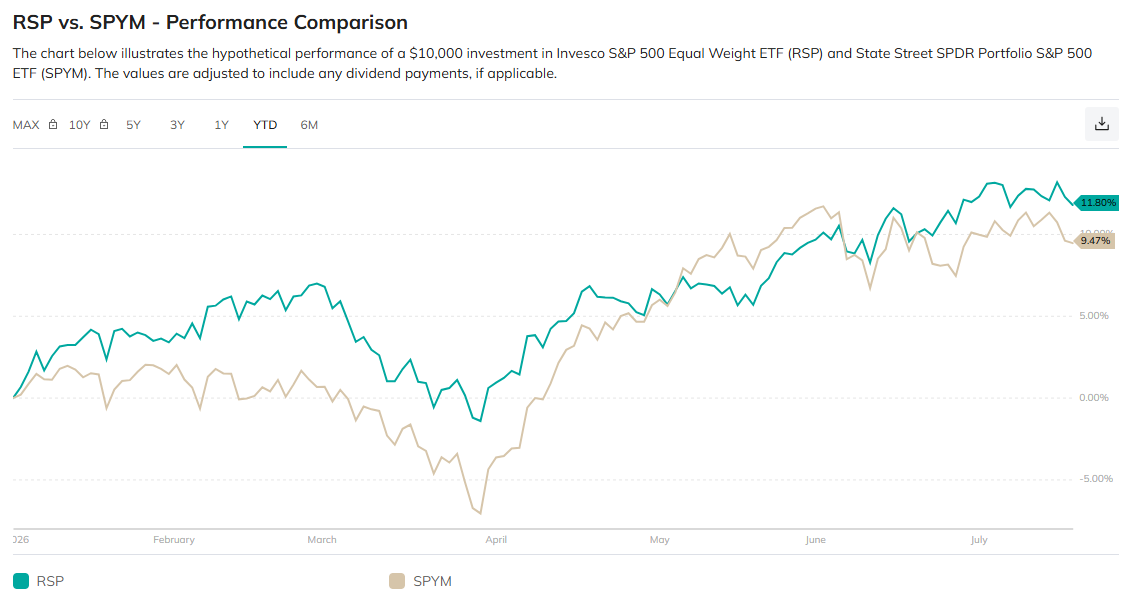
A look at the Invesco S&P 500 Equal Weight ETF (RSP) vs the SPDR Portfolio S&P 500 ETF (SPYM) shows outperformance in the equal-weighted S&P 500 basket, confirming that broadening story as well.
 Source: PortfoliosLab
“In aggregate, the Magnificent 7 companies have reported higher (year-over-year) earnings growth than the other 493 companies in the S&P 500 over the past several quarters,” John Butters at FactSet said in his latest note. “Is this trend expected to continue in Q2 2026? The answer is yes.”
That said, the blended earnings Q2 growth rate (expected) for the other 493 companies in the S&P 500 is 22.8%, which if it materializes, would be the highest year-over-year growth rate these companies have seen since late 2021, he noted.
“In fact, four of the five top contributors to earnings growth for the S&P 500 for Q2 2026 are not Magnificent 7 companies,” he said. “It is interesting to note that analysts expect higher earnings growth for the other 493 companies in the 2nd half of 2026.”
150+ Equal Weighted ETFs To Explore
RSP has picked up $1.5 billion in net new money in July alone, bringing its year-to-date asset haul to more than $11 billion. The fund is currently among the 15 most popular ETFs of the year.
RSP is a sort of poster child for the equal-weighted ETF category, but there are more than 150 equal weighted ETFs with about $100 billion in assets spread across them.
For example, the Goldman Sachs Equal Weight U.S. Large Cap Equity ETF (GSEW) has delivered double digit gains this year, and is finding traction with investors worried about tech and AI-related concentration risk.
At a sector level, the ALPS Equal Sector Weight ETF (EQL) equal-weights each sector in the portfolio at just under 10% allocation each. That’s a lot less tech exposure vs. the 37% seen in the S&P 500, and a lot more materials, utilities, energy and real estate exposure. Or the Invesco S&P 500 Equal Weight Technology ETF (RSPT) equal-weights the tech sector alone in a strategy that has more than $5 billion in total assets.
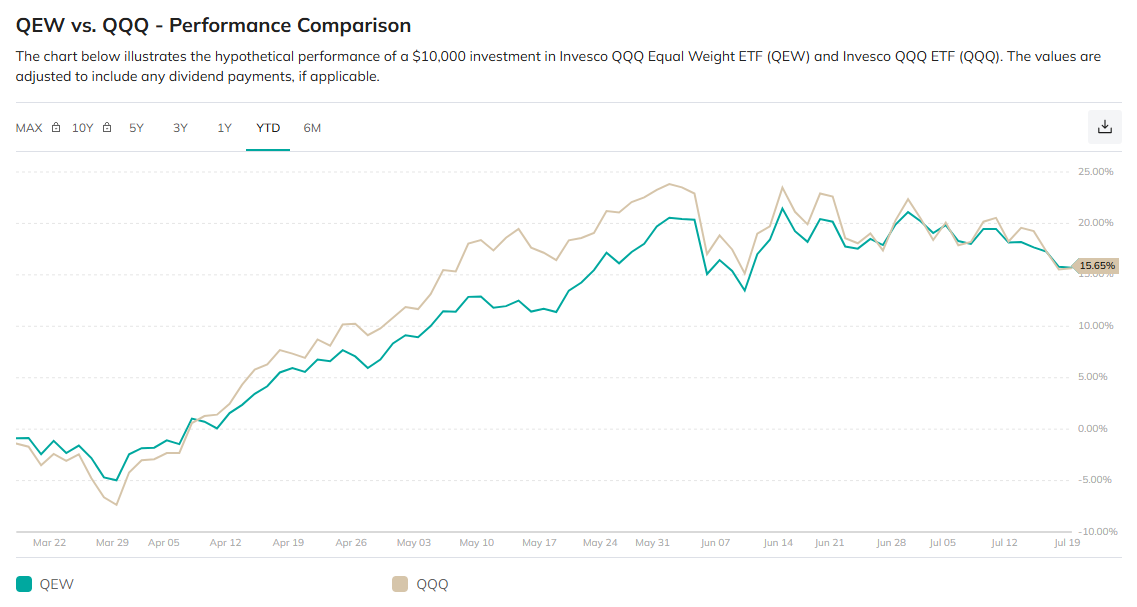
The Invesco QQQ Equal Weight ETF (QEW) is another example of an equal weighted approach to a popular benchmark: the Nasdaq 100 index benchmarking the Invesco QQQ ETF (QQQ). This past week, QEW’s performance just edged higher above QQQ’s year-to-date results.
In QEW, tech is about 47% of the sector exposure vs. nearly 69% in QQQ. While the top four holdings in QEW represent about 5% of the portfolio, in the Qs the top four stocks snag 25% of the mix, with Nvidia leading at 8%. Concentration risk is real.
 Source: PortfoliosLab
Smart Beta Solving Investor Needs
Equal-weighted ETFs are often overlooked in bull markets where market leadership is narrow, much like the one we’ve seen in the past couple of years. Their evenly distributed stock weights typically lag when a handful of stocks leads the pack.
But in 2026, the earnings gap between the Mag 7 and the 493 is narrowing, and expectations are pointing to a continuation of momentum in some of the market’s most overlooked names. In this environment, a smart beta approach offers a simple, elegant solution to concentration risk while positioning portfolios to capture a broadening story.
For a list of equal weighted ETFs, check our ETF Screener.
For more news and information, visit the Smart Beta Content Hub.
VettaFi LLC (“VettaFi”) is the index provider for EQL, for which it receives an index licensing fee. However, EQL is not issued, sponsored, endorsed, or sold by VettaFi, and VettaFi has no obligation or liability in connection with the issuance, administration, marketing, or trading of EQL.
