The midway point in 2026 offers advisors and investors alike a chance to rethink their strategies heading into the second half of the year. It’s an opportune time to reflect on what worked well and what didn’t work quite so well. Research Affiliates conducted their midyear recap, with moderating duties going to Brent Leadbetter (partner, head of solutions distribution at Research Affiliates) while Research Affiliates CIO Jim Masturzo and PIMCO Executive Vice President Justin Belsy opined on the first half of the year.
Key Takeaways:
- Market leadership is shifting away from mega-cap U.S. tech toward small-cap equities, emerging markets, and real assets like commodities and REITs.
- Recent inflation spikes are driven by geopolitical supply shocks rather than excess consumer demand, rendering traditional interest rate hikes less effective.
- Elevated Shiller CAPE valuations across U.S. and international AI markets make uncorrelated global diversification essential for the second half of 2026.
See More: Growth Without Price Distortion
Small-Cap, EM, & REITs Resurgence
Reflecting on performance in the first half of 2026, Masturzo pointed out a clear shift in equity and market dynamics. While the S&P 500 generated a 15 percent annualized return over the last decade, recent performance reveals a rotation toward small-caps and emerging markets (EM).
“The S&P 500 outpaced every other asset class for the last decade” Masturzo said. “But over the last year, we’ve seen a shift from large-caps in the U.S. to small-caps with the Russell 2000 up over 40%, as well as emerging markets.”
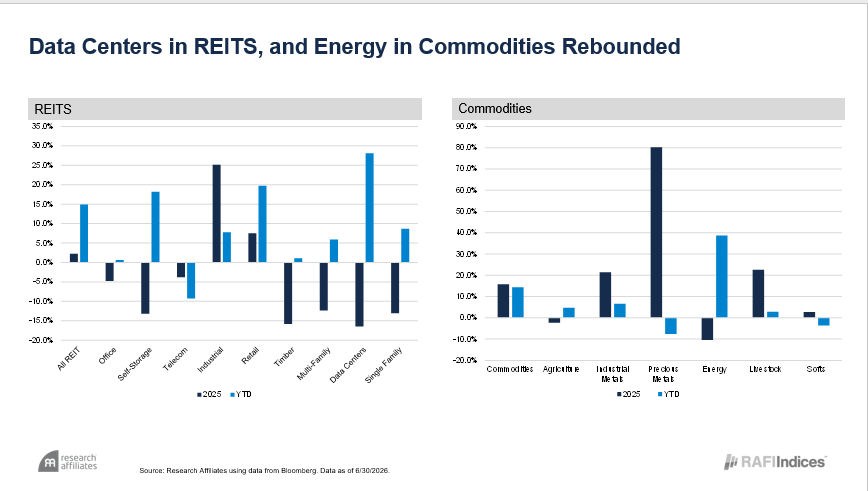
Outperformance wasn’t relegated to small-cap equities and EM. Masturzo cited a resurgence in alternative assets and inflation-fighting vehicles like commodities and real estate investment trusts (REITs). REITs, in particular, transitioned from a modest 5% 10-year average to double-digit returns over the past year.
See More: REIT ETFs: Real Estate’s Quiet Revival
Supply-Side Inflation & Labor Market Nuance
With a new Fed chair at the helm, a central debate for the second half of the year revolves around monetary policy and what will happen with interest rates. With U.S. headline inflation tracking back above 3%, Masturzo argued that rate hikes may be the wrong tool for current conditions. After all, recent price increases stem from supply shocks rather than excess demand. Much of these price pressures are tied to geopolitical conflicts occurring in the Middle East.
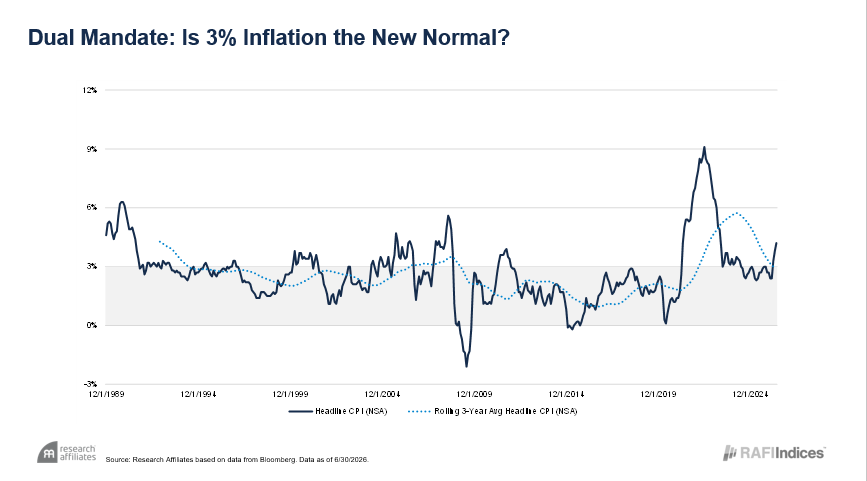
“While it [monetary policy]does a nice job of cooling inflation when it’s demand-driven, when you have these supply shocks, it really is less impactful,” Masturzo said.
Belsy echoed this sentiment, noting that recent inflation spikes differ fundamentally from those seen in earlier cycles because they have been almost entirely driven by surging energy prices. He also noted that while geopolitical conflicts may cause price fluctuations, energy trends are already showing signs of dissipating.
In terms of long-term inflation dynamics, both noted that market participants must weigh competing structural forces. On one side, artificial intelligence (AI) adoption, aging global demographics, and rising sovereign debt burdens exert deflationary pressure. Countering those forces are expanding fiscal deficits, nearshoring supply chain transitions, and recurring commodity supply disruptions that push prices upward. As a result of this deflationary-inflationary dynamic, higher overall inflation volatility ensues.
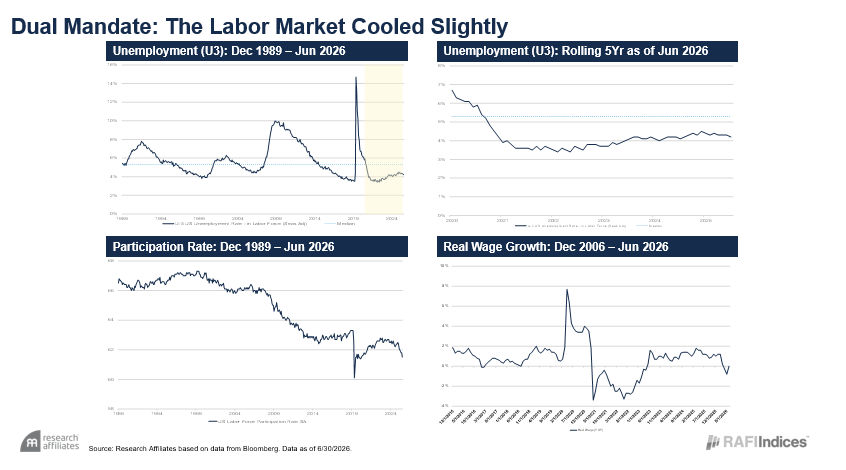
Analyzing the Fed’s dual mandate, Masturzo cautioned that despite steady headline unemployment hovering near four percent, underlying labor conditions are weaker than they appear due to falling participation rates and negative real wage growth.
U.S. Equities Face Late-’90s Froth
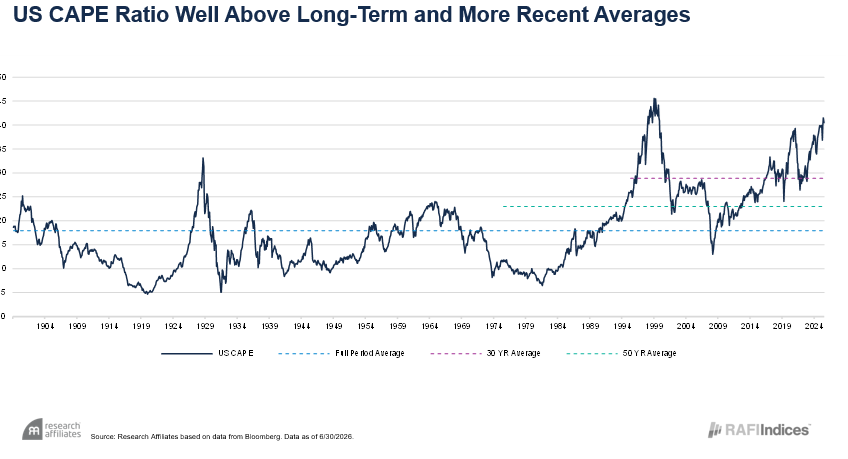
As AI sentiment fuels current market momentum, analysts are increasingly drawing parallels to the run-up before the dot-com crash. When evaluating fundamental equity valuations, Research Affiliates highlighted elevated Shiller CAPE ratios as a major headwind for future U.S. market returns.
“We are north of 40, getting very close to the tech bubble peak at 44,” Masturzo said. “Regardless of how you look at it, the U.S. current CAPE ratio is expensive relative to its own history.”
To that point, Leadbetter noted that extreme valuations are not isolated to the Magnificent Seven, but extend into international markets tied to the same AI trade.
“Today Korea is at 45, Taiwan’s at 52,” Leadbetter said. “So both those markets on a Shiller CAPE basis are more expensive than the U.S. was in March of 2000.”
“The AI story that’s come to dominate headlines in the U.S. is not a U.S.-specific phenomenon,” he emphasized.
Embrace Diversification in Today’s Market
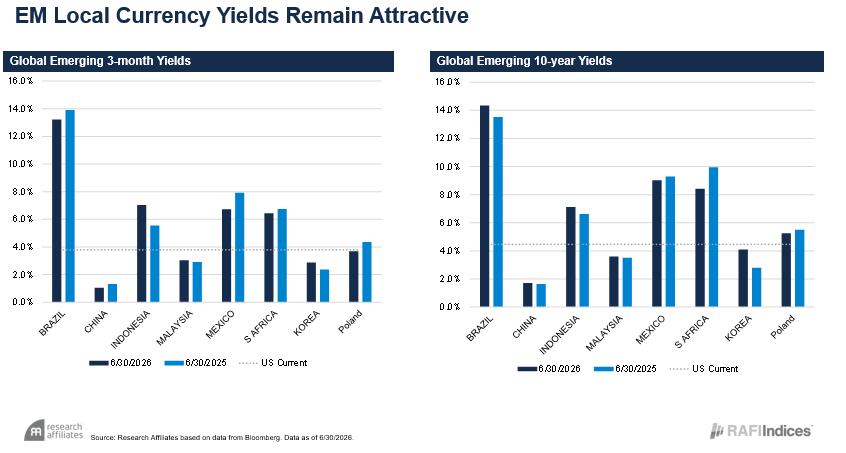
Given high U.S. equity valuations, a main point of emphasis is looking outside mainstream large-cap equities. Masturzo singled out local currency emerging market bonds as a compelling asset class, driven by high real yields and lower average inflation relative to developed markets.
“EM local currency rates are quite attractive,” Masturzo said, noting that what “is really interesting today is that if you look at inflation rates across emerging markets, on average, they’re lower than they are in the U.S. today.”
Citing the PIMCO All Asset Fund strategy as a prime example, Belsy emphasized that building robust long-term portfolios requires stepping beyond traditional 60/40 structures into diversifying real assets, TIPS, and non-U.S. exposures. Ultimately, as market concentration and valuation pressures mount, the second half of 2026 will reward investors who move beyond traditional benchmarks to embrace uncorrelated global diversification.
Originally published on Advisor Perspectives
For more news, information, and strategy, visit the Smart Beta Content Hub.
