
Advisors and investors wanting to augment and diversify their traditional portfolios should consider long-term exposure to managed futures. The noncorrelated benefits and historical performance during periods of market crisis make managed futures strategy a worthwhile, long-term ballast for traditional portfolios.
Managed futures strategies hold short and long positions in a variety of asset classes. They invest in bonds, equities, currencies, and commodities via futures and base positions on how asset classes currently trade. It’s a differentiated approach to traditional, long-only investing that typically takes into account forward-looking predictions and a variety of factors when investing. Instead, managed futures managers invest primarily on price momentum, as it can indicate developing or declining trends.
Additionally, the ability to short asset classes means the strategy can generate alpha during periods of market duress. It’s this capability that has earned managed futures their “crisis alpha” moniker. It makes the strategy an attractive one to maintain in portfolios long term, as it may provide differentiated returns amid significant market drawdowns.
Indeed, Bob Elliott, CEO and co-founder of Unlimited, recently made the case that long-term inclusion of these strategies results in a better risk/return profile for traditional portfolios.
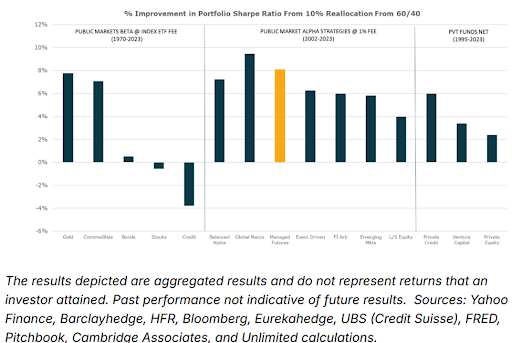
Image source: Unlimited
Benefit Across Market Cycles With Managed Futures
By focusing on pricing momentum and how assets currently trade, managed futures can take advantage of price dislocations when they occur. Traditional portfolios generally take time to respond to changing market regimes and trends. This means that they often may end up stuck on the wrong side of a trade for a prolonged period of time.
Managed futures strategies are nimble, steered by managers who are able to respond to changing trends as they unfold, in the pursuit of alpha. Additionally, they are able to capture positive market momentum, albeit with more muted returns than long-only positions. This makes them a notable addition, as many defensive strategies struggle in upward markets, Elliott noted.
Accessing these hedge fund strategies through the cost-savings and tax efficiency of an ETF may further compound potential benefits. The strategy, once relegated to hedge fund investors, is now available through a variety of ETFs. The fee savings that the ETF wrapper provides, compared to the 2/20 model of hedge funds, means that investors may potentially retain more of the returns generated when investing via an ETF.
While the hedge fund managers generally tout their strategies as an alternative to bonds, Unlimited works to boost the return potential while eliminating single-manager risk. The Unlimited HFMF Managed Futures ETF (HFMF) seeks to generate a similar return profile as the managed futures sector within the hedge fund industry. The fund also seeks to maintain twice the volatility of the sector, creating potential outperformance.
Unlimited uses a proprietary algorithm to create a portfolio of long and short positions in ETFs and futures. These positions replicate the sectors’ most recent returns, and doubles the volatility.
HFMF carries an expense ratio of 0.95%.
For more news, information, and strategy, visit the Portfolio Strategies Content Hub.
