
Key Takeaways
- The WisdomTree Target Range Fund (GTR) looks to hedge risk while allowing investors to participate in equity market gains, making it a potentially valuable addition to diversified portfolios.
- GTR’s use of options strategies, coupled with Treasury investments, provides the potential to participate in the growth of equity markets with limited downside protection over the course of an annual period.
- Recent resets in GTR’s options on U.S. large caps, small caps and emerging markets highlight its ability to lock in gains and manage risk as market conditions evolve.
When equities are in a bull market, it is easy to forget about the pain of loss, but the risk of significant loss can be part and parcel of investing. Many investors do not have the risk tolerance to take on 100% equity risk. To offset that risk, investors have primarily used bonds to create balanced or moderate risk levels. However, simply diversifying only amongst stocks and bonds can fall short in some market cycles and fail to cover certain risks, as we experienced in 2022, when rising bond yields and falling equity prices made for a challenging year for almost every type of traditional asset.
Fortunately, there are options for further diversification. WisdomTree worked with Valmark1 back in 2021 to provide a new solution to help investors achieve long-run portfolio objectives while targeting an explicit floor on their investment losses. The WisdomTree Target Range Fund (GTR) is a unique tool that may be used to enhance a diversified portfolio, providing benefits not available through simple stock/bond diversification.
Target Range Refresh
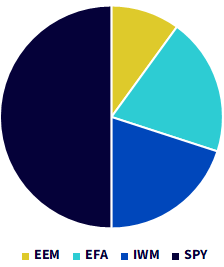
GTR provides exposure to an allocation of U.S. large caps (SPY), U.S. small caps (IWM), developed market equities (EFA) and emerging market equities (EEM) in similar proportions to how many investors diversify globally. However, instead of simply owning equities outright, GTR buys one-year call options on each underlying ETF at the start of the year that are 15% in-the-money and sells one-year call options that are 15% out-of-the money—while the remainder of the Fund is allocated to a collateral account invested in fixed income instruments. Should markets decline, the Fund’s maximum annual loss or “floor” is the amount of capital invested in the call options—minus any proceeds received from selling options to offset the cost.
Assuming the options cost 15 cents to acquire (15% in the money options), 85 cents of every dollar invested in the Fund is in cash instruments. Of note, the roughly 85 cents invested in collateral, primarily Treasury bills, is now adding considerable value compared to when the ETF launched more than three years ago in a lower interest rate environment. While some investors may shy away from options strategies due to the lack of opportunity for dividends or interest, GTR currently has an SEC yield of more than 3%1, driven by the interest from the collateral investments. This helps complete the unique story of GTR providing upside participation, limited downside protection and income.
WisdomTree Target Range Fund (GTR)
Locking in Gains
When we first launched GTR back in 2021, a key question on investors’ minds was what happens to the Fund’s downside management if markets rally over the next year before the reset. In theory, an investor could purchase the Fund when markets are higher and expose themself to a higher beta strategy (with more significant downside risk) than an investor who owned it in January. To potentially offset this issue, we decided to create a mechanism whereby investors could lock in gains and ratchet up the “floor” of the strategy. Fortunately, after a strong start to the year, positions in U.S. large caps and small caps were both reset on August 1. On October 1, the options positions in EEM were also restruck to lock in gains.
Restrike in U.S. Large Caps
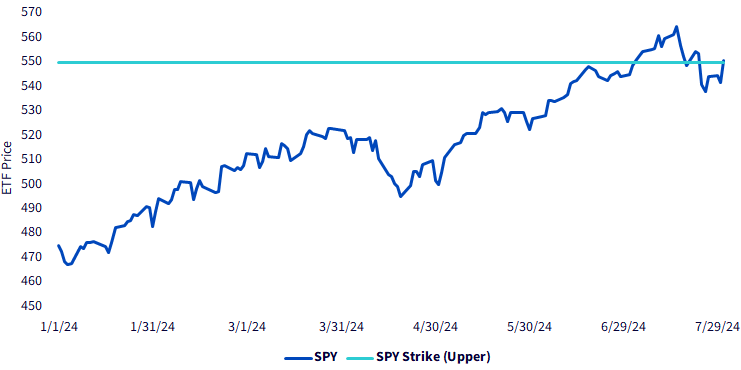
After a modest correction in April, positions in SPY rallied strongly as expectations for Fed rate cuts were brought forward. As a result, SPY closed the month of July above the strike price of 550. Also as a result, GTR rolled its options to lock in gains and bought calls at 470 and sold calls at 635.
ETF Price vs. Upper Strike Price (SPY)
Restrike in U.S. Small Caps
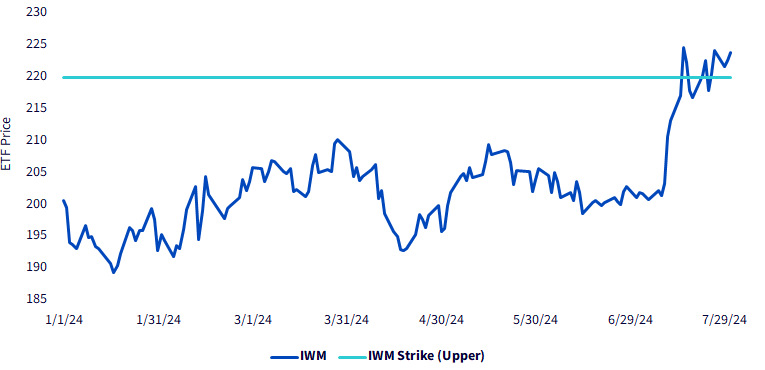
While large caps showed a steady rise, U.S. small caps rallied abruptly due to falling longer-term interest rates. Since small caps tend to be more interest rate-sensitive, the options were rolled into long calls at 191 and short calls at 260. With the benefit of hindsight, we know that taking chips off the table was a smart move, as rates have headed higher and small caps have fallen back below the original upper strike price of 220.
ETF Price vs. Upper Strike Price (IWM)
Restrike in Emerging Markets
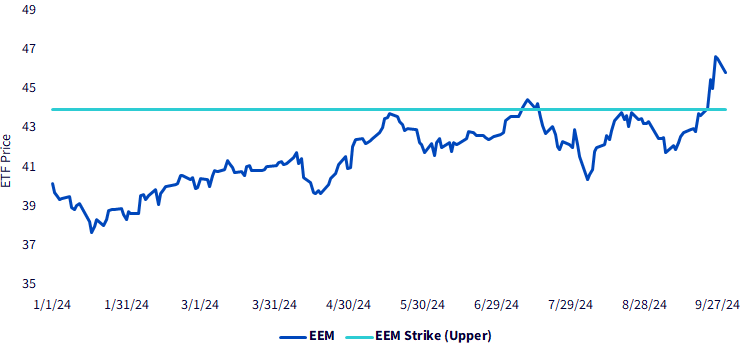
Finally, in emerging markets, the big story was China announcing stimulus to help stabilize its economy and markets. While not as violent as the rally seen in small caps, Chinese equities pushed broader markets higher, triggering an option reset above 44. On October 1, GTR opened new long call positions at 39 and short calls at 53. While emerging markets remain above the original strike price, concerns about the lasting impact of China’s policy announcements have caused markets to retrace.
ETF Price vs. Upper Strike Price (EEM)
Conclusion
While GTR does not necessarily aim to capture 100% of equity market upside, we believe the flexibility built into the methodology to take chips off the table can have a meaningful impact on helping investors compound returns. While the path of markets remains uncertain, we believe strategies like GTR that have clearly defined downside management could add significant value to investor portfolios. We have witnessed advisors using GTR as a long-term strategic holding in a diversified portfolio, a risk management tool, a way to fund a specific goal and a way to get defined risk equity exposure with income.
This article originally appeared on WisdomTree’s website and is reprinted on VettaFi | ETF Trends with permission from the author. For more information, please visit WisdomTree.com.
Originally published October 23, 2024
For more news, information, and strategy, visit the Modern Alpha Channel.
1 Past performance is not indicative of future results. Investment return and principal value of an investment will fluctuate so that an investor’s shares, when redeemed, may be worth more or less than their original cost. Current performance may be lower or higher than the performance data quoted. For the most recent month-end and standardized performance and to download the Fund prospectus, please click here.
U.S. investors only: Click here to obtain a WisdomTree ETF prospectus which contains investment objectives, risks, charges, expenses, and other information; read and consider carefully before investing.
There are risks involved with investing, including possible loss of principal. Foreign investing involves currency, political and economic risk. Funds focusing on a single country, sector and/or funds that emphasize investments in smaller companies may experience greater price volatility. Investments in emerging markets, currency, fixed income and alternative investments include additional risks. Please see prospectus for discussion of risks.
Past performance is not indicative of future results. This material contains the opinions of the author, which are subject to change, and should not to be considered or interpreted as a recommendation to participate in any particular trading strategy, or deemed to be an offer or sale of any investment product and it should not be relied on as such. There is no guarantee that any strategies discussed will work under all market conditions. This material represents an assessment of the market environment at a specific time and is not intended to be a forecast of future events or a guarantee of future results. This material should not be relied upon as research or investment advice regarding any security in particular. The user of this information assumes the entire risk of any use made of the information provided herein. Neither WisdomTree nor its affiliates, nor Foreside Fund Services, LLC, or its affiliates provide tax or legal advice. Investors seeking tax or legal advice should consult their tax or legal advisor. Unless expressly stated otherwise the opinions, interpretations or findings expressed herein do not necessarily represent the views of WisdomTree or any of its affiliates.
The MSCI information may only be used for your internal use, may not be reproduced or re-disseminated in any form and may not be used as a basis for or component of any financial instruments or products or indexes. None of the MSCI information is intended to constitute investment advice or a recommendation to make (or refrain from making) any kind of investment decision and may not be relied on as such. Historical data and analysis should not be taken as an indication or guarantee of any future performance analysis, forecast or prediction. The MSCI information is provided on an “as is” basis and the user of this information assumes the entire risk of any use made of this information. MSCI, each of its affiliates and each entity involved in compiling, computing or creating any MSCI information (collectively, the “MSCI Parties”) expressly disclaims all warranties. With respect to this information, in no event shall any MSCI Party have any liability for any direct, indirect, special, incidental, punitive, consequential (including loss profits) or any other damages (www.msci.com)
Jonathan Steinberg, Jeremy Schwartz, Rick Harper, Christopher Gannatti, Bradley Krom, Kevin Flanagan, Brendan Loftus, Joseph Tenaglia, Jeff Weniger, Matt Wagner, Alejandro Saltiel, Ryan Krystopowicz, Brian Manby, and Scott Welch are registered representatives of Foreside Fund Services, LLC.
WisdomTree Funds are distributed by Foreside Fund Services, LLC, in the U.S. only.
You cannot invest directly in an index.
