Coming off stellar gains from last year, many entered 2025 expecting limited upside. But upside may be even more limited following the recent rebound in equities as the tariff rhetoric cools. Even if the worst of the tantrum is over, tariffs leave a bitter aftertaste in the market’s mouth. The federal funds futures market is pricing in fewer and fewer rate cuts from the Federal Reserve. And inflation will likely remain on the stickier side for the foreseeable future. As a result, much of the Street has lowered its six- and 12-month price targets for the S&P 500. Considering the Street’s cautious stance, the search is on for additional income this year. Advisors and investors are increasingly turning to derivatives income ETFs for extra income.
The category has seen exceptional growth, gathering $100 billion in inflows over the past five years. Roughly 99% of all derivative ETF assets are held in covered call ETFs. Those have garnered more than $80 billion in net inflows since early 2024. This category saw north of $15 billion added to it in the first quarter of this year alone.
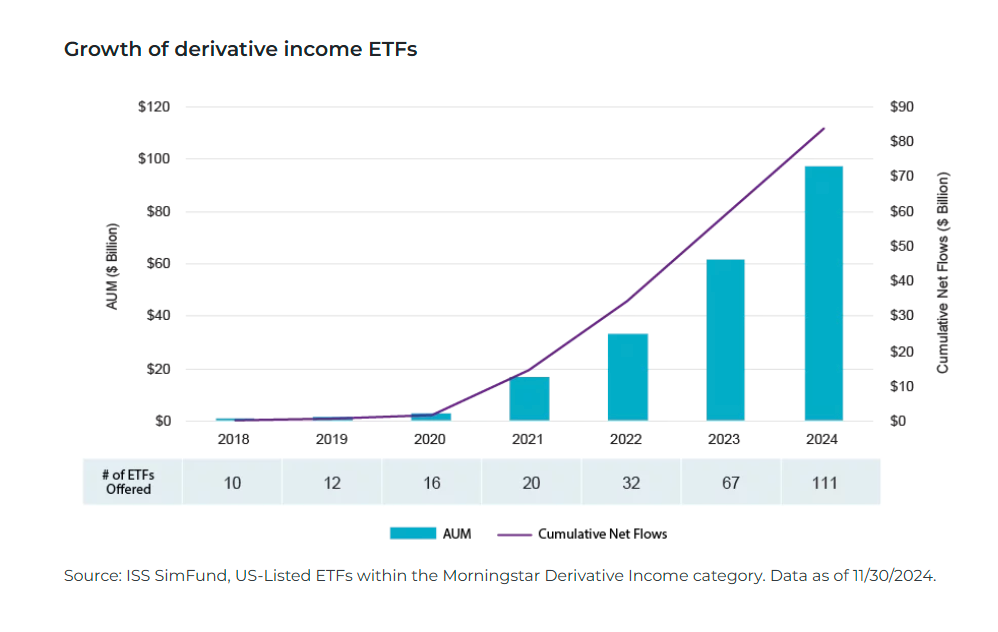
Covered Call ETFs: Seeking Shelter … & Income
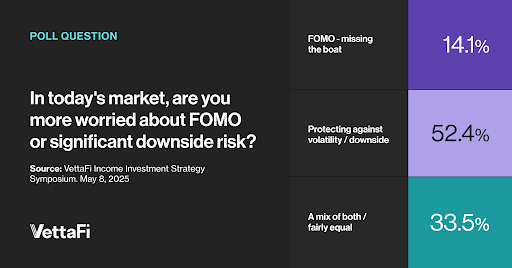
Polling data from VettaFi’s recent Income Investment Strategy Symposium showed more advisors were concerned with downside protection than missing out on any upside potential.
Even if the U.S. economy skirts a technical recession, expectations are for GDP to remain flat and growth to stay sluggish at best. Covered call ETFs, which are all about collecting premia and cushioning the blow, allow investors to take advantage of the view that equity markets will have both a floor and a ceiling. Many believe in a so-called “Fed put” on the monetary policy side and a “Trump put” on the fiscal side.
One fund benefiting from this mentality has been the actively managed NEOS S&P 500 High Income ETF (SPYI). It’s has already attracted more than $1 billion in net inflows this year, pushing its total assets beyond $3.5 billion. The fund uses a data-driven call option strategy written against S&P 500 constituents to generate monthly recurring income in a tax-efficient manner.
JPMorgan has largely cornered the market here with its JPMorgan Equity Premium Income ETF (JEPI). That is the world’s largest active ETF, and it’s so far netted $4 billion in 2025. The fund, which can be used as either an equity diversifier or bond substitute, garnered $40 billion in just five years.
The $8 billion Global X Nasdaq 100 Covered Call ETF (QYLD) has also been a standout, gathering more than $800 million in net inflows this year. Meanwhile, the Invesco S&P 500 BuyWrite ETF (PBP), which takes a passive approach and targets long-term returns, has been a pioneer in the covered call space. The $135 million fund is up 8% over the past year on a NAV basis.
For more aggressive investors, REXShares offers a thematic suite of covered call ETFs. They include the REX Crypto Equity Premium Income ETF (CEPI) and the FANG & Innovation Equity Premium Income ETF (FEPI), which have risen 11% and 13% over the past month.
Taylor Ranney, senior vice president of business development at REXShares, said the record volatility has painted a compelling case for REX’s particular brand of thematic strategies.
“The elevated level of implied volatility means that within these strategies, you can either collect more premiums or you could write further out of the money, which allows you to potentially capture some of the upside,” he told me at the symposium earlier this month. “We’re writing them focused on more concentrated baskets within big tech, AI, and crypto equity. And within those spaces, you get substantially higher premiums.” Since launching, these funds have added over 2.6% in premium returns on average.
International ETFs: Enhanced Income Beyond U.S. Borders
ETF providers are expanding beyond traditional large-cap equity strategies into multi-asset, sector-specific, and even international derivative-enhanced ETFs. Two of the few existing international derivative income ETFs are the Amplify CWP International Enhanced Dividend Income ETF (IDVO) and the KraneShares KWEB Covered Call Strategy ETF (KLIP).
IDVO seeks additional income by tactically writing covered calls against international dividend-paying stocks. KLIP buys shares of the KraneShares CSI China Internet ETF (KWEB) and writes corresponding call options on the fund. China stocks are finally outperforming this year. That’s thanks to a combination of historically low multiples and monumental strides in both the EV and AI space. KLIP is up nearly 10% over the past year on a total return basis.
Bottom Line
Enhanced income ETFs can capitalize on market conditions while protecting against potential downside by collecting a layer of recurring premiums. They offer enhanced yield opportunities for conservative investors. They can also serve as a powerful diversifier for balanced portfolios. Strong demand for income generation, lower volatility, and diversification amid fears over about a potential slowdown will only serve to further fuel this growing trend.
For more news, information, and analysis, visit VettaFi | ETF Trends.
