
Copper prices haven’t been immune to the market volatility seen as of late due to tariff news. But the fizzling rally could open up buy-the-dip opportunities. However, due diligence is always imperative.
While buying the dip may seem an attractive option to purchase assets at depressed prices, it’s always difficult to time the market. Like all buy-the-dip strategies, caution is certainly warranted. Investors don’t want to experience a downtrend that could spiral out of control with no bottom in sight.
“We’re certainly not recommending that anyone try to catch the falling knife,” warned Max Layton, global head of commodities research at Citigroup Inc., and rightfully so. “This is a massive change in global trading activity, and with it, we could see the kind of correction that we’ll remember in five, 10 or 20 years.”
Despite the market volatility, analysts are expecting copper to continue its upward trajectory. Macroeconomic factors like increased demand paired with a supply deficit should continue to provide upward momentum for prices.
“The market has evolved into a broader macroeconomic volatility event dominated by liquidity, uncertainty and geopolitical retaliation,” noted ETF product manager Jacob White in a market insights report. “Yet, amid the turbulence, the copper-specific policy trajectory is still moving forward.”
The chart below highlights key market events where copper fell but resumed its upward trend.
Figure 3. Copper Price & Key U.S. Policy Events (2024-2025)
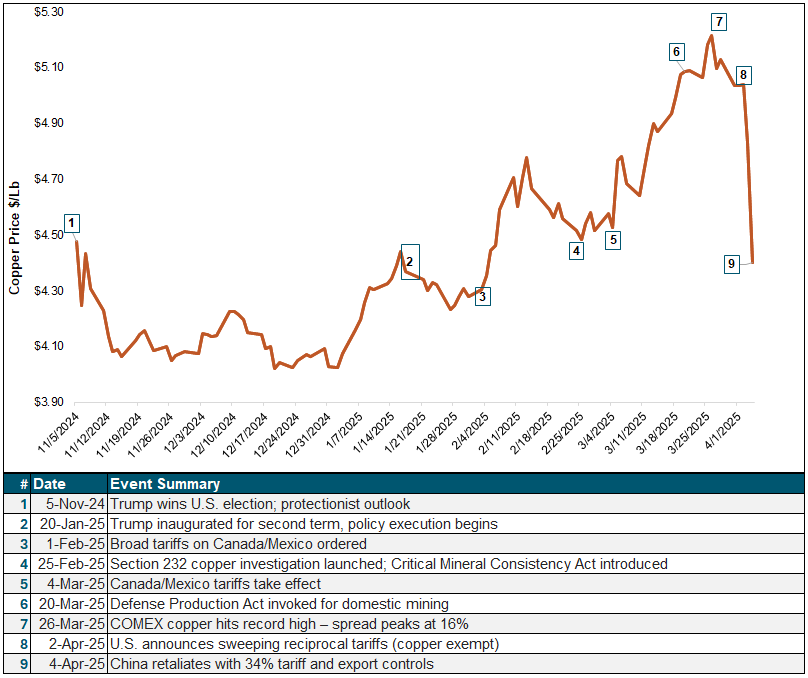
Source: Bloomberg. Data as of 04/04/2025. The front-month standardized contract on the CME, ticker HG1 represents COMEX Copper.
2 Copper Mining Funds to Ponder
Whether or not he dust settles on the tariff tantrum, copper presents a compelling long-term investment option. Tariffs or not, the world is becoming increasingly more reliant on electrical energy, which is where copper is lauded for its conductivity properties. In turn, this should also increase the demand for copper mining. And that creates opportunities via a pair of Sprott ETFs.
The first to consider is the Sprott Copper Miners ETF (COPP). The fund specifically tracks the Nasdaq Sprott Copper Miners Index (NSCOPP). The index includes producers, developers, and explorers that support the copper mining industry. For diversification, COPP provides blanket exposure by focusing on large-, mid-, and small-cap mining companies.
Copper Mining Stock Opportunities
Investors have seen heavy volatility as of late. For those who don’t mind the market fluctuations, small-cap equities open opportunities in copper mining stocks. In addition, midcap companies can offer a mix of large-cap characteristics with a tinge of growth from small-cap equities.
Both can be combined into one fund via the Sprott Junior Copper Miners ETF (COPJ). The fund aims to track the total return performance of the Nasdaq Sprott Junior Copper Miners Index. The index incorporates mid-, small-, and microcap companies entrenched in copper-mining-related businesses, offering exposure to equities with high growth potential.
For more news, information, and analysis, visit the Gold/Silver/Critical Materials Channel.
An investor should consider the investment objectives, risks, charges, and expenses carefully before investing. To obtain a Prospectus, which contains this and other information, contact your financial professional or call 888.622.1813. Read the Prospectus carefully before investing, which can also be found by clicking one of the links below.
Past performance is no guarantee of future results. One cannot invest directly in an index.
Funds that emphasize investments in small/mid-cap companies will generally experience greater price volatility. Diversification does not eliminate the risk of investment losses. ETFs are considered to have continuous liquidity because they allow an individual to trade throughout the day. A higher portfolio turnover rate may indicate higher transaction costs and may result in higher taxes when Fund shares are held in a taxable account. These costs, which are not reflected in annual fund operating expenses, affect the Fund’s performance.
Sprott Asset Management USA, Inc. is the Investment Adviser to the ETFs. ALPS Distributors, Inc. is the Distributor for the ETFs and is a registered broker-dealer and FINRA Member. ALPS Distributors, Inc. is not affiliated with Sprott Asset Management USA, Inc. or VettaFi.
Exchange Traded Funds (ETFs): SETM, LITP, URNM, URN, COPP, COPJ, NIKL, SGDM and SGDJ
Physical Bullion Funds: PHYS, PSLV, CEF, and SPPP.
