
For the latest standardized performance and holdings of the Sprott Copper Miners and Sprott Junior Copper Miners ETFs, please visit the individual website pages COPP and COPJ. Past performance is no guarantee of future results.
Copper capped off a strong August despite tariff headwinds blowing in its direction. Physical copper prices rose in tandem with copper mining equities, which created opportunities for investors to obtain exposure via ETFs.
“Copper showed notable strength in August, with strong price gains for both physical copper and copper mining equities reflecting renewed investor confidence and growing policy support,” said Sprott Asset Management ETF product manager Jacob White in a Sprott Copper Report. Copper continues to benefit from its central role in electrification, data infrastructure and strategic resource planning.
Furthermore, copper’s exclusion from Section 232 tariffs eased anxiety surrounding potential sanctions. Also, its inclusion in the 2025 draft iteration of the U.S. Geological Survey’s critical minerals list helped to buoy prices.
“Recent developments in monetary policy, trade dynamics and critical mineral classifications have reinforced copper’s positioning as a key beneficiary of long-term structural shifts,” White added.
As mentioned, the upside wasn’t just relegated to physical copper. Mining equities also exhibited signs of strength last month, benefiting from higher copper prices as well as other industry factors.
“Operationally, copper miners continued to deliver in August. Earnings results were positive, margins improved, and the benefits of higher copper prices were evident across the sector,” White pointed out. “August was a standout month for critical materials broadly, with copper at the forefront of both policy momentum and market performance.”
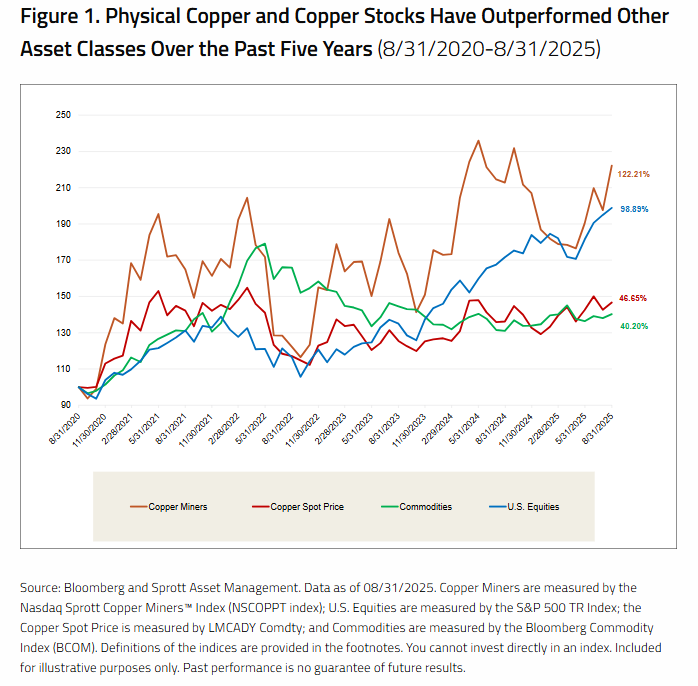
In the long-term, both physical copper and copper mining equities have outperformed broader commodities as well as U.S. equities.
2 Avenues for Copper Exposure
With strength in physical copper and its equities, investors don’t have to choose which avenue they prefer for exposure. They can simply get both with the Sprott Copper Miners ETF (COPP). COPP gives investors exposure to physical copper, which can provide closer tracking of spot prices. The fund also adds mining exposure by tracking the Nasdaq Sprott Copper Miners Index. Its constituents include mostly large- and midcap companies domiciled across various countries, which adds to the fund’s diversification benefits.
Small-cap companies can make amplified moves to the upside, and can see long-term opportunities for growth. Investors can combine these growth prospects and copper mining exposure with the Sprott Junior Copper Miners ETF (COPJ). The fund tracks the Nasdaq Sprott Junior Copper Miner Index (NSCOP), which includes mid, small- and micro-cap companies in copper-mining related businesses.
For more news, information, and analysis, visit the Gold/Silver/Critical Minerals Content Hub.
The S&P 500 tracks 500 of the largest publicly traded companies in the United States. Copper spot refers to the current market price for immediate delivery of physical copper, reflecting the real-time value of copper traded on global exchanges. The Bloomberg Commodity Index measures the price performance of a broad basket of physical commodities, including energy, metals, and agricultural products.
An investor should consider the investment objectives, risks, charges, and expenses carefully before investing. To obtain a Prospectus, which contains this and other information, contact your financial professional or call 888.622.1813. Read the Prospectus carefully before investing, which can also be found by clicking one of the links below.
Past performance is no guarantee of future results. One cannot invest directly in an index.
Funds that emphasize investments in small/mid-cap companies will generally experience greater price volatility.
Diversification does not eliminate the risk of investment losses. ETFs are considered to have continuous liquidity because they allow an individual to trade throughout the day. A higher portfolio turnover rate may indicate higher transaction costs and may result in higher taxes when Fund shares are held in a taxable account. These costs, which are not reflected in annual fund operating expenses, affect the Fund’s performance.
Sprott Asset Management USA, Inc. is the Investment Adviser to the ETFs. ALPS Distributors, Inc. is the Distributor for the ETFs and is a registered broker-dealer and FINRA Member. ALPS Distributors, Inc. is not affiliated with Sprott Asset Management USA, Inc. or VettaFi.
Exchange Traded Funds (ETFs): SETM, LITP, URNM, URN, COPP, COPJ, NIKL, SGDM, SGDJ, SLVR, GBUG, METL
Physical Bullion Funds:PHYS, PSLV, CEF, and SPPP.
Gold and precious metals are referred to with terms of art like store of value, safe haven and safe asset. These terms should not be construed to guarantee any form of investment safety. While “safe” assets like gold, Treasuries, money market funds and cash generally do not carry a high risk of loss relative to other asset classes, any asset may lose value, which may involve the complete loss of invested principal.
