
Whether it’s the heavy power draw required for artificial intelligence (AI) data centers or a structural supply deficit, both are feeding into a strong rally for uranium miners. Those demand drivers are likely to remain, which means their rally could extend further.
From a macro perspective, the World Uranium Index is outpacing the S&P 500 year-to-date. The MSCI World Metals & Mining index is having similar success. That said, the upside in both the metals & mining index and the global uranium index supports the investment case for uranium miners.
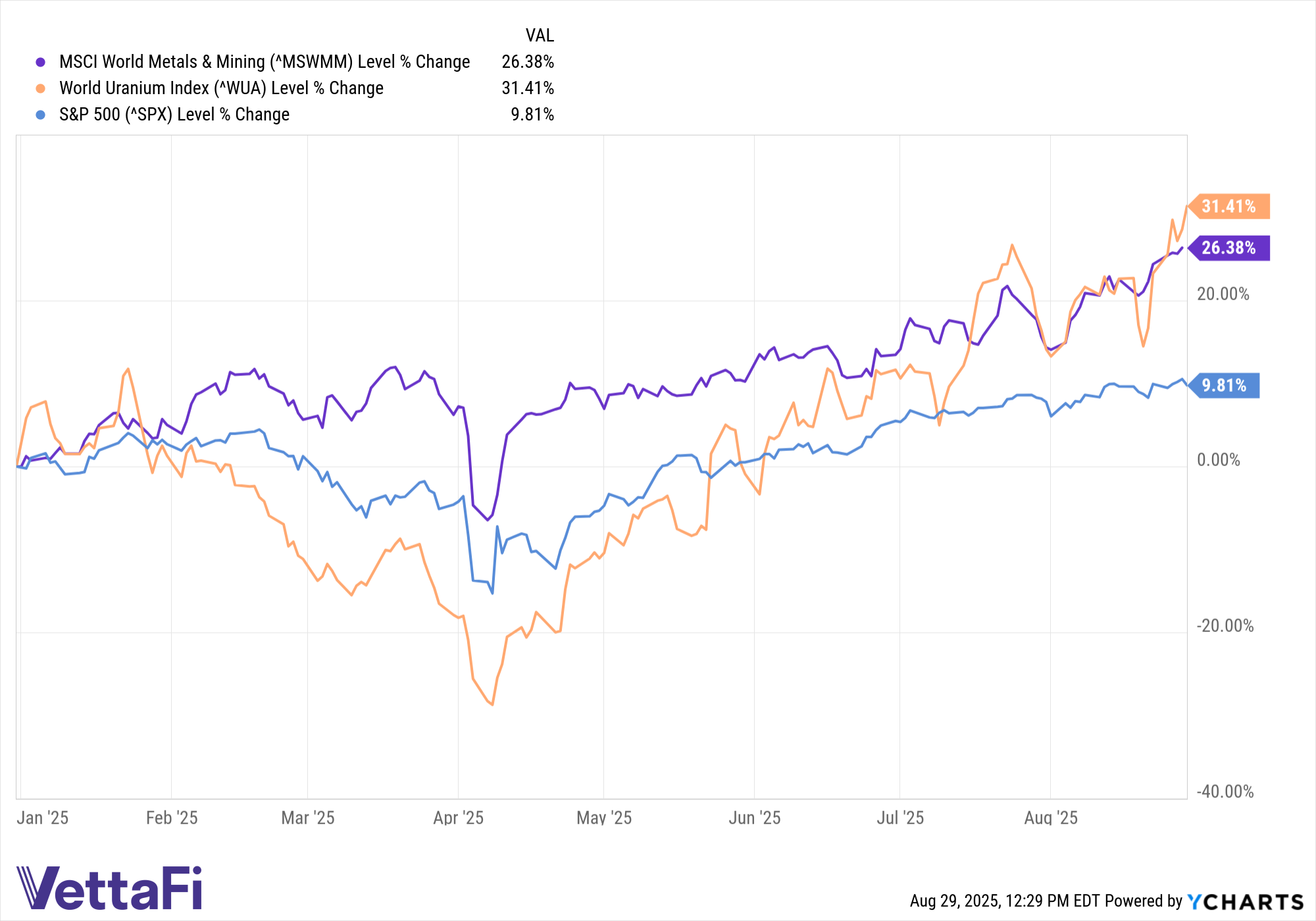
Source: YCharts as of 8/29/25
The Sprott Uranium Miners ETF (URNM) tracks the North Shore Global Uranium Mining Index, providing exposure to companies that focus on one or a combination of the following: mining, exploration, development and production of uranium, holding physical uranium, owning royalties, or engaging in other non-mining activities that support the uranium mining industry. It runs the gamut in terms of market cap exposure, but mainly limits itself to large, mid, and small-cap companies.
In addition to miners, URNM also adds a touch of physical uranium exposure. The fund’s holdings include physical uranium, uranium royalties, and firms that hold the physical metal, or that derive royalties from it.
Diversification is further achieved with varied country exposure. Companies are domiciled in not just the United States, but also Canada, Australia, Kazakhstan, the United Kingdom, and Hong Kong.
A Small Cap Opportunity
Though large cap growth names have been dominating the equity market as of late, small caps could be lying in wait for future upside. In the realm of uranium mining equities, it could be an opportune time to consider the Sprott Junior Uranium Miners ETF (URNJ).
Rather than sift through the universe of small cap stocks for uranium mining and exploration companies, URNJ does all the heavy lifting. The fund specifically tracks the total return performance of the Nasdaq Sprott Junior Uranium Miners Index. Within that index are constituents that are mid-, small-, and micro-cap companies operating within the uranium mining business. While having microcap and small cap companies can expose investors to potentially higher volatility, URNJ also adds midcap exposure as a counterbalance.
Furthermore, like URNM, the fund offers country diversification benefits. Companies within its holdings are domiciled in Canada, United States, Australia, Hong Kong, and the United Kingdom.
For more news, information, and analysis, visit the Gold/Silver/Critical Minerals Content Hub.
Disclosures
North Shore Global Uranium Mining Index tracks companies involved in uranium mining and physical uranium ownership, with a focus on junior miners.
Nasdaq Sprott Junior Uranium Miners Index follows small and mid-sized companies primarily engaged in uranium production, exploration, development, or royalty investments.
World Uranium Index tracks the performance of companies involved in the global uranium industry, reflecting price movements and trends in uranium-related stocks.
S&P 500 Index measures the stock performance of 500 of the largest publicly traded companies in the United States, serving as a key indicator of the U.S. economy.
MSCI World Metals & Mining Index is made up of large and mid-sized companies from developed markets that are classified in the metals and mining industry, offering exposure to global resource producers.
Diversification does not guarantee profits or protect against losses.
An investor should consider the investment objectives, risks, charges, and expenses carefully before investing. To obtain a Prospectus, which contains this and other information, contact your financial professional or call 888.622.1813. Read the Prospectus carefully before investing, which can also be found by clicking one of the links below.
Past performance is no guarantee of future results. One cannot invest directly in an index.
Funds that emphasize investments in small/mid-cap companies will generally experience greater price volatility. Diversification does not eliminate the risk of investment losses. ETFs are considered to have continuous liquidity because they allow an individual to trade throughout the day. A higher portfolio turnover rate may indicate higher transaction costs and may result in higher taxes when Fund shares are held in a taxable account. These costs, which are not reflected in annual fund operating expenses, affect the Fund’s performance.
Sprott Asset Management USA, Inc. is the Investment Adviser to the ETFs. ALPS Distributors, Inc. is the Distributor for the ETFs and is a registered broker-dealer and FINRA Member. ALPS Distributors, Inc. is not affiliated with Sprott Asset Management USA, Inc. or VettaFi.
Exchange Traded Funds (ETFs): SETM, LITP, URNM, URN, COPP, COPJ, NIKL, SGDM and SGDJ
Physical Bullion Funds: PHYS, PSLV, CEF, and SPPP.
