
Passive, active, Treasuries, corporates, munis, international, and more — the whole spectrum of fixed income ETFs seemed to come off a strong year in 2025. The year was also marked by a bevy of launches. When the smoke cleared, who managed to pump the most fixed income ETFs into the marketplace?
If your guess involved the industry’s heavy hitters like Vanguard and BlackRock, then that’s certainly correct. Y-Charts marketing strategist Jerome Taylor noted in a LinkedIn post that indeed, BlackRock (by way of their iShares brand) and Vanguard were present, but Northern Trust was among the top three and runner-up overall. F/m Investments and Invesco rounded out the top five.
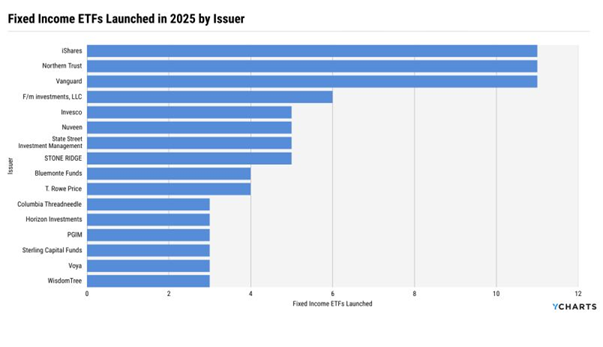
In August of last year, Northern Trust debuted 11 fixed income ETFs in one launch that featured distributing ladder and core muni funds. Munis, in particular, garnered more attention last year. They provided fixed income investors with a combination of yield and strong credit fundamentals.
Part of that launch included three funds: the Northern Trust Short-Term Tax-Exempt Bond ETF (TAXS), Northern Trust Intermediate Tax-Exempt Bond ETF (TAXI) and the Northern Trust Tax-Exempt Bond ETF (TAXT). The first two cater to the front and middle of the yield curve. Meanwhile, the latter adds core exposure across various durations. Dave Abner, Northern Trust Asset Management head of global ETFs & funds, discussed these funds in more depth during an Asset Allocation Summit webinar.
As noted in another LinkedIn post by Ben Johnson, Morningstar’s head of client solutions, it was a strong year for active ETF launches. There were 953 launches, accounting for $476 billion in flows. Of those launches, 418 were in discretionary and systematic fixed income. With iShares being at the top of the fixed income launch leaderboard in 2025, it’s notable to mention their new actively managed funds that launched just last week: the iShares Mortgage-Backed Securities Active ETF (MBBA) and iShares Securitized Income Active ETF (SECU). In an uncertain macro environment that demands income diversification, the launches of MBBA and SECU are timely.
Multi-Sector Income Prospers
The U.S. Federal Reserve instituted three consecutive rate cuts to end 2025, with possibly more to come in 2026. In response, fixed income investors sought to attain extra yield by diversifying their income. That said, a trend Taylor identified was that multi-sector income “doubled in back-to-back years, surpassing $50 billion in AUM.” It “has been a clear beneficiary of the active/passive barbell approach advisors continue to adopt.”
A fund mentioned by Taylor that occupied much of the multi-income market share was the iShares Flexible Income Active ETF (BINC). The fund is actively managed, offering investors the flexibility that’s needed in evolving macro conditions like now. With a net expense ratio of 40 basis points, BINC seeks opportunities in various income sectors to sustain long-term income. The portfolio management team is led by Rick Rieder, Morningstar’s 2023 Outstanding Portfolio Manager.
Another active option to consider is in the multi-income space is the Vanguard Multi-Sector Income Bond ETF (VGMS), which debuted last summer. It adds diversified exposure to corporate bonds, international bonds, or other fixed income assets to diversify yield opportunities. The fund leverages the expertise and experience of the Vanguard Fixed Income Group. In doing so, it helps advisors and investors navigate the murky macro environment.
For more news, information, and analysis, visit the Fixed Income Content Hub
