
Last time, we discussed how legacy bond benchmarks still carry the fingerprints of a market that no longer exists. This week, we turn to one of the most consequential artifacts still embedded in traditional bond benchmarks — debt weighting.
Traditional bond indices allocate weight according to each issuer’s total debt outstanding. To state it plainly, the more a company borrows, the larger its weight in the index. If that sounds counterintuitive, it’s because it is. Few investors building a portfolio from scratch would deliberately allocate the largest weights to the most indebted issuers without first discerning the quality of that debt. Yet trillions of dollars are managed against benchmarks built on exactly that principle.
Weight follows debt issuance, not credit quality
The convention was inherited from equities, where market-cap weighting has a defensible logic. When investors place a higher value on a company’s prospects, its market capitalization rises and its weight in the index increases. The weighting mechanism therefore incorporates the market’s collective judgment of the company’s prospects.
That logic breaks down in fixed income. A bond issuer does not receive a larger benchmark weight because the market has judged it to be more attractive. It receives a larger weight primarily because it has issued more debt. A company that substantially increases its borrowing can therefore become more important to the benchmark even as its balance sheet becomes more stretched and its credit metrics potentially deteriorate. The benchmark does not judge whether the additional borrowing strengthened the business. It simply gives the issuer a larger allocation.
The adverse effects compound over time. Sector allocations can become a by-product of corporate issuance patterns rather than a deliberate investment decision. Duration shifts as companies refinance, extend maturities and bring new debt to market, often independent of investor risk preferences. Concentration can build gradually and remain easy to overlook.
The financial crisis provides the clearest example of this dynamic. By 2007, the financial sector had grown to nearly 40% of the U.S. investment-grade corporate universe. Debt-weighted credit investors therefore entered 2008 with their largest sector allocation concentrated in the area that would soon experience the greatest stress.
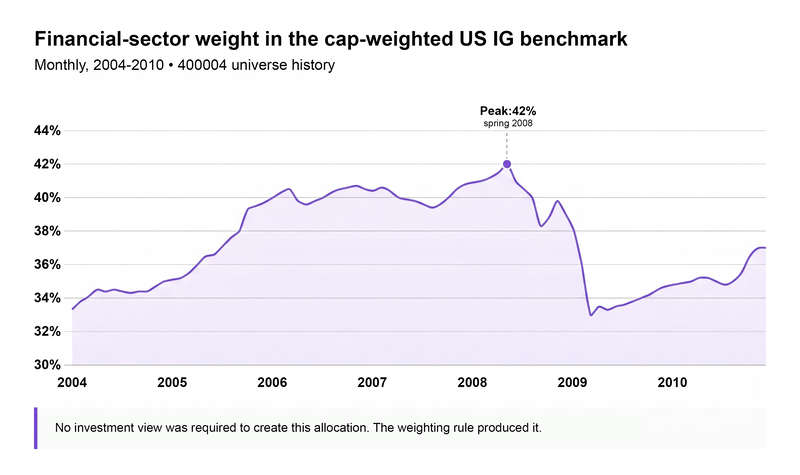
The lesson is not that financials should always be underweighted. It is that issuance volume should not be allowed to determine portfolio concentration.
The fix is structural, not clairvoyant
The most direct solution is to break the link between debt outstanding and portfolio weight.
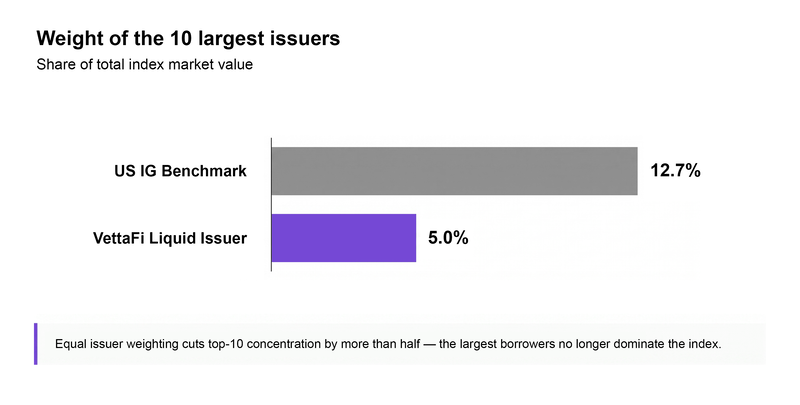
The VettaFi Liquid Issuer Index was designed to do exactly that. It rebuilds the investment-grade corporate universe as an equal-weighted basket of issuers while seeking to preserve the broad rating, sector and duration characteristics of the benchmark. The result is a more balanced portfolio that does not allow the largest borrowers to dominate simply because they have issued the most debt.
There is a subtler benefit as well. Equal weighting reduces exposure to the mega-cap debt complexes that dominate traditional benchmarks. Meanwhile, equal weighting also distributes capital more evenly across the selected issuer set. It creates a portfolio in which each issuer’s contribution reflects the index design rather than the size of its debt program.
You win by not losing
We describe the benefit of this approach with a simple phrase: You win by not losing. This does not mean that a defensive index design can predict defaults, anticipate downgrades or identify the next issuer to come under stress. An index cannot make such forecasts, and a well-designed one does not need to.
The argument is structural. When issuer weights are capped, the portfolio impact of any one issuer is limited as well. The index does not need to predict every credit event. It needs to prevent any single credit event from determining the portfolio’s outcome.
That matters especially in fixed income, where returns are inherently asymmetric. A bond’s upside is largely limited to its coupons and repayment at maturity, while its downside can extend to severe impairment or default. In that context, limiting exposure to the left tail can be more valuable than pursuing marginal additional upside.

Passive was never the problem
This perspective helps reframe a long-running debate in fixed income. The conventional view holds that credit markets are too complex and idiosyncratic for passive investing, making active management essential. But many of the weaknesses attributed to passive strategies are consequences of the benchmark being tracked, not the approach itself.
Active management can still play an important role in less liquid or more complex areas of fixed income. For investors seeking broad, transparent market exposure, however, a thoughtfully designed benchmark can address many of the structural weaknesses often associated with passive credit strategies.
The problem is not passive investing itself. It is starting with a benchmark that already favors the market’s largest borrowers. Equal weighting creates a more balanced foundation and gives investors a cleaner place to begin. The final piece of this series explores what that foundation makes possible and why it changes what an index can be.
Originally published on VettaFi.com
For more news, information, and strategy, visit the Fixed Income Content Hub.
