The opening act of 2026 has been nothing short of historic for the ETF industry, and fixed income is experiencing one of the strongest starts to a year on record. In January alone, bond ETFs pulled in a staggering $56 billion in net inflows, bringing the grand total for both fixed income ETFs and mutual funds to more than $105 billion. By comparison, money market funds saw $37 billion in inflows and equity funds saw $25 billion in net inflows — with strong equity ETF demand offset by continued massive outflows from equity mutual funds.
After years of “cash is king,” the tide is turning. The era of higher for longer rates is giving way to gradually declining — and less attractive — money market yields. Investors are strategically rotating out of cash-heavy money market funds and into sophisticated fixed income vehicles in search of higher income.
Year-to-date, four overarching trends are defining this new era.
The Active Alpha Surge
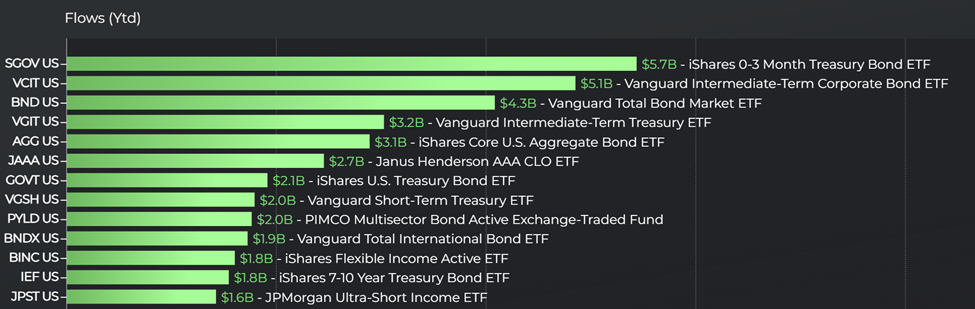
Nearly half of January’s fixed income ETF flows went into actively managed products, as investors sought professional expertise to navigate the pitfalls and potholes of volatility — and get more targeted exposure along both the credit and duration risk spectrum. Two standouts have been the PIMCO Multisector Bond Active ETF (PYLD) and the iShares Flexible Income Active ETF (BINC), both of which brought in roughly $2 billion in new money this year. In fact, PYLD’s haul marks 17% of the fund’s total $12 billion in assets, while BINC’s gain accounted for 10%.
Fixed Income ETF Flow Leaderboard
Source: VettaFi
Global Bonds in the Spotlight
For the first time in years, international bonds are mounting a major comeback, as investors look beyond U.S. borders for differentiated growth, higher real yields and a currency hedge. In several developed markets, inflation has cooled faster than in the U.S., leaving real yields comparatively attractive. Select emerging markets now offer some of the highest nominal yields in the global fixed income universe — with improving macro stability to boot.
It’s worth noting 64% of BINC’s bond allocation is in foreign bonds, while roughly a quarter of PYLD is weighted internationally. Meanwhile, the Vanguard Total International Bond ETF (BNDX) has attracted nearly $2 billion in inflows as investors look for broad-based global exposure. After years of domestic dominance, international bonds are no longer an afterthought.
The Intermediate “Sweet Spot”
Beyond short duration darlings like JPST, investors are moving deeper into the belly of the bond curve to lock in higher yields before money market rates slide further.
Intermediate bond ETFs — specifically those in the five- to 10-year range — have emerged as the preferred “sweet spot,” offering a mix of yield and price appreciation potential as central banks ease their grip. Funds like the iShares 7-10 Year Treasury Bond ETF (IEF), offer a “Goldilocks” scenario, reflecting investors’ current aversion to the long end. Both the Vanguard Intermediate-Term Corporate Bond ETF (VCIT) and the Vanguard Intermediate-Term Treasury ETF (VGIT) have seen significant inflows to the tune of $5 billion and $3 billion, respectively, marking asset growth of 7% -8% each.
The Rise of Structured Credit
With traditional spreads remaining historically tight, the search for yield has sparked a deluge into structured credit and securitized assets. Products like CLO ETFs are seeing sustained demand, providing diversified carry that was previously the sole domain of institutional giants. The Janus Henderson AAA CLO ETF (JAAA) has easily led the charge on the flows front for years, but the PGIM AAA CLO ETF (PAAA) has also gained solid traction in 2026.
Upcoming Exchange Conference: Lowdown on Bonds
If the current trends persist, the year of bonds may well be here to stay. We will be diving into all things fixed income at two separate panels at VettaFi’s upcoming Exchange Conference in Las Vegas next month. First, I will sit down with Tim Wickstrom from Reckoner Capital Management and Matt Roesler from Obra Capital on Monday, March 16, to discuss alpha-generating strategies in the fixed income landscape.
After that, I’ll be chatting with an expert panel of advisors — Eric Biegeleisen from 3EDGE Asset Management, Kevin Nicholson from Riverfront Investment Group and Jim Worden from The Wealth Consulting Group — to talk about how to how to allocate amid the uncertainties and position your fixed income sleeve to ride the momentum of 2026.
As we move further into 2026, the trend of “precision fixed income” is likely to accelerate. Investors are no longer content with broad-market exposure; they are seeking out specific credit ratings, target durations, and active expertise to navigate a landscape where the “risk-free rate” is no longer the only game in town.
For more news, information, and strategy, visit ETF Trends.
