Materials are often viewed as a sleepy, cyclical corner of the market, but the artificial intelligence (AI) buildout is adding vim and vigor to the sector. Along with a confluence of other factors like persistent inflation concerns, global supply chain recalibrations, as well as a buildout of physical infrastructure, materials ETFs offer investors ample opportunities in the second half of 2026.
Key Takeaways:
- The physical infrastructure required for AI data centers and power grid expansion is driving significant capital inflows into basic materials like copper, concrete, and structural steel.
- Broad materials ETFs offer liquid, inflation-hedged core market exposure, while sector-specific funds target critical technology inputs.
- Combining core broad-market funds with targeted critical mineral ETFs creates a strategic portfolio barbell that captures both industrial demand and supply chain innovation.
See More: A Moment for Materials: Why Targeted Investment Makes Sense
Macro Drivers Behind Materials
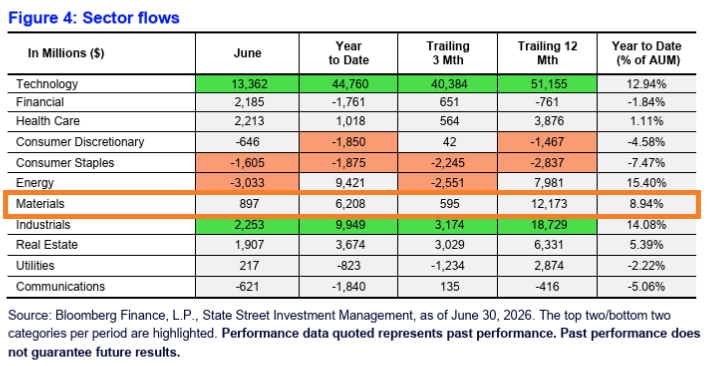
Sector tracking from State Street Global Advisors’ flash flows reveals that materials ETFs have captured the fourth-best sector inflows year-to-date, signaling that investor demand supports allocation to real assets. As noted, various overlapping macroeconomic forces are propelling basic materials beyond traditional cyclical boundaries.
 AI continues to dominate financial news headlines, but it needs the requisite hardware in order to run. As such, it requires physical infrastructure, immense data centers, and vast power grids. Building out these facilities demands copious amounts of concrete and structural steel, while upgrading power grids to fuel energy-hungry AI chips necessitating unprecedented volumes of copper.
Simultaneously, supply constraints, geopolitical friction in the Middle East, and rising extraction costs have elevated input prices across basic resources. Companies supplying primary inputs have inherent pricing power, allowing them to pass cost increases down the supply chain. Historically, physical assets and the companies that extract or process them have been effective hedges against broader price inflation. When consumer prices ultimately rise and fiat purchasing power dilutes, the revenues of basic material producers also have the potential to appreciate.
“Inflation does not start at the checkout counter,” said TMX VettaFi economic and market research analyst Jennifer Nash. “When rising extraction costs and supply constraints drive up producer prices, those wholesale increases inevitably push through the supply chain into consumer prices. Because basic materials are the original input for the entire economy, they directly absorb and reflect those cost pressures first.”

See More: Weekly Economic Snapshot: Inflation Spikes While Consumer Sentiment Breaks Its Decline
Key ETFs for Broad Materials Exposure
Investors looking for diversified, liquid access to the materials space can utilize several key ETFs with varying degrees of exposure. These include broad funds that cast a wide net into the materials equities universe as well as targeted niche plays.
For core domestic exposure, the State Street Materials Select Sector SPDR ETF (XLB) serves as the flagship fund in the sector with over $8 billion in assets. XLB, with its low 0.08% expense ratio, concentrates primarily on S&P 500 material giants to include chemical producers, industrial gas providers, and mining corporations. Investors looking for another low-cost core alternative can utilize the Vanguard Materials ETF (VAW), which provides comprehensive U.S. basic materials exposure across large-, mid-, and small-cap segments with a 0.09% expense ratio. For broader geographic reach and with an expense ratio of 38 basis points, the iShares U.S. Basic Materials ETF (IYM) targets domestic companies involved in chemicals, metals, forestry, and packaging to capture the U.S. supply chain supporting domestic infrastructure projects.
Weighing the Differences
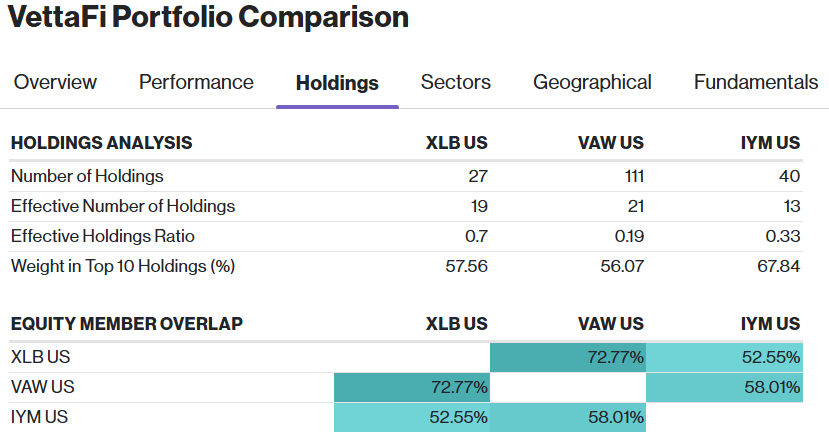
Among the three, VAW has the highest number of holdings with 111, whereas XLB has a smaller, higher-conviction portfolio of 27. Despite having the fewest total holdings, XLB maintains the highest effective holdings ratio (0.70), which signals a more evenly distributed allocation. VAW falls on the opposite end of that spectrum (0.19) and IYM is situated in the middle (0.33). Additionally, IYM exhibits the highest portfolio concentration, allocating 67.84% of its total weight to its top 10 holdings. In terms of portfolio similarities, XLB and VAW share the highest equity member overlap at 72.77%. Conversely, IYM shows lower overlap with both XLB (52.55%) and VAW (58.01%).
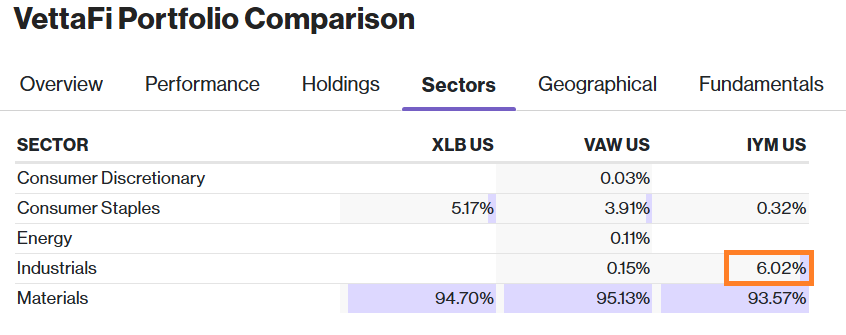
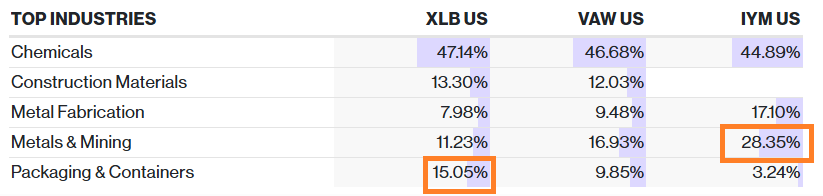
A closer look at the industry exposure among the three reveals key tilts. XLB leans toward packaging & containers (15.05%), VAW adds greater industrials exposure (6.02%), and IYM shifts significantly into metals & mining/natural resources (28.35%), while skipping construction materials entirely.
Outside of the aforementioned three, another fund to consider is the Fidelity MSCI Materials Index ETF (FMAT). This fund tracks the MSCI USA IMI Materials Index to offer broad domestic market coverage for long-term buy-and-hold portfolios at a cost-effective 0.08% expense ratio. Investors seeking international diversification can turn to the iShares Global Materials ETF (MXI), which looks beyond domestic borders to capture leading multinational resource and mining firms across both developed and emerging markets.
Granular and Differentiated Materials Exposure
Investors looking to move beyond broad ETFs for more targeted exposure can look into funds that focus on specific materials. For example, the Sprott Critical Materials ETF (SETM) offers a strategic play by focusing on companies producing critical and battery metals like copper, lithium, nickel, cobalt, and rare earth elements vital for modern technology and electric grid expansion.
Additionally, pure-play commodity equity funds offer direct sensitivity to physical infrastructure and industrial trends. For example, the VanEck Gold Miners ETF (GDX) provides focused exposure to gold mining companies as a traditional hedge against inflation, currency devaluation, and geopolitical uncertainty. To target the clean energy transition and technology infrastructure, the Global X Copper Miners ETF (COPX) focuses on copper miners that are vital producers for global electrification, power grid expansion, and AI data center buildouts. The iShares Global Timber & Forestry ETF (WOOD) accesses global timber suppliers and forest products companies tied to residential construction, packaging, and real estate. Likewise, the VanEck Steel ETF (SLX) delivers concentrated global exposure to steel producers driving major physical infrastructure projects and heavy industrial manufacturing.
Alternatively, investors can tailor core equity allocations through non-traditional investment or strategy models. Income seekers will appreciate the State Street Materials Select Sector SPDR Premium Income ETF (XLBI). The fund provides exposure to U.S. mega-cap materials leaders while overlaying a call-option strategy to generate enhanced derivative income. For differentiated materials exposure that goes beyond the typical market-cap weighted approach, the First Trust Materials AlphaDEX Fund (FXZ) deserves a look. By tracking the StrataQuant Materials Index, the fund employs a quantitative fundamental methodology that ranks and reweights materials stocks based on various metrics.
Integrating Materials ETFs Into Portfolios
Incorporating materials ETFs into a broader portfolio offers strategic advantages depending on market conditions and an investor’s goals. Allocating a modest portion to materials ETFs can cushion portfolios against unexpected inflationary price increases in today’s higher-for-longer inflationary regime. This materials exposure comes without the operational storage complications or friction of holding physical commodities directly.
Furthermore, investors who anticipate an uptick in global infrastructure spending, industrial reshoring, or persistent AI hardware demand can use broad funds like XLB or VAW. Moreover, combining positions with specialized critical material ETFs like SETM creates a structural barbell, allowing investors to participate in technological innovation while simultaneously owning the physical supply chains enabling its growth. As structural demand for physical resources intersects with persistent inflation, materials ETFs continue to offer an efficient way to build resilient, diversified portfolios.
For more news, information, and analysis visit, VettaFi | ETF Trends.