Market leadership within the tech momentum trade has shifted in the wake of the recent bloodbath. Over the past month, a sharp unwinding of crowded positions sent semiconductors into a steep correction from recent record highs. But instead of fleeing technology entirely, capital is rotating into cybersecurity, a far more resilient corner of the sector that accounted for six of the 12 best-performing ETFs over the past month.
Key Takeaways
- Cybersecurity funds represented six of the top 12 best-performing ETFs over the past month as investors rotated out of semiconductors.
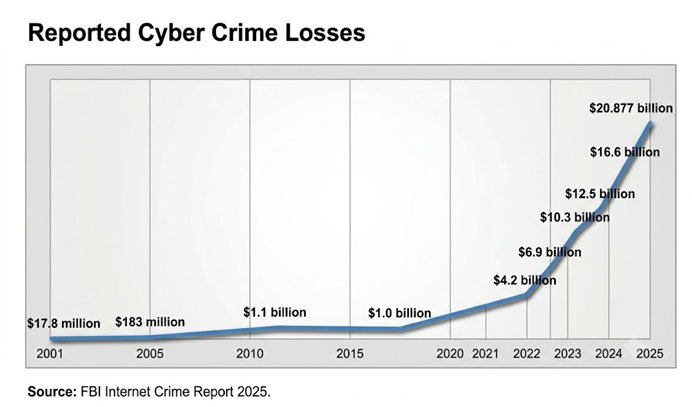
- Complaints to the FBI reach ~3,000 daily, driving $20 billion+ in annual losses and $10 million+ average U.S. breach costs.
- Top-performing WCBR surged 22% monthly and 41% year-to-date, outperforming broader software through cloud-native SaaS developer exposure.
Top-Performing ETFs (1-Month)
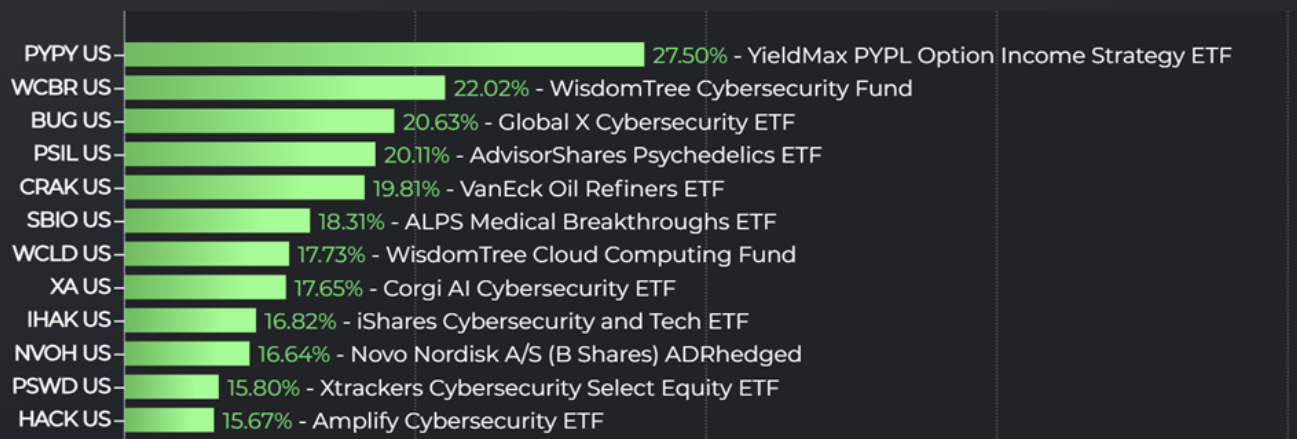
Source: VettaFi (as of July 17, 2026)
The sector combines a rare mix of structural growth and defensive resilience. Rather than relying on fickle capex spending cycles, cybersecurity is anchored by non-discretionary, mission-critical enterprise demand. Recent Morgan Stanley CIO surveys consistently rank security software among the last IT budget areas C-suite executives expect to cut during economic downturns.
The bull case is backed by staggering fundamental demand. The FBI’s Internet Crime Complaint Center now receives nearly 3,000 cybercrime complaints per day, with reported annual losses exceeding $20 billion. The average cost of a U.S. data breach has now climbed above $10 million, reinforcing cybersecurity as one of the few IT spending priorities companies simply cannot afford to defer.
According to a Goldman Sachs report released this week, “the Security category has shifted from being viewed as at risk from AI to being a clear beneficiary, with the consensus view being: more AI spend means more Security spend.”
As enterprises deploy AI models, autonomous agents and increasingly complex cloud environments, they must also invest in protecting them. At the same time, AI is making cyberattacks faster, more sophisticated and easier to scale, forcing organizations to expand security budgets beyond traditional IT infrastructure. Regardless of shifting AI hype cycles or broader macro uncertainty, the rise of agentic AI has made cybersecurity more mission-critical than ever.
Cybersecurity has consistently outperformed much of the broader software sector, led by names such as Palo Alto Networks, CrowdStrike and Fortinet. As a result, cybersecurity ETFs have acted as a defensive growth harbor for money pouring out of the semi space.
Cybersecurity ETFs: Bright Spots
Notably, cybersecurity has become one of the few bright spots within software. While much of the SaaS universe has struggled under multiple compression, major platforms continue to command premium valuations. Sticky, subscription-based models allow for ironclad earnings visibility, high switching costs and predictable cash flows — providing a much smoother ride for investors compared to volatile chipmakers.
For investors looking to capture this rotation, the category’s top-performing vehicles offer distinct structural exposures.
The WisdomTree Cybersecurity ETF (WCBR) has taken the top spot on performance leaderboards — up 22% over the past month and 41% year-to-date — thanks to its sharp focus on fast-growing, cloud-native security developers. The fund uses a proprietary score to identify emerging technology leaders rather than relying on legacy market-cap weighting. Because it heavily tilts toward hyper-growth SaaS platforms while eschewing mature hardware legacy firms, WCBR captures maximum upside when software multiples expand.
Investors can make more concentrated bets with the Global X Cybersecurity ETF (BUG), which is heavily tilted toward pureplay SaaS security. BUG requires companies to derive at least 50% of their revenue from core cybersecurity activities. It leans heavily into identity access management, Zero Trust architecture and endpoint security. With a tighter portfolio basket, BUG provides high-conviction exposure to industry giants like Palo Alto Networks, allowing it to capture rapid upside during targeted sector rallies.
As the pioneer fund in the space with roughly $3 billion in assets, the Amplify Cybersecurity ETF (HACK), offers a broader, more diversified mix of established prime contractors and emerging cyber software. HACK utilizes a modified equal-weighting methodology with a notable allocation to defense prime contractors, alongside infrastructure tech firms like Broadcom and Cisco — offering a smoother risk profile with less single-stock concentration risk as a result. HACK is up 40% so far this year on a total return basis.
Keep an Eye on Earnings
Capital isn’t abandoning technology — it is simply shifting from overextended chipmaker positions into cash-flow-backed software. Upcoming earnings reports from major cybersecurity players will serve as the next critical test. Strong results will validate this defensive-growth rotation and likely fuel the next leg of outperformance for cybersecurity ETFs.
For more news, information, and analysis, visit VettaFi | ETF Trends.