
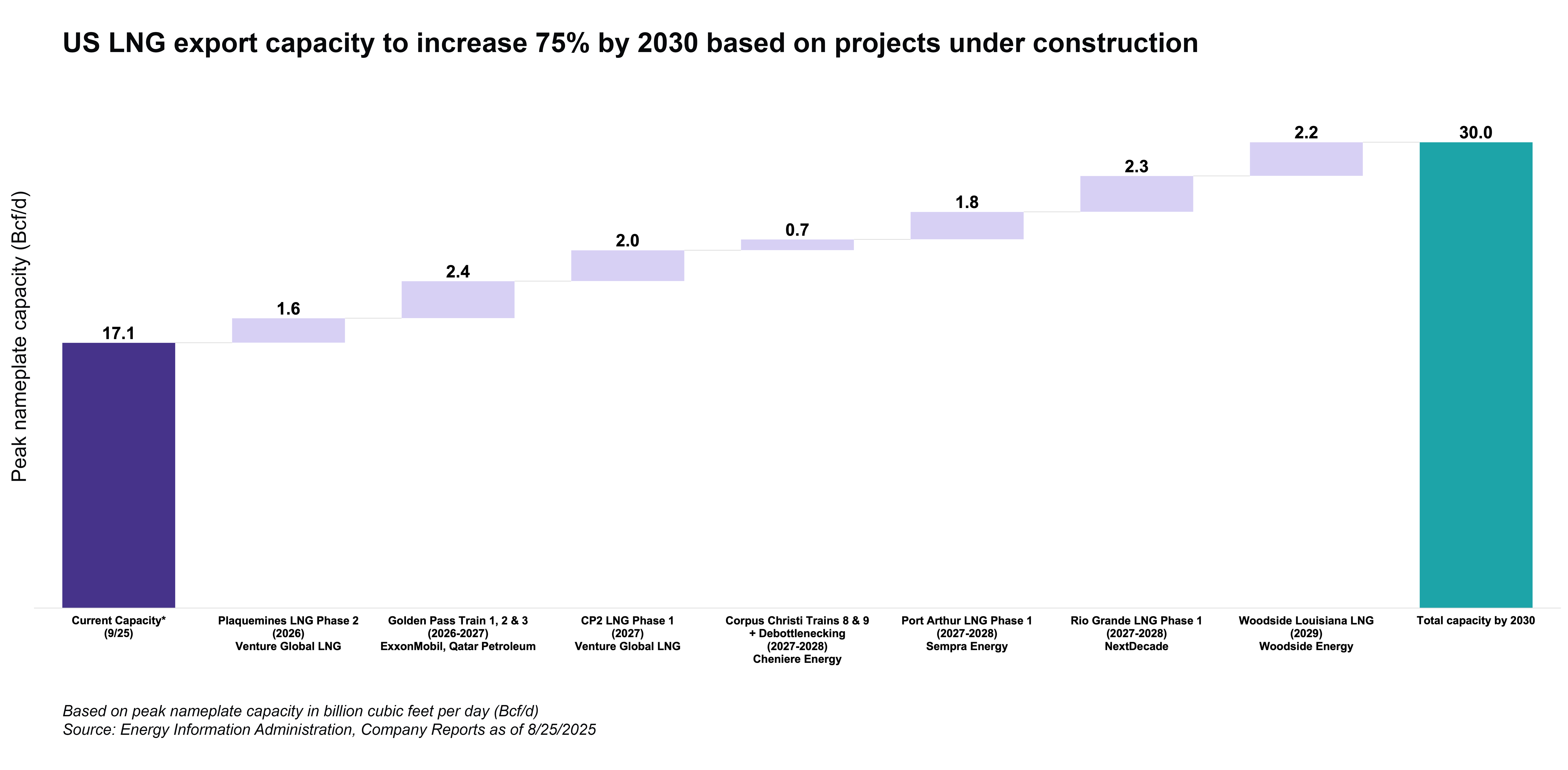
- A wave of sanctioned projects is set to expand U.S. LNG export capacity by 75% by 2030, driven by new final investment decisions (FIDs) from major players like Cheniere and Venture Global.
- Beyond current construction, a robust pipeline of U.S. LNG projects shows strong commercial momentum, indicating more FIDs are on the horizon this year.
- Growing LNG exports creates compelling opportunities for companies operating natural gas infrastructure.
The U.S. liquefied natural gas (LNG) industry has seen a noticeable pickup in activity in 2025. In recent months, there has been a steady stream of FIDs, representing the formal commitment by developers to begin construction. Even more projects are working toward FID this year. Today’s note provides an update on the latest wave of LNG export terminals getting the go-ahead, discusses projects expecting to reach FID this year, and explores how investors can gain exposure to this growth trend.
U.S. Leads the Global LNG Charge
The global LNG trade has seen explosive growth over the last several years, increasing by 80% between 2015 and 2023. This expansion occurred from a broad shift from coal, economic growth in Asia, and Europe’s need to replace Russian natural gas supplies. Looking ahead, a major wave of new liquefaction capacity is set to boost global LNG supply by 7% in 2026. The International Energy Agency (IEA) expects this to ease prices, paving the way for price-sensitive Asian demand to strongly rebound.
Already the world’s largest LNG exporter in 2023 and 2024, the U.S. is set to be a key driver of global supply growth in the coming years. After being largely flat in 2024, U.S. LNG exports surged by 21% in the first half of 2025, accounting for the vast majority of incremental global volumes. This was powered by the ramp-up of two new facilities, with a combined capacity of approximately 3 billion cubic feet per day (Bcf/d). Specifically, Venture Global’s (VG) Plaquemines LNG Phase 1 began commissioning in December 2024, followed by Cheniere Energy’s (LNG) Corpus Christi Stage 3 in February 2025.
With these two additions, total U.S. LNG peak nameplate export capacity is now over 17 Bcf/d. For context, the U.S. produced 118 Bcf/d of natural gas in June based on marketed production.
Recent FIDs Pave the Way for 75% U.S. Export Capacity Growth
The momentum in U.S. LNG export projects will continue. Since April 2025, three major projects have reached a positive FID with expected in-service dates between 2027 and 2029:
- Woodside Energy’s (WDS) Louisiana LNG Phase 1, with expected completion in 2029.
- Cheniere’s Corpus Christi Midscale Trains 8 & 9, with expected completion by 2028.
- VG’s CP2 LNG Phase 1, with expected completion in 2027.
As shown below, the seven projects under construction are set to increase U.S. LNG peak nameplate export capacity by 75% to 30 Bcf/d by 2030.
Further north, Canada is on its way to becoming a meaningful LNG exporter (read more), with advantageous proximity to growing Asian markets. The landmark LNG Canada project (1.8 Bcf/d) began service in June 2025, representing Canada’s first LNG export facility.
Other projects under construction in British Columbia include Woodfibre LNG (0.3 Bcf/d) and Cedar LNG (0.4 Bcf/d), with expected completion in 2027 and 2028, respectively. Combined, the projects are slated to increase Canada’s export capacity to 2.5 Bcf/d. Woodfibre is owned by Pacific Energy Corporation and Enbridge (ENB CN), while Cedar LNG is owned by the Haisla Nation and Pembina (PPL CN).
What’s Next in the U.S. LNG Project Pipeline?
Several U.S. LNG projects are targeting FID by the end of this year. As shown in the table below, these projects represent a combined 7.6 Bcf/d of capacity. If all proceed, U.S. LNG export capacity could be approaching 38 Bcf/d in the coming years.
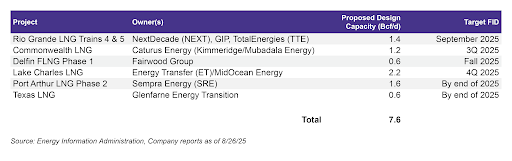
The commercial momentum for the largest pre-FID projects is accelerating, with a recent wave of major sales agreements pushing them closer to sanctioning.
- SRE’s Port Arthur LNG Phase 2 has secured around 1.0 Bcf/d in binding 20-year offtake agreements in recent months (EQT Corp, ConocoPhillips, JERA).
- NEXT has fully commercialized Train 4 at Rio Grande and is making significant progress on Train 5 (agreements with JERA, TotalEnergies, Aramco, and ADNOC).
- ET’s Lake Charles LNG gained significant commercial momentum in 2025, securing new agreements and expanding on existing ones (Chevron, Kyushu Electric Power). In April, ET announced an agreement with MidOcean Energy, which signed a nonbinding heads of agreement for 30% of LNG production and took a 30% equity stake in the project.
- Commonwealth LNG is now part of the new Caturus integrated platform, with major backing from Mubadala Energy.
Tracking the LNG Boom: Midstream Connects Wells to Export Terminals
LNG exports are expected to be the largest driver of incremental U.S. natural gas demand over the next few years. Increased demand is expected require more natural gas production, and infrastructure will be needed to get natural gas to the coast in usable form. Midstream or energy infrastructure companies have a large role to play here, including gathering natural gas, processing it, and transporting it to LNG facilities.
Some midstream companies are directly involved in LNG export projects, including ET, ENB, PPL, and KMI. Others are classified as liquefaction companies and primarily operate LNG facilities, including Cheniere, Cheniere Energy Partners (CQP), VG, and NEXT.
The Alerian Midstream Energy Select Index (AMEI) includes MLPs, as well as U.S. and Canadian midstream corporations. Approximately 70% of AMEI by weighting primarily focuses on natural gas infrastructure as of August 27. Liquefaction names LNG and NEXT had a combined weight of 6.1%.
The MLP-focused Alerian MLP Infrastructure Index (AMZI) was just over 50% weighted to companies primarily focused on natural gas. CQP is the lone liquefaction name in AMZI, with a weight of 4.4%.
The Alerian index suite also includes the Alerian Liquefied Natural Gas Index (ALNGX). ALNGX is a global index of companies that are materially involved in the LNG industry. It includes firms focused on liquefaction, carrier services, and regasification.
Bottom Line
U.S. LNG export growth should continue, with capacity projected to grow 75% by 2030 from already-sanctioned projects alone. Strong commercial momentum for a second wave of LNG projects, evidenced by a flurry of new sales agreements, points to more FIDs in 2H25. The growth trajectory for LNG exports creates compelling opportunities for North American energy infrastructure companies, which will play a critical role in connecting gas production with export facilities.
Register today for our 60-minute webcast, “Checking MLP/Midstream Fundamentals as 2026 Approaches” on Wednesday, September 3, at 2 p.m. ET. CE credit will be available.
Looking for midstream insights in your inbox? Subscribe here to keep a pulse on midstream investing through our weekly updates.
AMZI is the underlying index for the Alerian MLP ETF (AMLP) and the ETRACS Alerian MLP Infrastructure Index ETN Series B (MLPB). AMEI is the underlying index for the Alerian Energy Infrastructure ETF (ENFR) and the ALPS Alerian Energy Infrastructure Portfolio (ALEFX).
Related Research:
Canada Enters LNG Export Market as First Facility Prepares for Shipment
Cheniere Grows LNG Capacity, Updates Dividend Outlook
U.S. LNG Dealmaking Picks Up With Benefits for Midstream
vettafi.com is owned by VettaFi LLC (“VettaFi”). VettaFi is the index provider for AMLP, MLPB, ENFR, and ALEFX, for which it receives an index licensing fee. However, AMLP, MLPB, ENFR, and ALEFX are not issued, sponsored, endorsed, or sold by VettaFi. VettaFi has no obligation or liability in connection with the issuance, administration, marketing, or trading of AMLP, MLPB, ENFR, and ALEFX.
For more news information and analysis, visit the Energy Infrastructure Content Hub.
