
For over five years, Midstream MLPs and corporations have stood out for their robust free cash flow (FCF) generation, supporting reliable dividend growth and share buybacks. In 2026, midstream MLPs continue to generate among the highest FCF yields in the energy sector. Meanwhile, broad midstream C-Corps have seen FCF yields moderate as natural gas-focused names step up capital programs to capture historic growth in LNG and power infrastructure. Backed by healthy balance sheets across the space, this capital spend targets high-return investments that lock in attractive multi-year EBITDA growth. In turn, this strengthens long-term cash flow visibility and extends the runway for dividend growth.
Key Takeaways
- Midstream MLPs and corporations generate some of the highest free cash flow (FCF) yields in the energy sector and broader market. However, some natural gas-focused companies are increasing spending to capture growth opportunities.
- Fee-based contracts shield midstream companies from commodity price swings, giving them clear multi-year cash flow visibility.
- Strong balance sheets allow companies to largely self-fund the equity component of major growth projects while supporting steady dividend growth and opportunistic buybacks.
U.S. Energy Maintains a FCF Advantage, Particularly Among Midstream MLPs
For years, the energy sector has focused on capital discipline, free cash flow generation, and shareholder returns. In 2025, energy had the highest trailing 12-month FCF yield of any sector in the S&P 500, at 5.3%. Trailing FCF yields have since fallen for the sector amid strong year-to-date performance. However, this is a result of the TTM FCF yield being a lagging metric. Annual FCF per share for the broad Energy Select Sector Index (IXE) is expected to nearly double in 2026 according to Bloomberg consensus estimates. That’s a result of higher prices for oil, liquefied natural gas (LNG), natural gas liquids (NGLs), and refined products. Most of the energy sector generates robust FCF when oil prices are high. However, it sees more modest FCF when prices moderate.
As shown in the chart below, midstream MLPs, represented by the Alerian MLP Infrastructure Index (AMZI), have higher trailing FCF yields than the energy sector benchmark. Broad midstream, represented by the Alerian Midstream Energy Select Index (AMEI), roughly matches broader energy. AMZI holds solely midstream MLPs, while AMEI holds ~75% U.S. and Canadian midstream corporations and ~25% MLPs. Energy as a whole maintains a clear FCF advantage over the broader equity market.
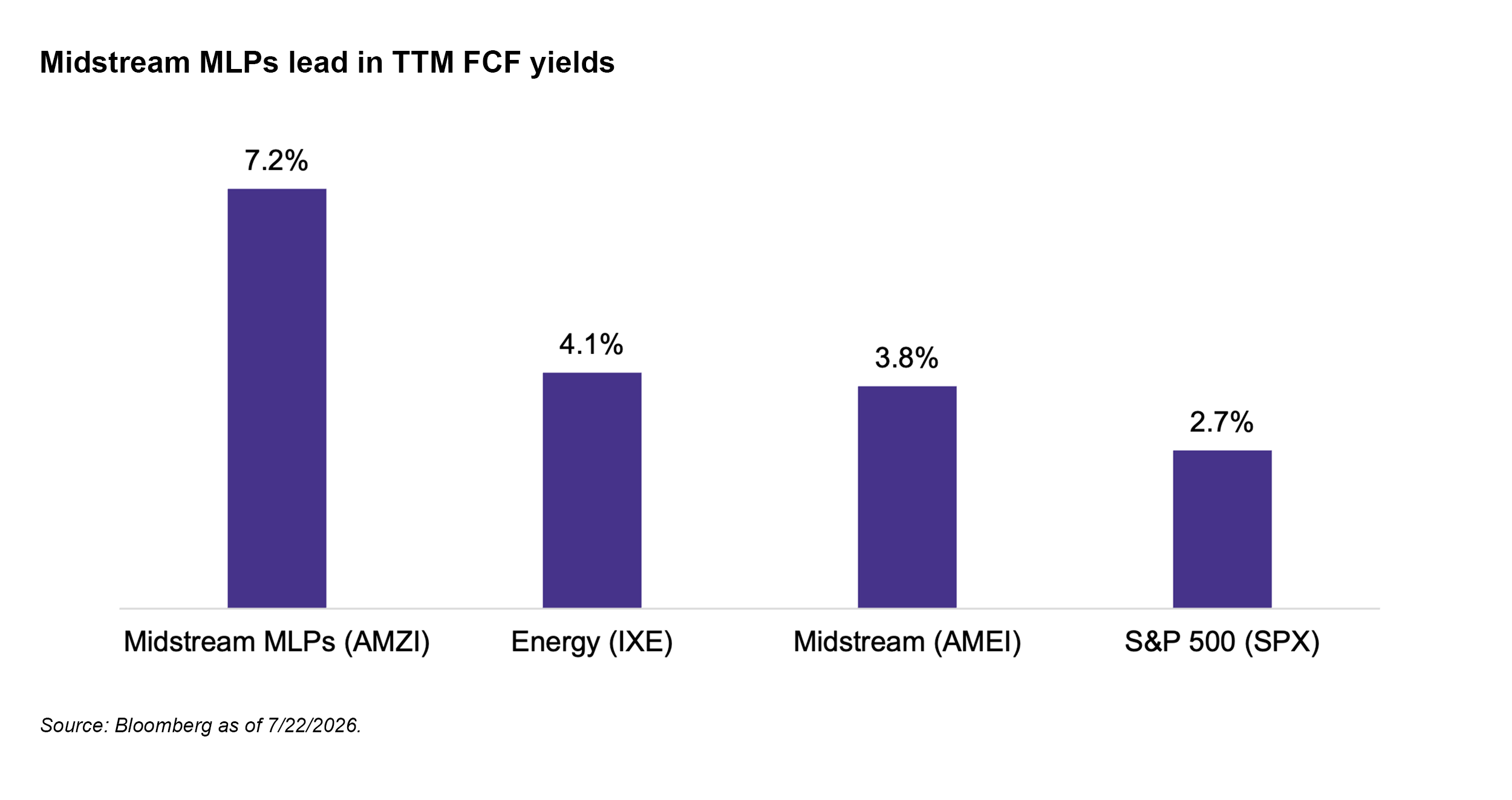
Midstream MLPs and corporations benefit from lower direct exposure to commodity price volatility. Thanks to fee-based business models anchored by long-term contracts, free cash flow generation is both durable and highly predictable. This stability allows midstream management teams to provide reliable year-ahead EBITDA guidance and multi-year growth visibility. That sets the sector apart from broader energy. Moving forward, an improved production outlook amid higher commodity prices should serve as an additional tailwind for midstream operators.
Midstream MLPs Diverge From Growth-Focused C-Corps
Digging deeper, the chart below shows FCF yields for some of the larger constituents of AMZI and AMEI using 2027 consensus estimates from Bloomberg. Consistent with the index-level TTM FCF yields, MLPs tend to have higher 2027 FCF yields than their C-Corp counterparts. This divergence partly reflects strong year-to-date performance for natural gas-focused C-Corps. It also reflects substantial capital spending on growth opportunities tied to liquefied natural gas (LNG) exports and power demand. Gas-related project backlogs collectively exceed $150 billion for these names, leading to significant reinvestment of operating cash flow into growth capital programs, compressing near-term FCF yields.
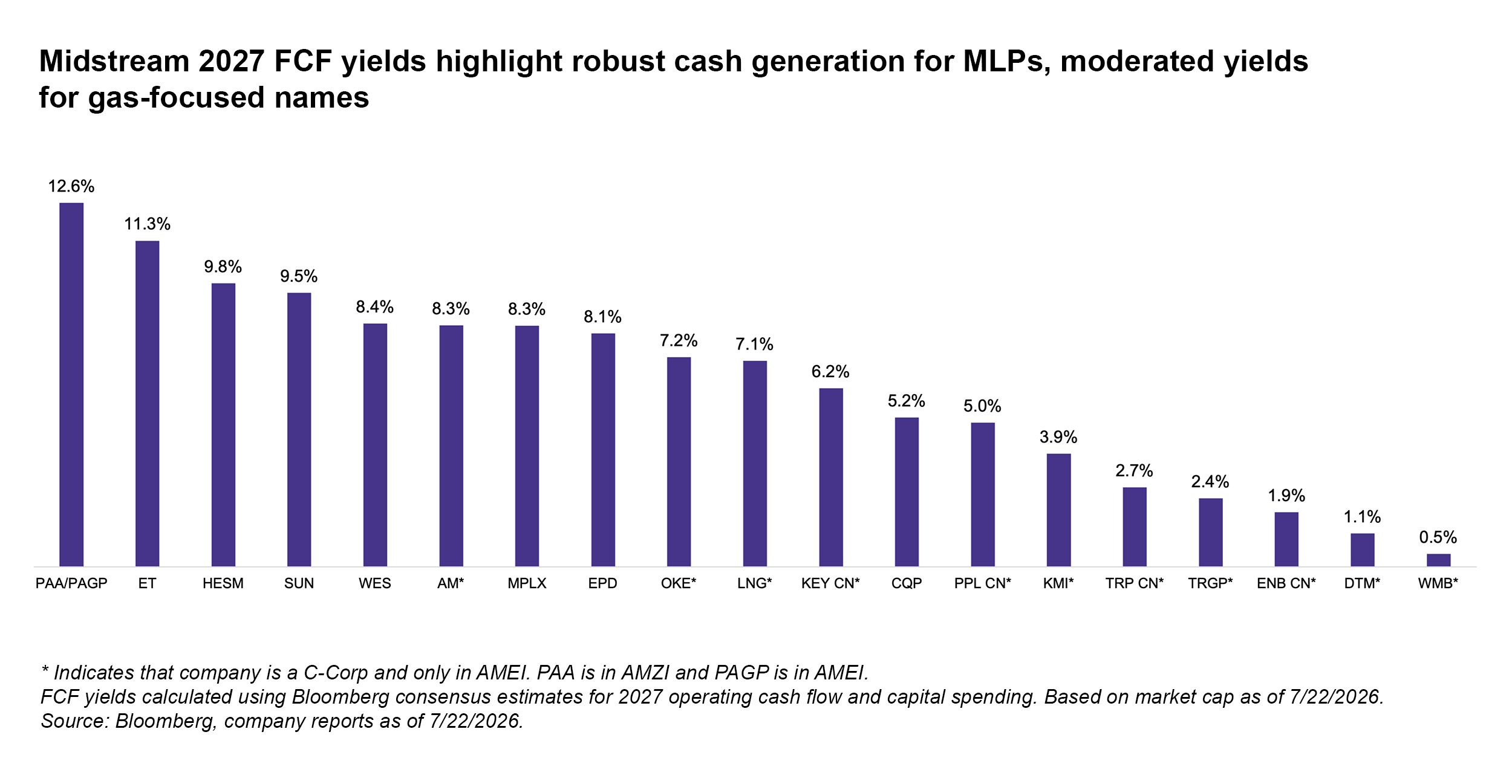
As can be seen above, midstream MLPs and select corporations are expected to deliver robust free cash flow in 2027. Crucially, the vast majority of midstream operators are equity self-funding (companies widely use debt, though leverage has come down over time). Thirteen of the 19 companies included in the chart are expected to have positive free cash flow after dividends. Four names are estimated to have more than $1 billion in excess cash after dividends, including Energy Transfer (ET), Enterprise Products Partners (EPD), Cheniere Energy (LNG), and ONEOK (OKE).
As mentioned earlier, natural gas-focused corporations are the notable exception to robust free cash flow generation across the space. Williams (WMB), Enbridge (ENB CN), TC Energy (TRP CN), Kinder Morgan (KMI), and DT Midstream (DTM) are heavily involved in natural gas pipeline projects serving LNG and power infrastructure, with WMB also expanding into direct power generation. While Pembina (PPL CN) has historically been more weighted towards liquids infrastructure, the company recently announced a C$4 billion joint-venture investment to build a power plant supporting a Meta data center. As seen below, capital spending has stepped up across these names this year. It is expected to remain elevated in 2027.
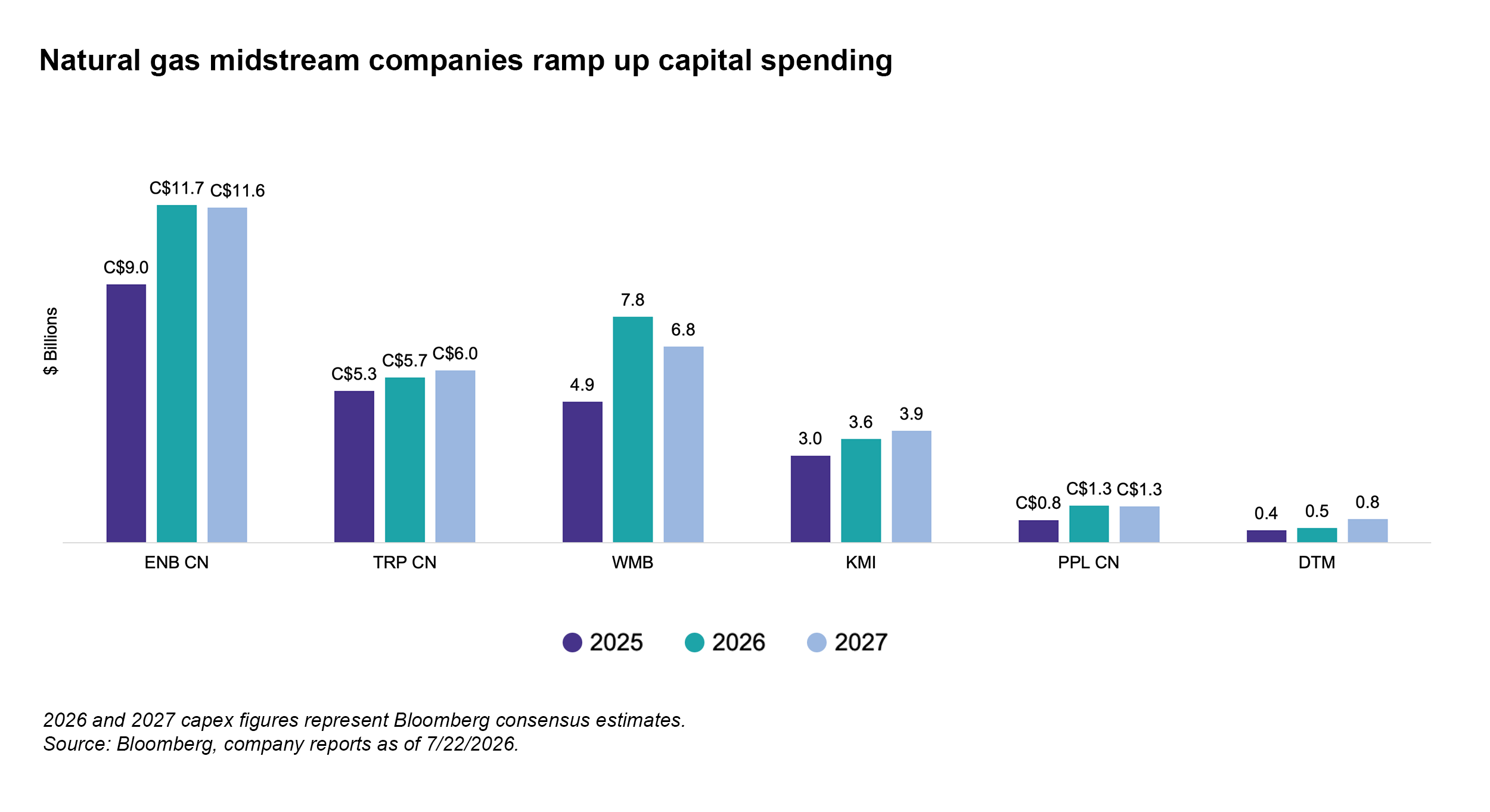 While these expanded capital programs lower near-term free cash flow, they are securing highly visible, fee-based revenue streams. As these projects come online, they translate directly into higher long-term EBITDA guidance and extend the runway for future dividend growth.
Why Do FCF and Capital Allocation Matter?
FCF enhances the overall financial flexibility of midstream MLPs and corporations. Even as select companies step up capital spending to pursue high-return growth projects, robust cash generation allows management teams to maintain strong balance sheets while retaining the flexibility to pay down debt or pursue targeted bolt-on acquisitions. Broad midstream FCF yields have moderated. However, MLPs continue to lead both broader energy and the equity market as a whole in FCF generation.
Midstream MLPs and corporations, including those investing significantly in natural gas infrastructure, have used excess cash to grow their dividends. Those dividends are also generous relative to the broader market and the energy sector. As of July 24, AMZI and AMEI were yielding 6.5% and 4.4%, respectively. The dividend yield for broader energy was 2.6%. While midstream companies tend to prioritize dividend growth, many have also deployed buybacks as a tool for returning excess cash to investors.
Looking for midstream insights in your inbox? Subscribe here to keep a pulse on midstream investing through our weekly updates.
AMZI is the underlying index for the Alerian MLP ETF (AMLP) and the ETRACS Alerian MLP Infrastructure Index ETN Series B (MLPB). AMEI is the underlying index for the Alerian Energy Infrastructure ETF (ENFR) and the Alerian Energy Infrastructure Portfolio (ALEFX).
Related Research:
U.S. Oil Production Outlook & Midstream Implications
2026 Midstream M&A: Deal Flow Slows
Midstream: Robust Gas Backlogs Drive Growth Visibility
1Q26 Midstream/MLP Buybacks: Steady Start to Year
1Q26 MLP/Midstream Dividends: Growth Trend Continues
2025 Midstream/MLP Leverage Ratios Signal Flexibility
vettafi.com is owned by VettaFi LLC (“VettaFi”). VettaFi is the index provider for AMLP, MLPB, ENFR, and ALEFX, for which it receives an index licensing fee. However, AMLP, MLPB, ENFR, and ALEFX are not issued, sponsored, endorsed or sold by VettaFi, and VettaFi has no obligation or liability in connection with the issuance, administration, marketing or trading of AMLP, MLPB, ENFR, and ALEFX.
For more news, information, and analysis, visit the Energy Infrastructure Content Hub
