
The Healthcare Technology and Innovation index (HTEC) was launched back in 2019 with a specific purpose in mind: to allow investors to participate in the evolution of healthcare needed to address critical societal challenges. Issues such as an aging population, rising medical costs, and a shortage of skilled healthcare workers drove the creation of the index back then, and they remain just as relevant today.
Key Takeaways:
- CRISPR Therapeutics, co-developer of the CASGEVY gene-editing cure for sickle cell disease and beta-thalassemia, was added to HTEC. The company brings an advanced pipeline of therapies targeting cardiovascular and autoimmune diseases.
- Insilico Medicine joins HTEC as its first pure-play AI drug discovery company, generating 6 to 8 preclinical candidates annually and projecting $1,287MM in FY 2026 revenue.
- Compass Pathways was added to the index following its final, large-scale trials for COMP360, a synthetic psilocybin treatment that provided three to six months of relief for treatment-resistant depression during clinical trials.
Evolving the HTEC Index Portfolio
In order to keep up with what is a fast-moving and complex sector, the team determined that companies should be selected based not only on their revenue purity within 9 strategic subsegments, but also on forward-looking, research-based factors. These include their technological and market leadership, as well as their ongoing levels of investment into their technology.
See more: Grail Inc. Early Cancer Detection News Boosts Healthcare Tech ETF HTEC
9 Key Subsegments Solving Critical Healthcare Challenges
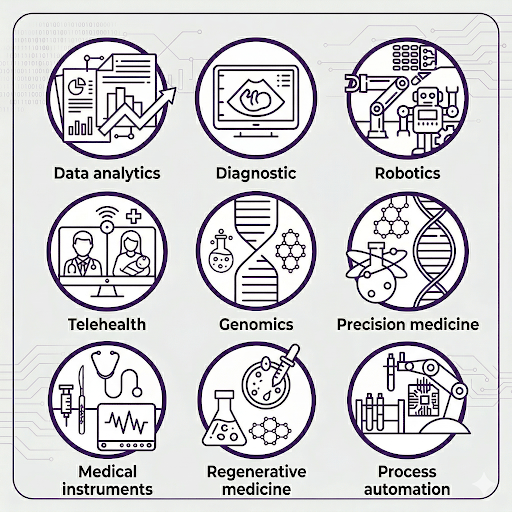
Furthermore, the index may add or remove companies every quarter to ensure the portfolio stays aligned with the latest technological advancements. Its integral part in this regular rebalance process was demonstrated on June 19, when three companies that we view as key to the future of healthcare were effectively added to HTEC: CRISPR Therapeutics (CRSP), Insilico Medicine (3696), and Compass Pathways (CMPS).
CRISPR Therapeutics: Gene-Editing Pioneers
CRISPR Therapeutics is a pioneer in gene-editing technologies. Together with another index constituent, Vertex (VRTX), the company developed CASGEVY, the only viable cure for sickle cell disease and beta-thalassemia.
The treatment extracts the patient’s own blood stem cells, edits their DNA, and then reintroduces them into the patient’s body. The CASGEVY market could expand significantly as its global launch approaches and the company seeks approval for pediatric use, which would allow patients to be treated at a much earlier stage of life.
Expanding the CRISPR Pipeline
The company is also working on other technologies, such as a small interfering RNA (siRNA) therapy to prevent blood clots, and a next-generation allogeneic off-the-shelf CAR-T cell therapy for autoimmune diseases like lupus.
Additionally, its pipeline includes two separate gene-editing therapies: one aiming to permanently lower triglycerides and LDL cholesterol, and another targeting Lp(a). Roughly one in five people globally have elevated levels of Lp(a), which is linked to an increased risk of heart attacks and strokes.
Insilico Medicine: Scaling AI Drug Discovery
This is the first pure-play AI drug discovery company added to the index. Its core business model focuses on generating drug candidates faster and more cost-effectively than traditional competitors, then partnering with pharmaceutical companies for clinical development.
Additionally, the company licenses its proprietary software to major drugmakers. This is a process that continuously generates data to refine and improve its underlying models.
Pioneering Generative AI Clinical Trials
Insilico was the first company to bring a drug candidate that was both discovered and designed entirely by generative AI into Phase II human clinical trials. Expanding its technological reach, the company recently introduced Science MMAI Gym, an infrastructure designed to train other frontier large language models (LLMs) to perform complex, domain-specific drug discovery tasks.
Currently, the company generates approximately 6 to 8 preclinical candidates (PCCs) per year. It expects to scale revenue generation in 2026 through partnerships originating from both its existing pipeline and new launches. FactSet estimates FY 2026 revenue at $1,287MM, compared to an estimated $440MM in FY 2025, while maintaining strong margins (>80%).
Compass Pathways: Redefining Mental Health Care
Its core business centers on developing COMP360, a proprietary synthetic psilocybin formulated for treatment-resistant depression (TRD). In final, large-scale human trials, this synthetic version of the psychedelic compound traditionally found in magic mushrooms demonstrated the ability to deliver rapid and durable relief for patients with TRD.
Currently, around 3 million patients in the US suffer from TRD, yet fewer than 5% are treated with medications developed specifically for the condition. Current alternatives entail either daily pills with significant side effects or 30+ clinic visits to receive treatment. The antidepressant benefits of a COMP360 treatment have been shown to last anywhere from three to six months after just one or two dosing sessions.
Regulatory Milestones for COMP360
Compass is on track to finalize its New Drug Application in the fourth quarter of this year. Following this, the company expects to benefit from a recent White House Executive Order directing the DEA to rapidly expedite the rescheduling of any psychedelic treatment that successfully completes Phase 3 trials. Furthermore, COMP360 has shown promising results in early trials for the treatment of PTSD.
Investing in Practical Healthcare Solutions
Ultimately, addressing the challenges in healthcare requires identifying the businesses building practical solutions. The HTEC index offers a way to follow these changes.
By using a methodology focused on the specific technologies and themes that will matter over the next decade, HTEC tracks companies working to make the healthcare system more efficient and effective.
Related Research:
Healthcare Exposure Focused on Big Pharma? You’re Missing Out
The Brain: From Black Box to Engineering Problem
The AI Revolution in Diagnostic Imaging
Looking for regular updates? Subscribe here for weekly insights on Healthcare Technology, AI, and Robotics, delivered straight to your inbox.
For more news, information, and strategy, visit the Disruptive Technology Content Hub.
HTEC is the underlying index for the Robo Global Healthcare Technology & Innovation ETF (HTEC) and the L&G Healthcare Technology & Innovation UCITS ETF (DOCT.LN).
VettaFi is the index provider for HTEC ETF and DOCT.LN, for which it receives an index licensing fee. However, HTEC ETF and DOCT.LN are not issued, sponsored, endorsed, or sold by VettaFi. VettaFi and its affiliates have no obligation or liability in connection with the issuance, administration, marketing, or trading of HTEC ETF and DOCT.LN.
