
Issuers are still driving forward with crypto launches, with around 30 new products already launched so far in 2026. Understandably, net flows across the broader asset class have been weak due to pressured spot prices. Despite the macro headwind, certain launches have still managed to find notable success. Two of the most compelling launches this year sit at near-opposite ends of the spectrum: a strategic new spot Bitcoin ETF and the birth of the Hyperliquid ETF category.
Spot Bitcoin Remains a Resilient Core Holding Despite Weaker Prices
At first, the thought of a 13th spot Bitcoin ETF seemed redundant, especially given the iShares Bitcoin Trust’s (IBIT) dominance with over $60 billion in assets. But the Morgan Stanley Bitcoin Trust (MSBT) is already proving that the market still has room. MSBT came to market in April as the first cryptocurrency ETF from a major U.S. bank-affiliated asset manager, giving investors spot Bitcoin exposure through a familiar structure. While the fund does what twelve other existing funds do, the true differentiator is who is behind it. Morgan Stanley brings a large wealth management footprint with around 16,000 advisors, a well-known brand, and a 0.14% expense ratio, which currently makes MSBT the lowest-cost spot Bitcoin product available.
See more: Morgan Stanley Enters Bitcoin World With Low-Cost ETF
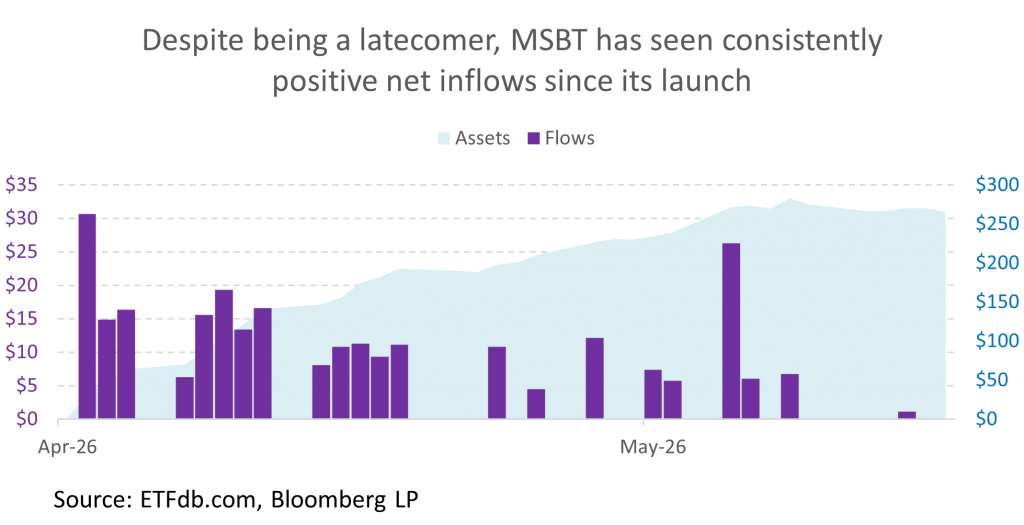
The early impact has been stronger than many may have expected from a late entrant. MSBT gathered roughly $34 million on its first day and reached about $265 million in total net assets by May 26. The fund has maintained an uninterrupted streak of recording zero net outflows since its inception. This proves that demand for spot Bitcoin ETFs is not limited to the original 2024 launch group. Although IBIT and the Fidelity Wise Origin Bitcoin Fund (FBTC) still dominate the category, they have both seen repeat days of outflows recently. MSBT’s early traction suggests that trusted traditional finance brands can still gather assets in an already crowded market — particularly as advisors and investors continue looking for lower-cost, regulated access to Bitcoin.
Hyperliquid: The Next Phase is Crypto Innovation
Hyperliquid (HYPE) ETFs are another one of the more interesting crypto ETF launches with a clear use case far different from Bitcoin’s store-of-value narrative. A high-performance blockchain optimized for onchain trading, Hyperliquid is best known for its decentralized perpetual futures exchange. In simpler terms, it gives users access to crypto derivatives trading without relying on a traditional centralized exchange. Bitwise noted that Hyperliquid generated $2.9 trillion in trading volume in 2025 and holds roughly 60% of global onchain derivatives open interest. Another interesting feature is that the majority of trading revenues (~95% or more) are used to buy back HYPE tokens on the open market, reducing supply and supporting the price. This setup makes HYPE perform more like an equity-like play on the growth of a functional crypto trading business, rather than a speculative asset.
The Dedicated HYPE Treasury: PURR
Another interesting layer to this ecosystem is Hyperliquid Strategies (PURR), a publicly traded stock on NASDAQ which acts as a digital asset treasury (DAT) company accumulating HYPE. This is similar to what Strategy (MSTR) does for Bitcoin. The presence of PURR demonstrates that structural institutional demand is already deep enough to support a dedicated corporate HYPE treasury.
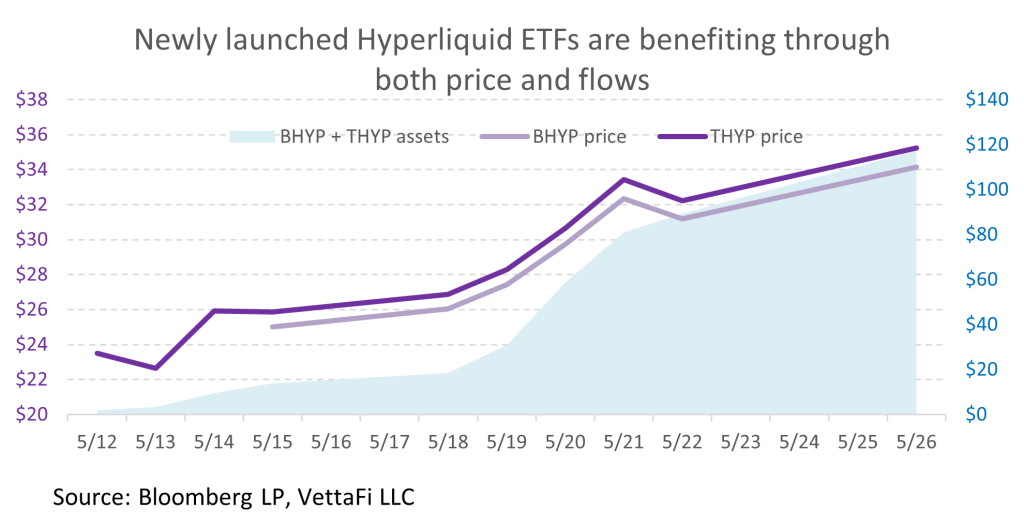
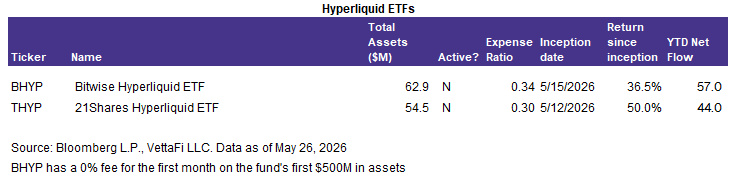
While PURR started trading in December 2025, ETF access is still very new but growing rapidly. The 21Shares Hyperliquid ETF (THYP) launched first on May 12 with a competitive 30 basis point expense ratio. THYP currently has about $55 million in assets. 21Shares also offers the 21Shares 2x Long HYPE ETF (TXXH), a leveraged product designed to deliver 2x the daily price performance of HYPE. Bitwise followed with the Bitwise Hyperliquid ETF (BHYP), which began trading on May 15 and differentiates itself through in-house staking and a 34 basis point expense ratio, which is waived for the first month on the first $500 million in assets. BHYP reached over $60 million in AUM, bringing total U.S.-listed HYPE ETF assets to roughly the $120 million range in a short period. This was partially due to strong net inflows (about $100 million for both) in addition to price appreciation. HYPE prices have been up around 40% over the past month. Grayscale has also filed for its own Hyperliquid ETF which could bring the number of funds up to three very soon.
Bottom Line:
Though Hyperliquid ETFs are still relatively small in terms of total AUM, they illustrate where the next phase of crypto asset innovation is heading. On the other hand, Bitcoin continues to solidify its status as a core, institutional portfolio holding, proving that even late-moving players see great strategic value in launching their own Bitcoin products.
For more news, information, and strategy, visit the Crypto Content Hub.
