
Before spot bitcoin ETFs launched (and even before futures bitcoin ETFs), crypto equity ETFs helped build early appetite for crypto. They were the first real taste of bitcoin that investors could get in their traditional brokerage accounts. This picks-and-shovels approach offered a simple way to get exposure to bitcoin — but it wasn’t direct ownership. And once spot bitcoin ETFs arrived, crypto equity ETFs moved out of the spotlight. Still, crypto equity ETFs have their own investment case — notably crypto miners, which are the backbone of the crypto industry. Here is what investors and advisors need to know before digging deep into crypto mining.
The Investment Case Behind Mining Equities Often Differs From the Underlying Asset
Crypto mining equities offer an alternative way to express a bitcoin view without owning bitcoin itself (just like gold mining does for gold). When bitcoin rises, well-run miners can see faster growth in revenue and margins. That’s because many operating costs (especially power) don’t move as quickly, creating operating leverage.
Unlike owning bitcoin, investors in miners are evaluating and performing due diligence on businesses. This due diligence includes evaluating electricity contracts, equipment refresh cycles, scale, balance sheet strength, and management discipline. Public miners publish production updates and file detailed reports, giving investors concrete metrics to track.
Many miners are also building complementary revenue streams, such as hosting and data center services, which can help stabilize results through the bitcoin cycle. Mining stocks, however, can be more volatile than bitcoin itself, and are highly sensitive to electricity prices and capital needs.
Mining Is a Focused Infrastructure Play vs. Broader Blockchain Themes
The mining story is more targeted than the broader blockchain theme. Mining revenue tends to move more directly with bitcoin prices, while broad blockchain exposures can depend on trading volumes, payment activity, or other timelines. Diversification in blockchain ETFs can be helpful — but if you want a strong, targeted assertion around the bitcoin cycle, miners offer a clearer linkage.
Most public miners are classified within the technology sector in the software and services industry. Broader blockchain may be more exposed to financials, in addition to Magnificent Seven megacap names. The trade-off with miners is higher cyclicality and sensitivity to power and capital costs. However, the connection to bitcoin is more direct — and easier to monitor — than most alternatives.


The Intersection of Mining & AI Grows Stronger
Crypto miners sit at a useful crossroads with AI: They already control inputs like power, land, and data center operations. Some are now using those assets to support AI and high-performance computing, alongside bitcoin mining, through long-term contracts. For example, Core Scientific Inc. (CORZ) signed a series of 12-year hosting contracts with CoreWeave (an AI Hyperscaler) and later signed a deal to be acquired by CoreWeave — turning mining campuses into AI infrastructure businesses. Iren Ltd (IREN) has been buying next-gen Nvidia GPUs, supported by dedicated financing, expanding its fleet to 10.9k GPUs for its AI cloud. And Riot Platforms (RIOT) highlights 1.0 GW of secured power and land at its Corsicana, Texas campus — positioning the site for high-density compute designs, including AI/HPC tenants. Overall, those with signed multi-year contracts and concrete GPU orders/deliveries have the potential to offer strong cash-flow opportunities.
Two Crypto Mining ETF Approaches
While there are many broad blockchain ETFs, there are only two crypto mining ETFs which vary significantly in their strategies.
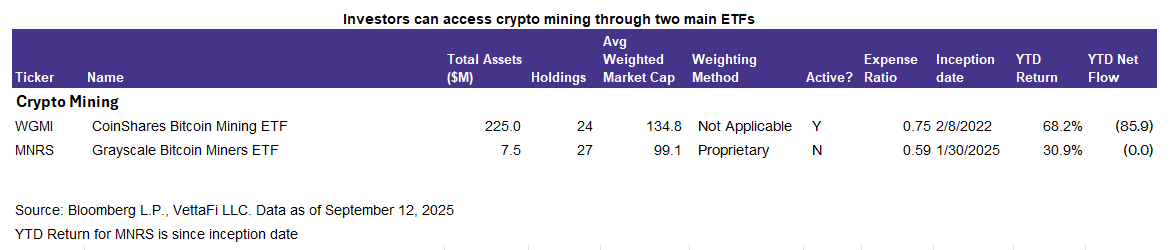
The CoinShares Bitcoin Mining ETF (WGMI) is the oldest and largest crypto mining ETF, with $200 million in assets. The ETF is actively managed. It invests at least 80% of its net assets in companies that derive 50% or more of their revenue or profits from bitcoin mining operations (or from providing specialized chips, hardware, software, and other services to miners). Because it is actively managed, it has more flexibility, not just in holdings, but also weightings.
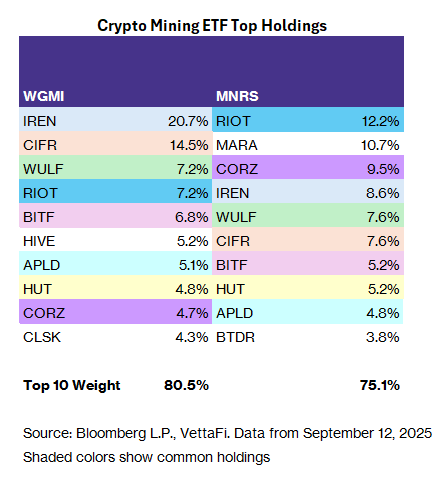
WGMI has allocated about 20% weight to IREN, which is up almost 250% year-to-date. The remaining top five include: Cipher Mining (CIFR), Terawulf (WULF), RIOT, and Bitfarms Ltd (BITF), which are all up double to triple digits YTD. As of September 12, WGMI was up 68% YTD (on a like-for-like basis, up 66% vs. 31% from the January 30 inception date of MNRS). The tradeoff is that WGMI has a slightly higher fee than MNRS (75 basis points vs. 59 basis points).
The Grayscale Bitcoin Miners ETF (MNRS) launched in January of this year and currently sits at around $7 million in assets. MNRS is passively managed and rules-based, tracking the Indxx Bitcoin Miners Index. The index prioritizes companies that generate at least 50% of revenue from Bitcoin mining. These are weighted based on free float market capitalization, with a single security cap of 15% applied to any pure-play stocks. The total weight of non-pure play companies is limited to only 15%. This keeps the index (and ETF) from becoming too over-concentrated, while maintaining a fair representation of the crypto mining industry.
Its top five names are almost 50% of the ETF’s weight, led by RIOT, Mara Holdings (MARA), CORZ, IREN, and WULF. It holds only one financials name — Block Inc (XYZ) — and one consumer discretionary name — Cango Inc (CANG). The rest are tech names, including a couple of semiconductors: Nvidia (NVDA) and Intel (INTC). But because Nvidia and Intel are not pure-play names, they weigh only 2.3% and 2.1%, respectively. That helps keep the target on pure-play miners.
Like CoinShares, Grayscale is a trusted name in the crypto ETF industry. Grayscale played the most significant role in advocating for spot bitcoin ETF approval. It continues to launch relevant products in the space.
Other Crypto Mining ETFs
Notably, some other crypto mining ETFs have closed in the first half of 2023: the Viridi Bitcoin Miners ETF (RIGZ) and the VanEck Digital Assets Mining ETF (DAM).
Blockchain ETFs can also provide significant exposure to crypto mining companies despite having a broader focus. For instance, top holdings of the iShares Blockchain and Tech ETF (IBLC) are all miners, except for Coinbase (COIN) and Galaxy Digital (GLXY). The Global X Blockchain ETF (BKCH) similarly focuses heavily on miners, despite targeting a wider exposure.
One advantage of broader blockchain ETFs is flexibility. Many currently hold a large share of crypto miners. However, they can readily add other company types as they come to market. Because the industry is evolving, I expect new companies to emerge over the next few years.
Bottom Line
Crypto mining equities offer a focused, measurable way to express a bitcoin view within a traditional portfolio, with clear operating metrics and public disclosures. For diversified access, miner-focused ETFs like WGMI (active) and MNRS (indexed) provide two distinct options.
For more news, information, and strategy, visit the Crypto Content Hub.
