Wednesday, July 23 came and went with another spate of earnings to report. While the still-hot theme of artificial intelligence (AI) living through big tech earnings may grab headlines, the communications sector specifically may also speak to investors. If so, it’s time for them to listen to communications-focused ETFs.
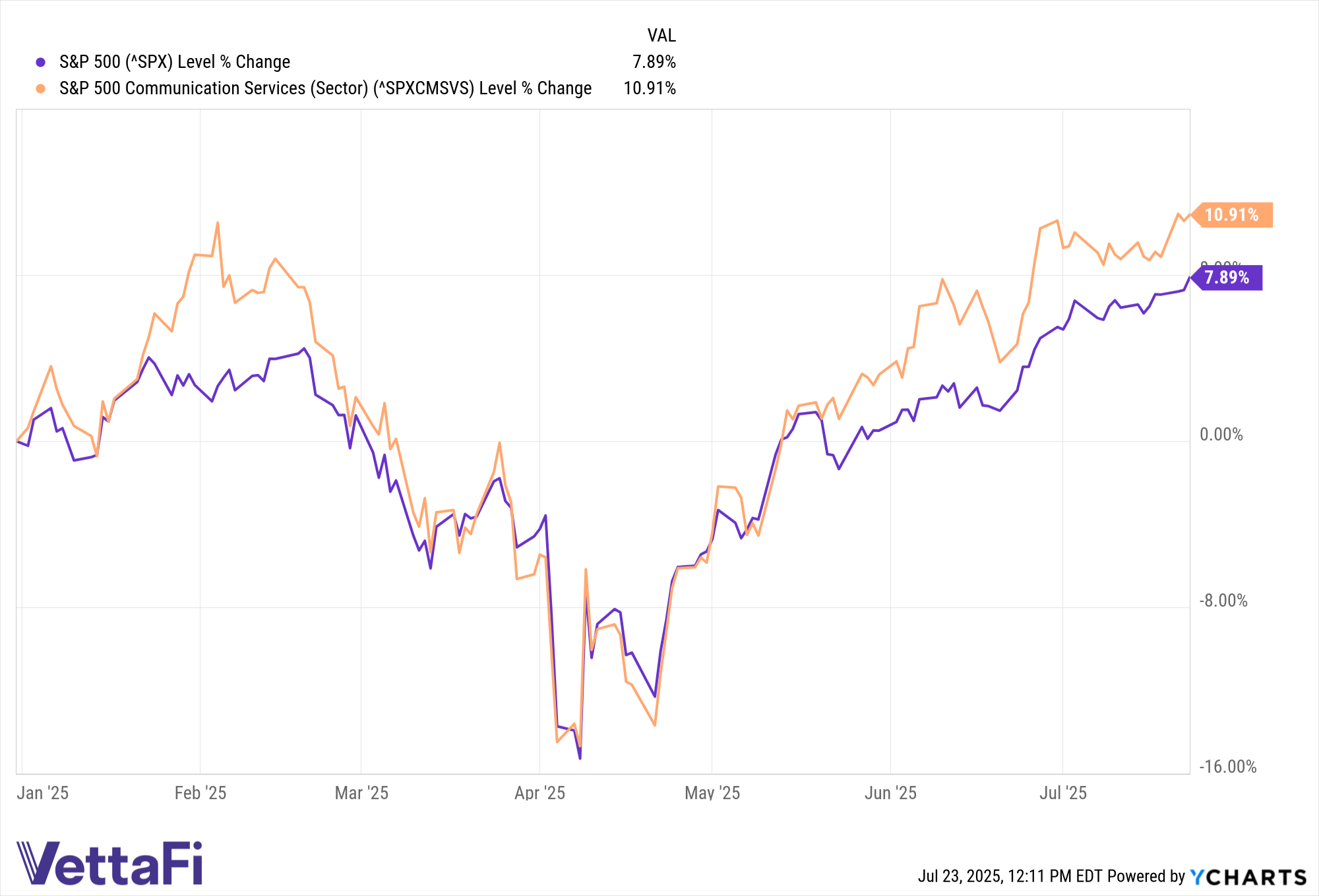
In terms of the sector as a whole, looking at the S&P comparative indexes show the communications sector outperforming the broad S&P 500. Even ahead of April’s tariff-fueled sell-off, the sector was outperforming the broader index. And now, it continues to do so, recovering on the back of big tech names like Google (GOOG) and Meta (META).
Comm Earnings Get Loud
Some notable names tied to the comm sector that reported earnings on Wednesday included Google, AT&T (T), and T-Mobile (TMUS). As the largest name of the trio in terms of market cap, Google certainly made sure it was known. The online search giant beat Wall Street expectations, notching $96.4 billion in revenue (versus $94 billion expected) and an earnings per share of $2.31 (versus an estimated $2.18 EPS).
“We had a standout quarter, with robust growth across the company. We are leading at the frontier of AI and shipping at an incredible pace. AI is positively impacting every part of the business, driving strong momentum. Search delivered double-digit revenue growth, and our new features, like AI Overviews and AI Mode, are performing well,” Alphabet CEO Sundar Pichai said.
AT&T beat its Q2 estimates, seeing its revenue rise by 3.5% to $30.8 billion. It also added 401,000 postpaid wireless phone customers in Q2, handily beating estimates of 302,000.
“We are winning in a highly competitive marketplace, with the nation’s largest wireless and fiber networks. Customers are increasingly choosing AT&T because we have the best technology and options for wireless and broadband connectivity, backed by the AT&T Guarantee,” said John Stankey, AT&T Chairman and CEO.
T-Mobile’s current slogan is “Get thanked,” and investors can do plenty of thanking after its Q2 results. The company also bested estimates, garnering postpaid net customer additions of 1.7 million. Service revenue and postpaid service revenue grew by $17.4 billion and $14.1 billion, respectively.
“T-Mobile crushed our own growth records with the best-ever total postpaid and postpaid phone nets in a Q2 in our history,” said Mike Sievert, CEO of T-Mobile.
All three names find themselves, in part, through six funds that investors may want to keep on their watch lists.
6 Comm Funds to Ponder
Google is the obvious heavy hitter amongst the three companies that will sway a number of ETFs, but communication-specific ETFs with the largest allocations of the stock are Fidelity MSCI Communications Services Index ETF (FCOM), iShares Global Comm Services ETF (IXP), and Vanguard Communication Services Index Fund ETF (VOX). Of the trio, FCOM will have the highest weighting (as of July 23), with 10.27% per ETF Database. Equally as heavy with a 10.17% weighting is IXP. Meanwhile, VOX carries a 9.73% weighting.
T-Mobile finds its heaviest allocations in the iShares US Telecommunications ETF (IYZ), Communication Services Select Sector SPDR Fund (XLC), and the Invesco S&P 500 Equal Weight Communication Services ETF (RSPC). AT&T’s heaviest allocations appear in IYZ, VOX, and XLC.
Here’s a snapshot of how the funds stack up:
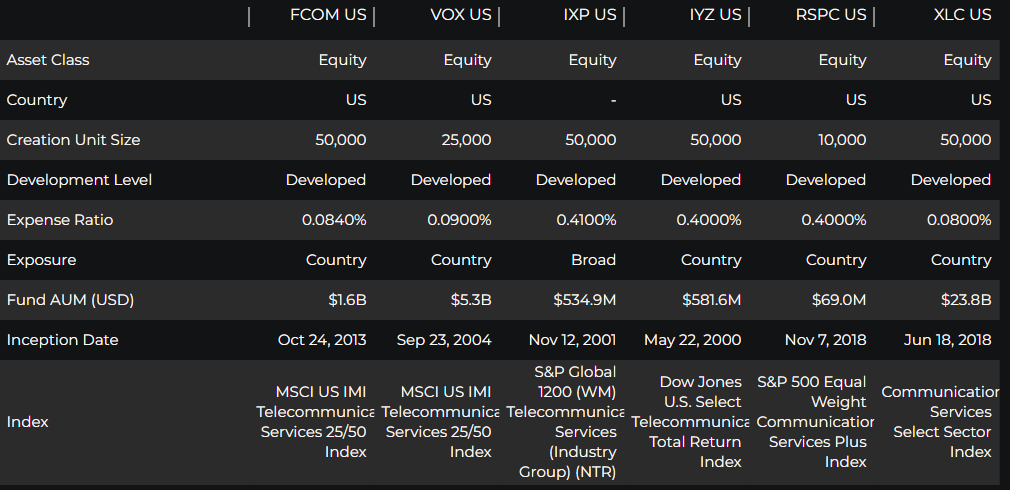
In terms of assets under management (AUM), XLC is the biggest. It won’t be much of a surprise given BlackRock’s market presence in the ETF provider industry. The same goes for Vanguard with VOX as the second largest fund and FCOM rounding out the top three.
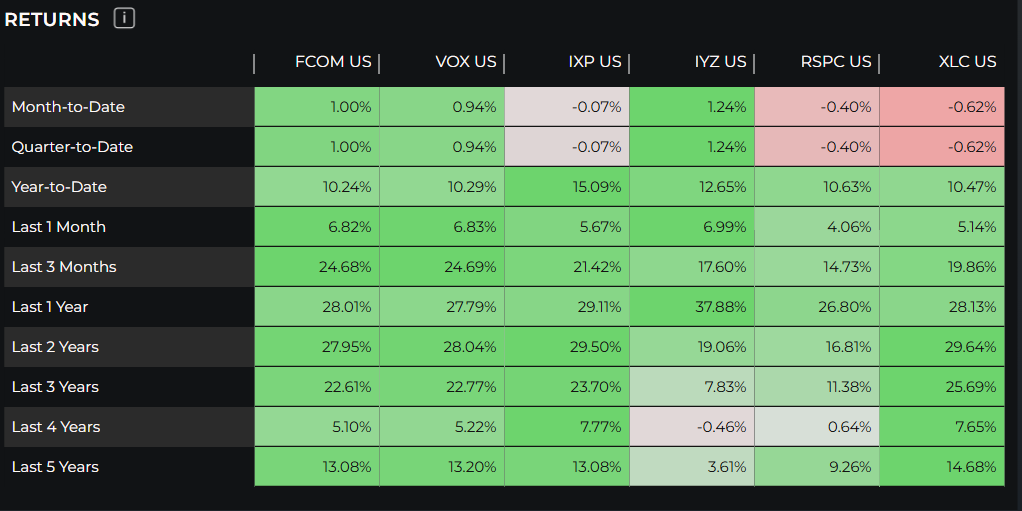
Five of those six funds offer investors exposure to communications companies within the U.S. Therefore, those with a home bias can look to that quintet. IXP makes for an interesting play for investors seeking comm sector exposure outside of the U.S. Investors will have to pay more for IXP to get that global exposure with its 0.41% expense ratio, but based on year-to-date performance alone, as indicated below, it’s been the best of the six. The fund is ideal for those looking for tailored comm exposure outside of the U.S., but for those looking for cost-effective ingress into the sector in the U.S., then XLC, VOX, and FCOM will be ideal with their lower expense ratios.
An Equally Weighted Option
An intriguing option to consider in the comm ETF space is RSPC. The aforementioned funds were heavy with Google stock, but some investors may want to avoid the concentration risk. Hence, an equally weighted fund.
As its fund name explicitly says, RSPC tracks the S&P 500 Equal Weight Communication Services Plus Index. As of July 22, the fund has 27 holdings, but assets are equally allocated across those constituents. An equally weighted fund may not capture the stronger upside of a single or group of stocks that might be outperforming, but it also protects against the downside when those same names falter. As such, an equally weighted fund may suit the more risk averse.
For more news, information, and analysis, visit VettaFi | ETF Trends.
