
What You’ll Learn
In this article, you’ll discover why crypto index ETFs are changing the way financial advisors offer digital asset exposure. We’ll cover how these ETFs work, the differences between spot, futures, and thematic products, and why regulated, exchange-traded access to crypto is a game-changer for portfolio diversification, compliance, and client demand.
A crypto exchange-traded fund (ETF) is a regulated investment product that tracks the price of a digital asset—such as Bitcoin or Ethereum—and trades on traditional U.S. stock exchanges.
Although these are widely referred to as “ETFs,” it’s important to note that U.S. spot Bitcoin and Ether products are not structured under the Investment Company Act of 1940. Instead, they are 33 Act commodities-based trusts, meaning they do not carry certain protections and structures typical of traditional ETFs (e.g., independent boards, diversified holdings, etc.).
Still, they meet the operational and custodial standards required to be listed on exchanges like NYSE Arca or Nasdaq.
How did we get here?
- Pre-2024: Crypto access was fragmented. Retail investors could use crypto exchanges like Coinbase or Kraken, but custody, tax reporting, and regulatory clarity were inconsistent.
- GBTC: The Grayscale Bitcoin Trust was the most accessible option via traditional finance, but it operated as a closed-end fund, often trading at a premium or discount and subject to liquidity constraints.
- Futures ETFs: In 2021, the SEC approved Bitcoin futures ETFs (e.g., BITO), offering regulated access—but not to the spot market.
- 2024 Breakthrough: The SEC approved 11 spot Bitcoin ETFs in January 2024. Products from BlackRock, Fidelity, and others immediately drew over $2B in inflows in their first three days, confirming strong pent-up demand. Spot Ether ETFs followed mid-year.
How do crypto ETFs work?
Like any commodity-backed ETF:
- A custodian (typically a regulated crypto firm) securely holds the underlying asset—Bitcoin or Ether—in cold storage.
- Authorized participants (APs) create or redeem shares to keep ETF prices aligned with the underlying asset.
- Shares are traded on U.S. exchanges during normal market hours.
- The structure allows crypto to be held in brokerage accounts, IRAs, and tax-advantaged plans, making it accessible to a broad range of clients.
This process removes the need for direct wallet management or exchange use while still delivering spot price exposure.
Types of crypto ETFs available today
- Spot ETFs: Physically backed by Bitcoin or Ethereum. Reflect real-time market price.
- Futures ETFs: Use CME-regulated futures contracts. Indirect exposure; subject to roll costs and tracking error.
- Thematic/Equity ETFs: Track crypto-adjacent equities (miners, exchanges, blockchain tech).
Spot ETFs are the most direct and efficient way to gain price exposure, now with the regulatory wrapper that financial advisors prefer.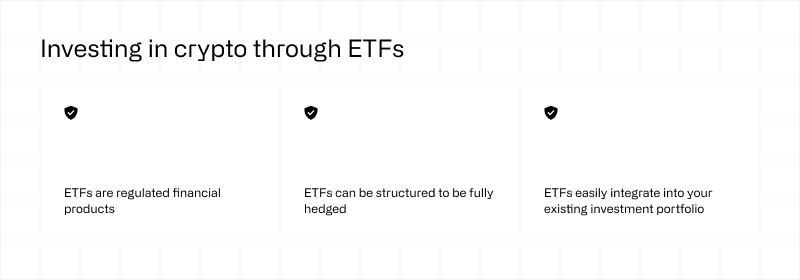
A significant success since launch
Since their authorization by the SEC, spot crypto ETFs have been a major success, with record-breaking inflows—most notably into BlackRock’s spot Bitcoin ETF, which has outpaced the world’s largest gold fund.
As of May 13, 2025, these digital asset investment products have attracted over $40 billion in net inflows, underscoring the strong demand for this asset class and the appeal of gaining exposure through secure and liquid vehicles.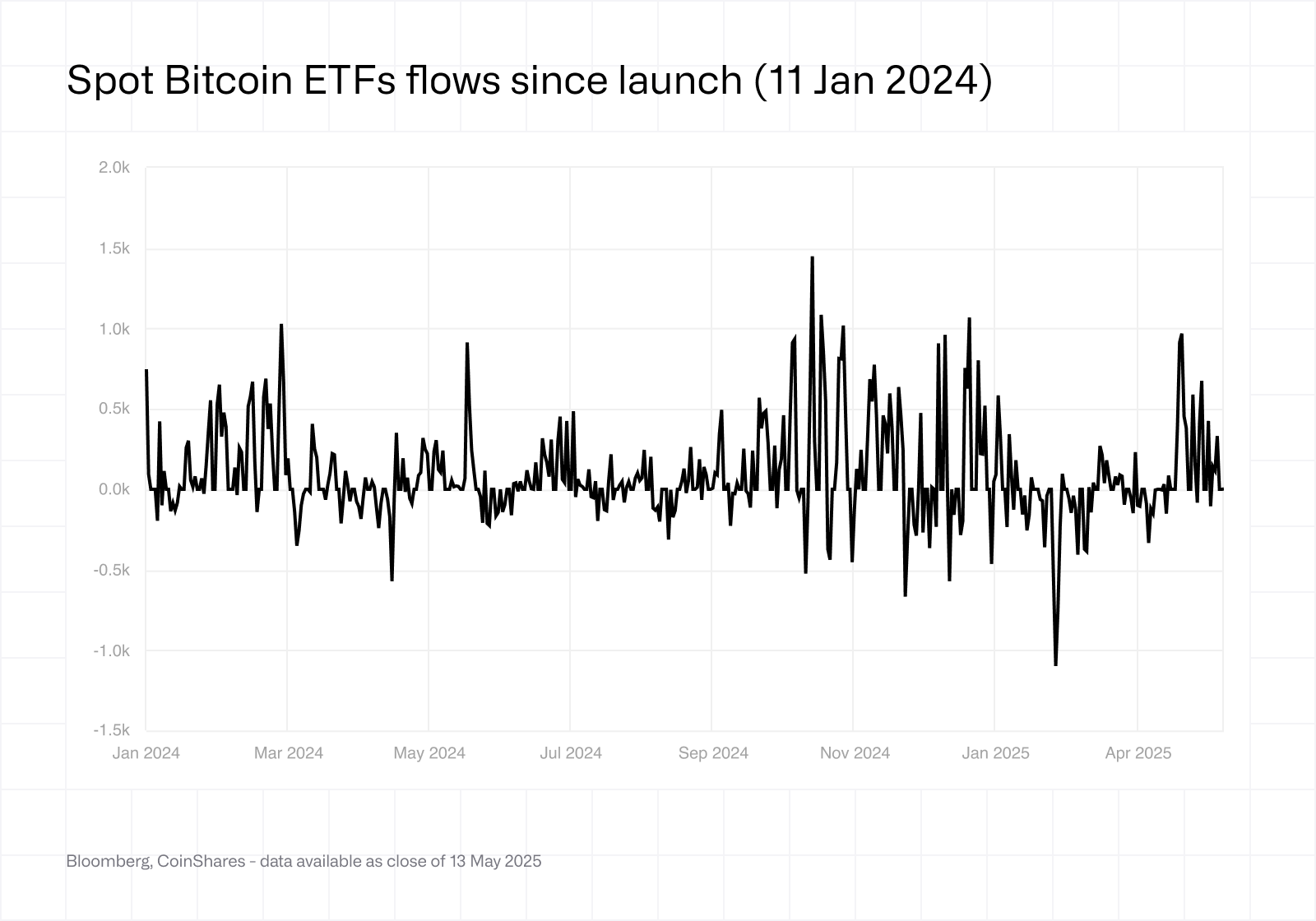
Benefits vs. risks: what clients should know
Benefits
- Regulated: Offers compliance confidence in line with client suitability rules.
- Simple: Integrated with standard custodians and portfolio management tools.
- Cost-effective: Fees as low as 0.25%—competitive with traditional index funds.
- Diversifiable: Low correlation to equities and bonds over the long term.
Risks
- Volatility: Crypto remains volatile and sensitive to macro and regulatory shifts.
- Limited trading hours: ETFs trade only during market hours, unlike 24/7 crypto markets.
- Tracking discrepancies: Especially for futures-based ETFs.
Integrating crypto ETFs into portfolios
Crypto ETFs are not a replacement for core portfolio components—but they can complement them as:
- A non-correlated asset that may hedge against monetary debasement.
- A growth sleeve tied to digital adoption themes.
- A small allocation in alternative or satellite positions.
Why This Matters for Advisors
As macro factors like inflation, monetary tightening, and fiscal uncertainty reshape asset allocation discussions, crypto—particularly Bitcoin—is increasingly seen as a strategic complement, not a speculative fringe.
The approval of spot Bitcoin and Ether ETFs in the U.S. has changed the conversation from “if” to “how”. Clients no longer need to open new accounts or use unregulated platforms. Advisors now have institutional-grade tools to access this asset class—regulated, reportable, and compatible with long-term wealth planning.
