
What You’ll Learn:
This article explains how and why companies—both public and private—are adding Bitcoin to their balance sheets. You’ll learn what’s driving adoption among major corporations, how small and midsize enterprises (SMEs) are approaching Bitcoin treasury strategies, and why ETFs offer a simple, regulated path to exposure. It also outlines key risks, like volatility, and how advisors can help clients evaluate Bitcoin as part of a broader financial or treasury strategy.
Originally conceived as a medium of exchange, Bitcoin has evolved into a multi-dimensional asset within the global financial system. One of its most compelling emerging roles is as a corporate treasury reserve. While still early in its adoption curve, the trend is accelerating. As of April 28, 2025, 93 publicly listed companies hold a combined 746,302 BTC—valued at over $70.8 billion—on their balance sheets, according to Bitcoin Treasuries. An additional 25 private firms hold an additional 285,992 BTC, worth $27 billion. River Financial further estimates that businesses now hold at least 3.3% of Bitcoin’s circulating supply. These are not marginal figures—they reflect a structural shift in capital allocation strategy.
As Bitcoin continues to gain traction as a treasury asset, financial advisors would do well to understand the drivers behind this movement: inflation hedging, liquidity, technological alignment, and the quest for non-sovereign store-of-value assets in an era of macro instability.
Bitcoin: already an asset for public companies
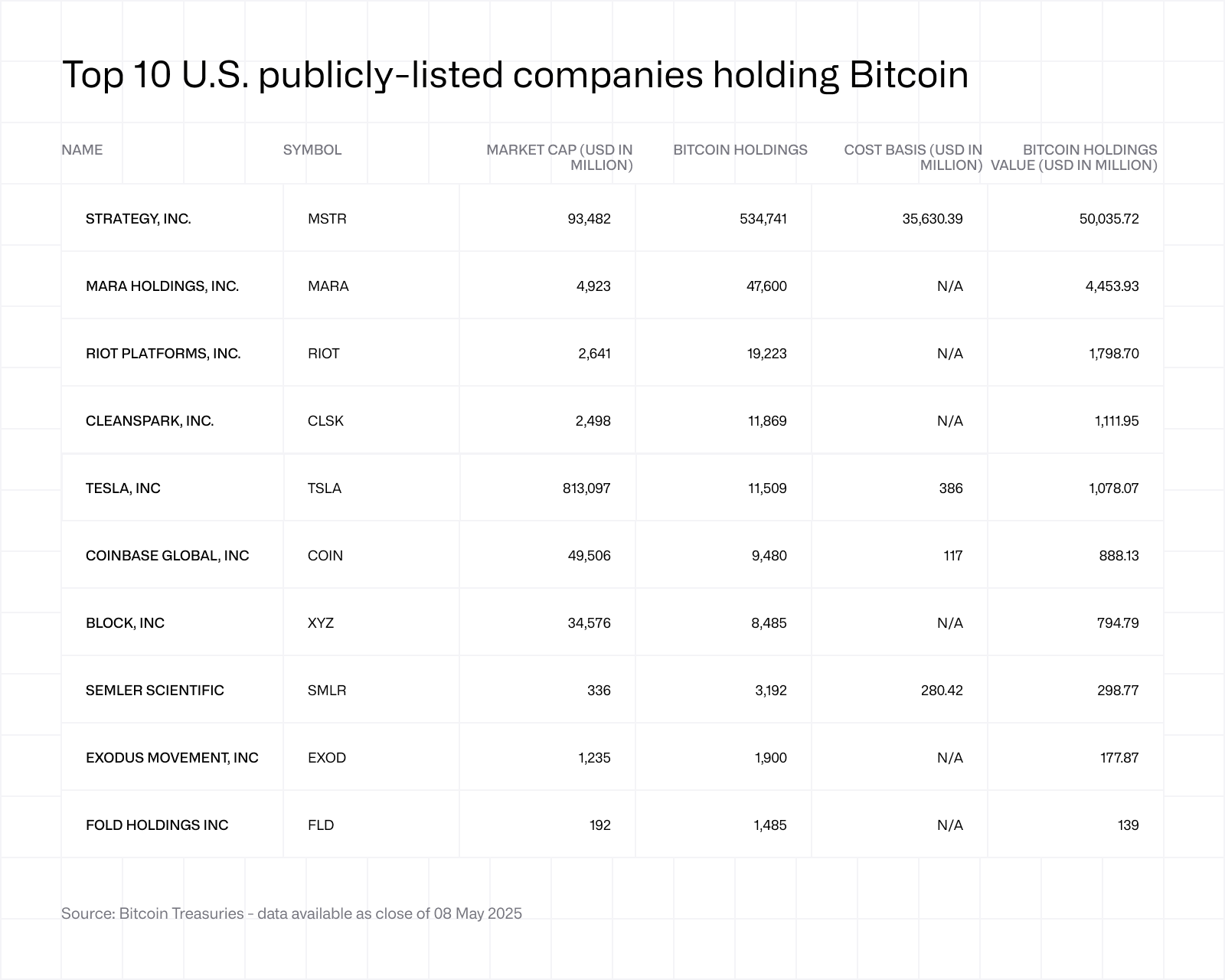
In recent years, a growing number of publicly traded companies have added Bitcoin to their balance sheets, marking a shift in how corporations manage capital reserves. For some, Bitcoin represents a strategic hedge against inflation and fiat currency depreciation, while for others it’s a way to diversify assets, align with disruptive innovation, or leverage their operational link to the crypto ecosystem. These decisions reflect broader institutional confidence in Bitcoin as a long-term store of value and an emerging macro asset.
The most prominent example is Strategy (formerly MicroStrategy), a business analytics firm that has evolved into the world’s largest corporate Bitcoin holder. Co-founded by outspoken Bitcoin advocate Michael Saylor, the company began acquiring Bitcoin in 2020 as part of a bold capital allocation strategy. As of 5 May 2025, Strategy holds 555,450 BTC, valued at approximately $52.3 billion. Its leadership sees Bitcoin as a form of digital gold—a harder, more secure alternative to cash—and a safeguard against inflation and monetary debasement. Given the size of its holding, investors increasingly view Strategy’s stock as a surrogate for direct Bitcoin exposure.
Bitcoin mining firms, such as Marathon Digital, are also significant holders—albeit through different mechanisms. Miners earn Bitcoin directly by validating transactions on the network through its proof-of-work consensus process. As the largest U.S.-listed miner by hashrate, Marathon has amassed 47,600 BTC (worth roughly $4.5 billion) through its operations. But like Strategy, it has also purchased Bitcoin on the open market. “Bitcoin’s recent price decline, coupled with the strength of our balance sheet, afforded us an opportunity to add to our holdings,” said CEO Fred Thiel in 2024, following a $100 million Bitcoin purchase. The company later followed up with an additional $249 million purchase of Bitcoin after a convertible note offering.
Finally, Tesla remains one of the most recognizable names among corporate Bitcoin holders. In February 2021, the electric vehicle giant announced a $1.5 billion purchase of 40,000 BTC, citing its intent to “to further diversify and maximize returns on [its]cash”. Since then, it sold 75% of its position during the 2022 bear market and, in October 2024, transferred the remaining 11,509 BTC (worth about $1.1 billion) to unidentified wallets. While the company hasn’t clarified its long-term strategy, Q1 2025 earnings filings confirm it hasn’t sold any more.
The case for SMEs?
According to wealth management firm Bernstein, quoted by media outlet The Block, publicly listed companies worldwide could allocate up to $330 billion to bitcoin treasuries over the next five years. Yet, the same firm acknowledges that not every company has the same resources to mimic Strategy’s success. “Not every Bitcoin treasury will be successful simply replicating MSTR’s playbook, in our view.” Especially SMEs that cannot diverge their core business to the same extent. Still, allocating a bit of its treasury to Bitcoin could help enhance financial results: allocating up to 4% of an investor’s portfolio to bitcoin and rebalancing this exposure quarterly has, in the past, made it possible to take advantage of potential gains while limiting the impact of volatility, according to CoinShares’ research. All around the world, many companies have already chosen to do so, as recently highlighted by Reuters, which mentions the case of several biotech firms: “Evaluating bitcoin as an additional tool became a must,” one of the CEOs says in the piece.
As a treasury asset, Bitcoin could also offset long-term fiat currency fluctuations, which can be valuable for companies exposed to foreign markets, especially those experiencing high inflation, like Argentina. In the last 10 years, the peso has lost 99% of its value against the US dollar, while bitcoin appreciated by nearly 17,000%.
Finally, when yields are near or below zero, the opportunity cost of holding Bitcoin drops—making its asymmetric return profile more appealing than assets with negative real or nominal yields. In high interest rate environments, where traditional assets may underperform, Bitcoin’s low correlation can help reduce portfolio risk. For corporate treasurers, its fixed supply and transparent monetary policy offer a potential hedge against inflation and currency debasement, as we’ll see below.
How can companies add bitcoin to a balance sheet?
The easiest way is through exchange-traded funds (ETFs). Following approval by the SEC, 11 spot bitcoin products started trading on the US markets at the start of 2024: ETFs are easy to account for because most jurisdictions have clear rules for tax treatment of regulated investment products.
Crucially, ETFs eliminate the operational burden of self-custody. The fund provider assumes responsibility for holding and securing the underlying Bitcoin, meaning corporate treasuries can allocate with confidence—without managing private keys or setting up digital wallets. Compared to direct crypto exchange purchases, ETFs provide greater accessibility, regulatory clarity, and operational simplicity, making them the preferred route for businesses entering the Bitcoin economy.
Bitcoin ETFs offer deep liquidity, competitive fees, and daily pricing. They trade through traditional brokerage platforms, allowing corporate finance teams to allocate and rebalance with the same tools they use for equities, bonds, and other ETFs.
What companies must know about risk and return
One of the primary risks of holding Bitcoin is its volatility. Its price can fluctuate dramatically based on various catalysts, such as investor sentiment, financial regulations and the evolution of the underlying technology. Volatility has eased as Bitcoin has matured: the 60-day Bitcoin Volatility Index stood at 1.86% (as of 28th April 2025), down from 7.05% in April 2020.
Bitcoin can also diversify a treasury- CoinShares estimates its correlation with common holdings, like government bonds, is relatively low- and it can overcome the opportunity cost of holding cash because Satoshi capped the total supply of Bitcoin at 21 million, making it anti-inflationary.
Conclusion
A broad range of crypto-native and non-crypto native companies hold bitcoin as a treasury asset, most famously business analytics firm Strategy but also publicly-listed miners like Marathon Digital, and consumer companies such as Tesla.
ETFs, approved by the SEC, offer an easy way to add bitcoin to a corporate treasury. Companies can choose between products tracking the spot price or offering indirect exposure.
Financial advisors can add value for corporate clients by providing a clear framework for asset allocation, risk management, and board education.
Quick facts
- One of the roles bitcoin serves in the finance industry is as a treasury asset.
- More than just publicly traded companies hold bitcoin, most notably Strategy, MARA Holdings and Tesla, as of April 2025.
- One of the easiest ways for companies to access bitcoin is through ETFs
- Bitcoin’s volatility is its greatest risk, although it offers the potential for return, diversification and an inflation hedging.
Why this matters to advisors:
Advisors can guide corporate clients on using Bitcoin to diversify reserves, hedge inflation and access asymmetric returns. ETFs simplify access, and advisors who understand the risks, benefits and mechanics can offer valuable counsel in a shifting environment.
