What you’ll learn
Amid shifting market dynamics—marked by rising interest rates, geopolitical risks, and shifting investor sentiment—financial advisors are challenged to deliver diversified, resilient portfolios. This article explores how Bitcoin, once a nerdy digital experiment, has matured into a recognized asset class. You’ll discover how Bitcoin’s unique characteristics, including its finite supply, institutional-grade infrastructure, and increasing adoption by corporations and governments, position it as a strategic asset for wealth preservation. The content explains Bitcoin’s role, covers important regulatory updates, and provides practical steps for advisors to effectively include BTC in client portfolios.
On March 6, 2025, the White House established the United States Strategic Bitcoin Reserve, officially recognizing Bitcoin as a strategic national asset alongside gold, foreign currencies, and U.S. Treasury bonds. This move highlighted Bitcoin’s dual role as a store of value and a hedge against inflation.
Federal Reserve Chair Jerome Powell reinforced this view at the DealBook Summit, on December 4, 2024, explaining that Bitcoin is a speculative asset similar to gold—“it’s just virtual and digital.” Powell clarified that Bitcoin does not compete with the U.S. dollar but serves as an alternative asset, further cementing its status as a globally recognized store of value.
Once dismissed as a nerdy concept, Bitcoin has established itself as a legitimate financial asset. By May 2025, BTC was being held not only by major corporations like Strategy, Tesla, and Coinbase but also by national governments, cementing Bitcoin’s status as a trusted and strategic financial instrument.
1. From fringe to financial mainstream
Corporate adoption has been a powerful driver of Bitcoin’s transition to mainstream recognition. Public companies are increasingly integrating Bitcoin into company balance sheets as a strategic reserve asset. As of May 14, 2025, public companies collectively hold 786,857 BTC. Strategy leads with 568,840 BTC, championed by Michael Saylor’s strategic vision of Bitcoin as a superior store of value. MARA Holdings follows with 48,237 BTC, while Tesla, with 11,509 BTC, has leveraged Bitcoin both as a treasury asset and a potential medium of exchange.
Governments have also begun accumulating Bitcoin alongside the corporate sector. The United States holds the largest amount of Bitcoin among sovereign entities, with 198,012 BTC. China follows with 190,000 BTC, while the United Kingdom holds 61,245 BTC, valued at around $6.32 billion. Other countries, such as Ukraine and Bhutan with 46,351 BTC and 12,062 BTC respectively. El Salvador, the first country to adopt Bitcoin as legal tender in 2021, holds 6,175 BTC..
Since January 2024, major asset managers like BlackRock, Fidelity, and Grayscale have launched spot Bitcoin ETFs. The iShares Bitcoin Trust (IBIT) leads with $64.71 billion in AUM, followed by Fidelity’s FBTC ($20.54 billion) and Grayscale’s GBTC ($19.47 billion), collectively holding 1.34 million BTC. These ETFs provide investors with direct exposure to Bitcoin without the complexities of self-custody, offering a regulated and compliant pathway for both institutional and retail investors.
This widespread adoption by corporations, governments, and institutional investors is transforming BTC into a strategic financial instrument.
2. Institutional infrastructure is here
In 2025, the Financial Accounting Standards Board (FASB) introduced new fair value accounting rules for Bitcoin through Accounting Standards Update (ASU) 2023-08, which was issued in December 2023. This update, effective for fiscal years beginning after December 15, 2024, allows companies to measure qualifying crypto assets, including Bitcoin, at fair value, with changes recognized directly in net income each reporting period.
This regulatory change replaced the previous impairment model, where companies were required to record Bitcoin at the lower of cost or market value, often leading to losses on financial statements even if prices later recovered. By providing clear and transparent guidelines, FASB has empowered corporate treasuries to hold Bitcoin, significantly improving trust among investors and stakeholders.
Another key regulatory development on the horizon, set to bolster the crypto industry, is the Financial Innovation and Technology for the 21st Century Act (FIT21). FIT21 is set to boost institutional confidence in Bitcoin by providing legal clarity, ensuring digital asset platforms operate transparently, and safeguarding investor interests. With regulations for exchanges, custodians, and brokers, FIT21 minimizes regulatory risks, making it easier for institutions to adopt Bitcoin as a secure, compliant, and trusted financial asset. Institutional custodians like Fidelity Digital Assets, Coinbase Custody, and Gemini Custody offer multi-signature security, regulatory compliance, and insurance coverage.
Beyond the U.S., global regulatory clarity has significantly improved, providing a safer environment for Bitcoin adoption. In the European Union, the Markets in Crypto-Assets (MiCA) Regulation has established a comprehensive framework for crypto service providers, enhancing transparency and consumer protection.
Across Asia, several countries including Singapore and Japan have continued to refine their regulatory approaches to digital assets, aiming to balance innovation with robust investor protection.
3. A new asset class for the modern portfolio
Understanding Bitcoin’s core fundamentals: scarcity, liquidity, and growing adoption
Bitcoin’s growth is rooted in core fundamentals—scarcity, liquidity, and resilience—making it a valuable diversification tool. With a capped supply of 21 million coins, Bitcoin’s scarcity is hardcoded, unlike gold. Over 19.86 million BTC are already mined, leaving just 1.14 million to be issued at a gradually slowing rate. Currently, 164,250 BTC are mined annually until the next halving in 2028, enforcing long-term scarcity.
Unlike traditional financial assets restricted by market hours, Bitcoin trades 24/7, providing continuous liquidity. This characteristic allows investors to enter or exit positions anytime, a flexibility that has become increasingly valuable in an interconnected world. Moreover, Bitcoin’s global nature means that its price is determined by Bitcoin’s decentralized network of buyers and sellers, not confined to any single jurisdiction.
Millennials and Generation Z have emerged as advocates for Bitcoin, viewing it as both a store of value and a technology-driven asset class. This demographic shift is reshaping wealth management, with financial advisors increasingly recommending Bitcoin to cater to the preferences of younger clients.
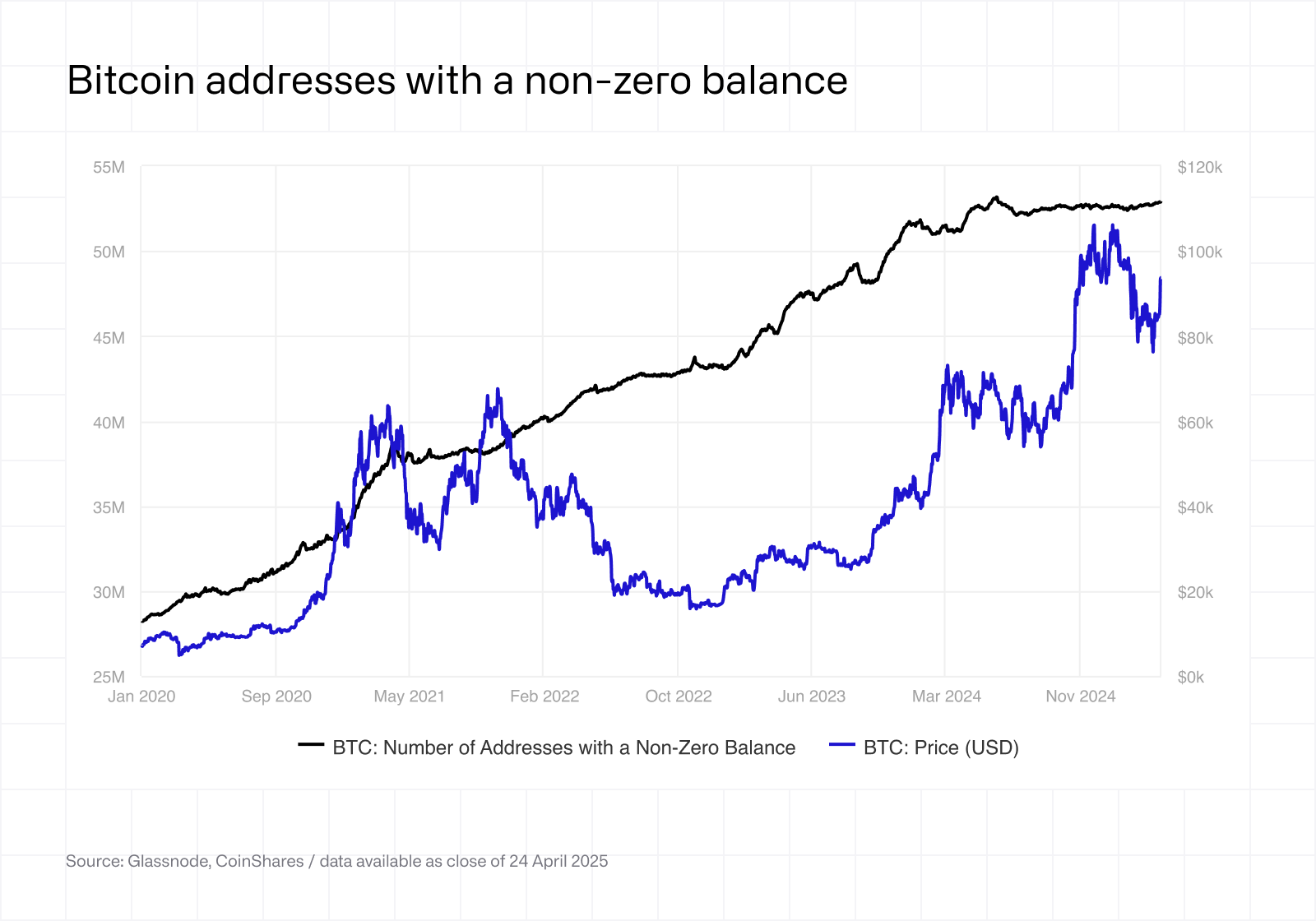
- Adoption growth: The rise to 55 million unique addresses with Bitcoin indicates a steady increase in user adoption. Each address represents a user, an entity, or even a smart contract holding Bitcoin. This growth suggests more individuals and institutions are holding Bitcoin over time.
- Wider distribution: With 55 million non-zero addresses, Bitcoin ownership is becoming more decentralized. It is not just being concentrated among a few large holders but instead, millions of addresses are holding various amounts of Bitcoin.
- Network security and resilience: A higher number of active addresses means more participants in the Bitcoin network, increasing its security and resilience.
- User behavior and market maturity: The consistent growth in non-zero addresses also reflects a maturing market.
Bitcoin: a secure asset for wealth preservation and diversified portfolios
Bitcoin’s decentralized nature makes it a reliable tool for preserving wealth during currency collapses, sanctions, or economic crises, providing a financial lifeline beyond the reach of central banks or governments. Bitcoin’s role as a hedge against inflation has been evident in regions facing economic instability, where local populations have adopted Bitcoin as an alternative to volatile national currencies.
For financial advisors, Bitcoin is now a practical asset to offer clients. Custodial solutions like Fidelity Digital Assets and BlackRock ensure secure storage, while Bitcoin ETFs provide regulated access without the complexities of self-custody. Advisors can confidently integrate Bitcoin into portfolios, aligning with diversification goals and future-focused investment strategies.
Conclusion
Bitcoin is no longer just a nerdy concept—it’s a mainstream financial asset discussed at major global forums like the World Economic Forum in Davos and the G20. Influential figures like Federal Reserve Chair Jerome Powell have acknowledged Bitcoin as a digital alternative to gold. Media coverage from outlets like the Financial Times has spotlighted how corporations are buying Bitcoin, while Cathie Wood of ARK Investment has projected massive future value at $2.4 million a coin by 2031.
C-suite endorsements and global discussions highlight Bitcoin’s evolution into a recognized asset within the world’s largest portfolios. Beyond its brand recognition, Bitcoin has achieved widespread global adoption, becoming a strategic tool for diversification, inflation hedging, and portfolio growth.
Why this matters to advisors
This article is designed to empower advisors with clear insights, data, and practical guidance on Bitcoin’s place in modern portfolio management. The article helps bridge the gap between client curiosity and informed advisory, equipping professionals to explain Bitcoin’s benefits, assess BTC’s fit within diversified portfolios, and access BTC through compliant, secure investment channels. Whether addressing questions from next-gen investors or seeking clarity on regulatory developments, advisors will gain the knowledge needed to make informed, fiduciary decisions about Bitcoin for their clients.
