
What You’ll Learn
In this article, you’ll explore the strategic case for Bitcoin as a modern complement—or even alternative—to gold in diversified portfolios. You’ll learn how Bitcoin mirrors key attributes of gold such as scarcity and durability, while offering new benefits like transparency and portability. You’ll also examine data showing how modest allocations to Bitcoin have enhanced portfolio performance without materially increasing risk. Finally, you’ll understand why recent regulatory developments have made it easier than ever for advisors to access Bitcoin through traditional investment vehicles.
Rethinking gold: Bitcoin’s strategic emergence
Gold has long been the cornerstone of wealth preservation—prized for its scarcity, durability and role as a hedge against uncertainty. But today, a digital contender is rising: Bitcoin. With a fixed supply, global liquidity, and growing institutional acceptance, Bitcoin doesn’t just echo gold’s attributes – it introduces a compelling alternative with distinct advantages.
In this article, we explore the parallels between gold and Bitcoin and outline how incorporating Bitcoin can enhance a portfolio’s risk-return profile in a time of macro volatility and monetary uncertainty.
Gold’s traditional role vs. Bitcoin’s emergence
Gold has historically served as a store of value due to several qualities:
- Scarcity – The USGS estimates that ~244,000 metric tons of gold have been discovered to date, with roughly 57,000 metric tons left to mine.
- Divisibility – Gold can be split into smaller units.
- Portability – Gold is easy to transport (in small quantities).
- Durability – Gold remains intact for thousands of years without degrading.
While bitcoin launched as a medium of exchange, it has become recognised as a digital store of value, or ‘digital gold’. Despite its differences from the physical metal, Bitcoin shares many of gold’s properties. For example, its supply is capped at 21 million coins, with over 94.5% already in circulation as of April 2025. The last coin is expected to be mined around 21040. Bitcoin is also durable thanks to the decentralized nature of the blockchain technology underpinning it
Bitcoin’s place in a balanced portfolio
Investors are increasingly seeking exposure to bitcoin because it’s typically uncorrelated with other asset classes. According to CoinShares, since 2018, Bitcoin’s correlation with the NASDAQ has averaged just 40% (as of April 2025) and its correlation with gold is even lower – only 19% since 2019.
The appropriate Bitcoin allocation depends on investor risk tolerance. CoinShares research, which analyzed the impact of different allocations on a portfolio’s volatility, found that an optimal allocation ranges from 4% to 7.5%.
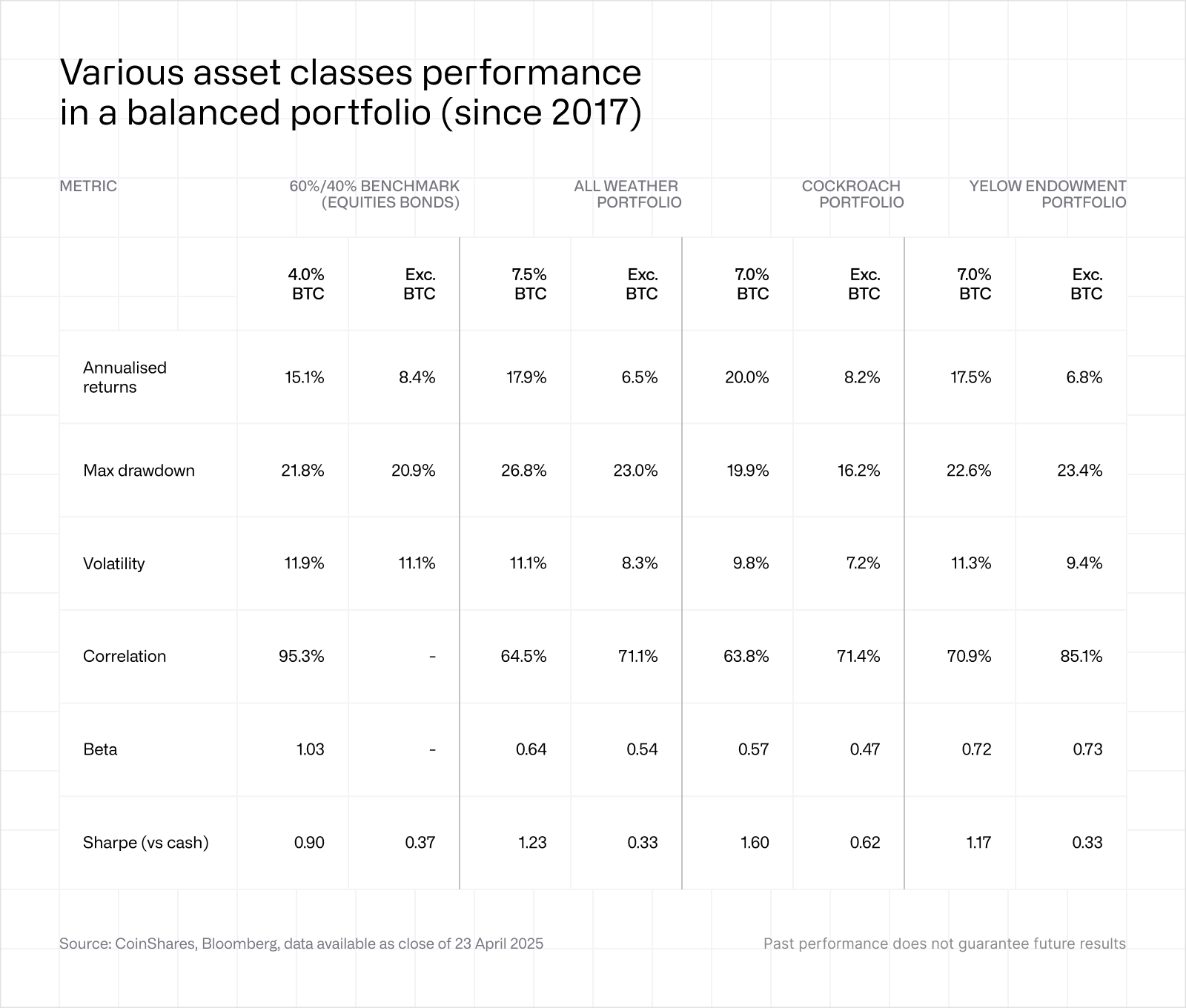
To illustrate, CoinShares tracked 4 portfolios from December 2016 to April 2025, comparing versions with and without Bitcoin.
- A classic 60/40 portfolio (60% equities, 40% bonds)
- A 60/40 portfolio with a 4% bitcoin allocation
- Ray Dalio’s All Weather Portfolio, substituting gold’s 7.5% allocation with bitcoin
- Dylan Grice’s Cockroach portfolio, replacing gold’s 7% allocation with bitcoin
- The Yale Endowment-style strategy (which doesn’t hold gold), replacing the 7% allocation to real estate investment trusts with bitcoin
Across all models, adding Bitcoin enhanced returns and improved diversification, with minimal impact on volatility and drawdowns
Conclusion
Bitcoin has established a reputation as a store of value because it’s scarce, divisible, portable and durable. As a result, it could serve the same purpose as gold in a portfolio: as a hedge against inflation, a safe haven during geopolitical or economic instability and a source of diversification.
Bitcoin is an effective source of diversification because it’s uncorrelated with other risky assets. Research by CoinShares shows that allocating between 4% and 10% to bitcoin since 2015 has improved the performance and diversification of standard portfolios while having a limited impact on maximum drawdown and volatility.
Bitcoin has become more accessible since spot ETFs started trading at the start of 2024. These ETFs give advisors familiar and trustworthy products they can recommend to clients seeking exposure to this emerging asset class.
Quick facts
- Bitcoin shares core attributes with gold: scarcity, durability, and divisibility.
It offers added benefits: permissionless access, transparency, and global portability. - Bitcoin ETFs launched in early 2024 provide regulated, convenient exposure.
- These ETFs are subject to traditional investment regulations, improving investor protection compared to direct exchange purchases.
Research shows small allocations to Bitcoin can enhance returns and reduce correlation in diversified portfolios
Why This Matters for Advisors
Bitcoin’s growing status as a strategic asset can no longer be ignored. By understanding Bitcoin’s similarities to gold—and the advantages it offers—advisors can craft more resilient, modern portfolios. Incorporating Bitcoin enables advisors to meet evolving client demands while remaining grounded in sound risk management.
