
Corporate adoption of artificial intelligence is extending far beyond merely employing AI as an augmented search engine.
The Alger team recently broke down how different firms in the U.S. are using artificial intelligence. Their recent Alger on the Money article looked at research from the Federal Reserve Bank of New York, which in August 2025 surveyed service firms in the New York/Northern New Jersey region regarding how they are using AI in their operations.
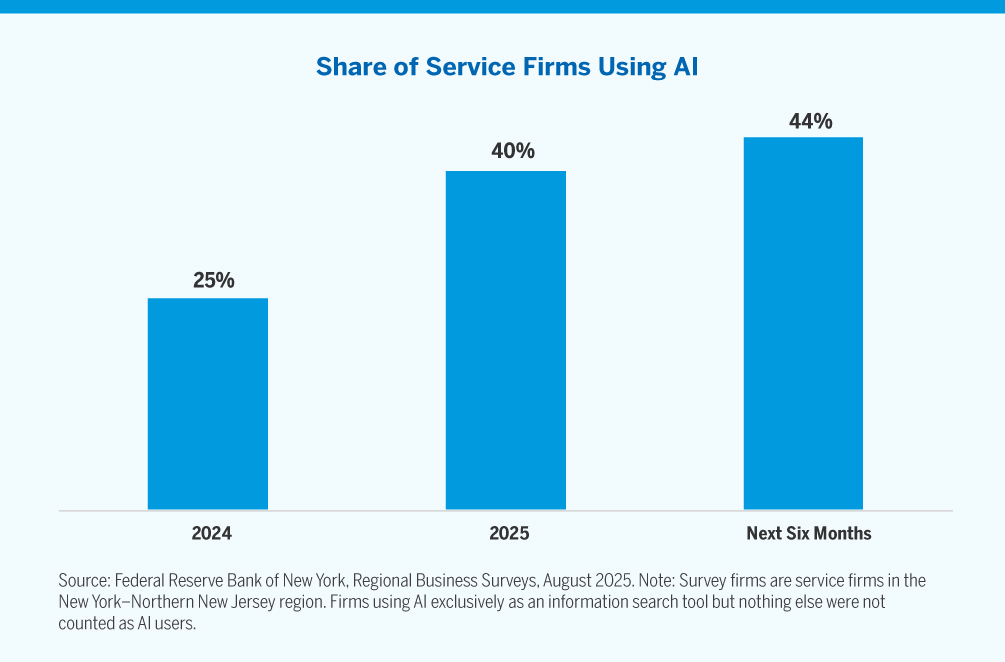
As the above chart illustrates, the amount of service firms implementing AI has risen tremendously between 2024 and 2025. Further growth is still expected, as the number of service firms using AI is expected to rise by 4% over the next six months, according to the Federal Reserve Bank of New York.
Crucially, this survey does not include firms that are using artificial intelligence solely as a search tool. Instead, these results are looking at companies that are embracing AI in a more wholesale manner, adapting the technology to support more in-depth business operations.
This makes the New York Fed survey results even more interesting. After all, these results are not only showcasing rising AI adoption, but growing adaptation into more complicated business operations.
Data like this only furthers the case for advisors and investors to maintain focused access to companies that are facilitating AI adoption. In our view, as long as demand continues to mount, portfolios invested in AI hyperscalers and their key beneficiaries remain well positioned.
How ALAI Approaches AI Investing
The Alger AI Enablers & Adopters ETF (ALAI) can help investors and advisors stay engaged with these kinds of companies. ALAI’s investment process focuses on proprietary field research designed to dial in on companies undergoing positive dynamic change.
Positive dynamic change, for ALAI’s portfolio team, refers to companies that are either seeing “high unit volume growth” or “positive lifecycle change.” “High unit volume growth” refers to companies that are seeing substantial market growth and demand. Meanwhile, “positive life cycle change” companies are those in a fortuitous position to benefit from new company leadership, regulations, or innovations.
With artificial intelligence adoption continuing to grow, ALAI is seeing more and more net flows. FactSet data shows that as of October 8, 2025, the fund has seen more than $200 million in net flows year-to-date.
For more news, information, and strategy, visit the Artificial Intelligence Content Hub.
Disclosure Information
Click here for more information on the Alger AI Enablers & Adopters ETF.
The views expressed are the views of Fred Alger Management, LLC (“FAM”) and its affiliates as of October 2025. These views are subject to change at any time and may not represent the views of all portfolio management teams. These views should not be interpreted as a guarantee of the future performance of the markets, any security or any funds managed by FAM. These views are not meant to provide investment advice and should not be considered a recommendation to purchase or sell securities. Holdings and sector allocations are subject to change. Past performance is not indicative of future performance.
Risk Disclosures: Investing in the stock market involves risks, including the potential loss of principal. Growth stocks may be more volatile than other stocks as their prices tend to be higher in relation to their companies’ earnings and may be more sensitive to market, political, and economic developments. Companies involved in, or exposed to, AI-related businesses may have limited product lines, markets, financial resources or personnel as they face intense competition and potentially rapid product obsolescence, and many depend significantly on retaining and growing their consumer base. These companies may be substantially exposed to the market and business risks of other industries or sectors, and may be adversely affected by negative developments impacting those companies, industries or sectors, as well as by loss or impairment of intellectual property rights or misappropriation of their technology. Companies that utilize AI could face reputational harm, competitive harm, and legal liability, and/or an adverse effect on business operations as content, analyses, or recommendations that AI applications produce may be deficient, inaccurate, biased, misleading or incomplete, may lead to errors, and may be used in negligent or criminal ways. AI technology could face increasing regulatory scrutiny in the future, which may limit the development of this technology and impede the future growth. AI companies, especially smaller companies, tend to be more volatile than companies that do not rely heavily on technology. A significant portion of assets will be concentrated in securities in related industries, and may be similarly affected by adverse developments and price movements in such industries. A significant portion of assets may be invested in securities of companies in related sectors, and may be similarly affected by economic, political, or market events and conditions and may be more vulnerable to unfavorable sector developments. Investing in companies of small and medium capitalizations involves the risk that such issuers may have limited product lines or financial resources, lack management depth, or have limited liquidity. The Fund is classified as a “non-diversified fund” under federal securities laws because it can invest in fewer individual companies than a diversified fund. Private placements are offerings of a company’s securities not registered with the SEC and not offered to the public, for which limited information may be available. Such investments are generally considered to be illiquid. Foreign securities involve special risks including currency fluctuations, inefficient trading, political and economic instability, and increased volatility. ADRs and GDRs may be subject to international trade, currency, political, regulatory and diplomatic risks. Active trading may increase transaction costs, brokerage commissions, and taxes, which can lower the return on investment. At times, cash may be a larger position in the portfolio and may underperform relative to equity securities.
ETF shares are based on market price rather than net asset value (“NAV”), as a result, shares may trade at a price greater than NAV (a premium) or less than NAV (a discount). The Fund may also incur brokerage commissions, as well as the cost of the bid/ask spread, when purchase or selling ETF shares. The Fund faces numerous market trading risks, including the potential lack of an active market for Fund shares, losses from trading in secondary markets, periods of high volatility and disruption in the creation and/or redemption process of the Fund. Any of these factors, among others, may lead to the Fund’s shares trading at a premium or discount to NAV. Thus, you may pay more (or less) than NAV when you buy shares of the Fund in the secondary market, and you may receive less (or more) than NAV when you sell those shares in the secondary market. The Manager cannot predict whether shares will trade above (premium), below (discount) or at NAV. The Fund may effect its creations and redemptions for cash, rather than for in-kind securities. Therefore, it may be required to sell portfolio securities and subsequently recognize gains on such sales that the Fund might not have recognized if it were to distribute portfolio securities in-kind. As such, investments in Fund shares may be less tax-efficient than an investment in an ETF that distributes portfolio securities entirely in-kind. Brokerage fees and taxes will be higher than if the Fund sold and redeemed shares in-kind. Certain shareholders, including other funds advised by the Manager or an affiliate of the Manager, may from time to time own a substantial amount of the shares of the Fund. Redemptions by large shareholders could have a significant negative impact on the Fund.
Alger pays compensation to VettaFi to sell various strategies to prospective investors.
Before investing, carefully consider a Fund’s investment objective, risks, charges, and expenses. For a prospectus and summary prospectus containing this and other information or for a Fund’s most recent month-end performance data, visit www.alger.com, call (800) 992-3863 (for a mutual fund) or (800) 223-3810 (for an ETF), or consult your financial advisor. Read the prospectus and summary prospectus carefully before investing. Distributor: Fred Alger & Company, LLC. All underlying series of The Alger ETF Trust listed on NYSE Arca, Inc. NOT FDIC INSURED. NOT BANK GUARANTEED. MAY LOSE VALUE.
