
Weekly trading in large ETFs often makes it difficult to spot a clear pattern. However, the $22 billion iShares U.S. Technology ETF (IYW) was an exception last week .According to ETF Database, IYW experienced a $2.8 billion net outflow on September 17. VettaFi believes that significant move was triggered by a BlackRock model allocation change. BlackRock recently managed $185 billion for financial advisors through their model portfolios.
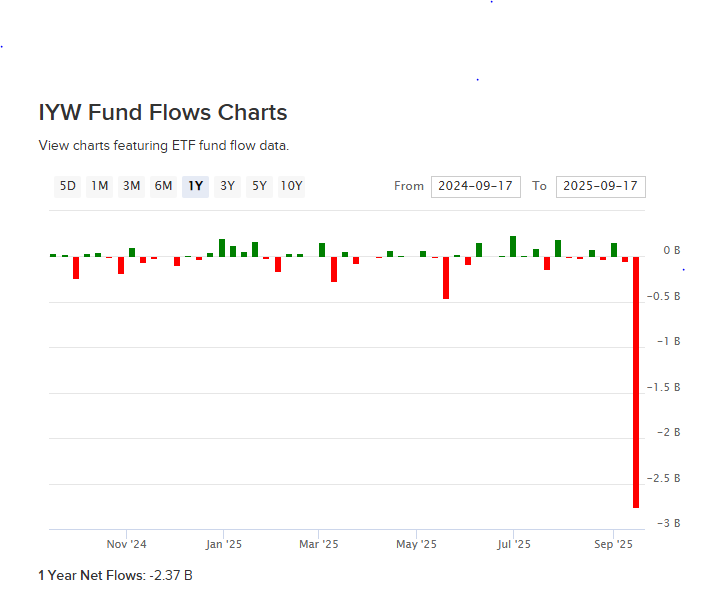
In a note shared with VettaFi, BlackRock explained they completed a shift from a broad-based U.S. Tech position into a dedicated AI ETF. Michael Gates, lead portfolio manager for BlackRock’s Target Allocation ETF model portfolio suite, stated “The advancement of generative AI represents a multi-decade structural trend, set to reshape industries and alter sources of economic value — an era comparable to the dawn of the internet.”
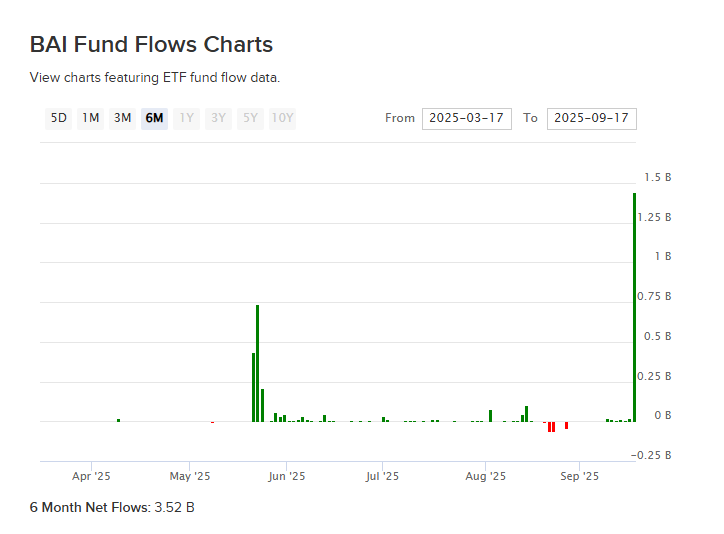
VettaFi believes that the iShares A.I. Innovation and Tech Active ETF (BAI) was the primary beneficiary of this allocation change. When BlackRock adjusts its models, the impacted ETFs often become apparent.
The actively managed BAI, which launched in October 2024, had $5.1 billion as of September 19. On September 17, ETF Database showed BAI with a $1.4 billion net inflow. VettaFi believes additional money has since flowed in. BlackRock initially added BAI to its model portfolios in May, which led to its assets initially soaring past $1 billion. Prior to the May move, BAI managed $145 million.
“Accessing alpha-seeking strategies through an active ETF provides the potential for more dynamic alpha seeking while retaining the tax efficiency, liquidity and transparency benefits of the ETF wrapper”, explained Gates in a May 2025 note.
Broader Tech vs. AI
Let’s compare the former and new allocation exposure for investors using BlackRock models.. IYW is a market-cap- weighted ETF with a concentration in the largest companies generally classified as information technology. NVIDIA, Microsoft, Apple represent 16%, 15%, and 14% of assets, respectively. Meanwhile, IYW also owns Alphabet and Meta Platforms among its top-10 positions. This is different from many other information technology ETFs such as the Technology Select Sector SPDR (XLK) and the Vanguard Information Technology ETF (VGT). IYW owns 139 positions though many of them are quite small in weighting.
In contrast, BAI is actively managed and owns just 39 positions. NVIDIA is the largest, but the semiconductor company represents only 9% of fund assets. BAI’s management favors more moderately sized companies they believe have strong fundamentals. Astera Labs and Snowflake were 5% and 4% of assets, respectively. These tech companies are each less than 0.5% of assets for IYW. Three-quarters of BAI’s assets were in the information technology sector, as classified by GICS. Communication Services (13%) and industrials (7%) represented the majority of the rest.
Year-to-date, BAI was up 26%, outperforming IYW by more than 700 basis points. This relative performance occurred even as BAI charges a higher expense ratio (0.55% vs. 0.38%). For those unaware, iShares ETFs are managed by BlackRock.
How to THNQ About AI ETFs
Last week, I emphasized the importance of understanding an ETF’s holdings before investing. One of the ETFs highlighted in that piece was the ROBO Global Artificial Intelligence ETF (THNQ). Disclosure: My firm, VettaFi, is the index provider for THNQ, for which it receives an index licensing fee. However, THNQ is not issued, sponsored, endorsed, or sold by VettaFi.
Both BAI and THNQ provide investors with exposure to companies that stand to benefit from further AI adoption. However, the funds are not identical. Astera Labs was recently THNQ’s largest position at 4% of assets, while NVIDIA was the 14th largest at 2%. Ambarella and Nebius Group were also in the top-10 for THNQ but are not inside BAI. THNQ was up 29% for the year and has a 0.68% expense ratio.
BlackRock believes the AI infrastructure spend is equivalent to 0.5% of Global GDP and it is expected to nearly double annually as intelligence models are advancing even more aggressively. Gates and team anticipate that on top of the half a trillion dollars of annual investment into foundational infrastructure, future commitments are likely to accelerate. The strategic move by BlackRock has not only increased many investors’ exposure to the AI theme but should draw attention to the broader ETF theme.
VettaFi is the index provider for THNQ, for which it receives an index licensing fee. However, THNQ is not issued, sponsored, endorsed, or sold by VettaFi. VettaFi and its affiliates have no obligation or liability in connection with the issuance, administration, marketing, or trading of THNQ.
For more news, information, and analysis, visit the Artificial Intelligence Channel.
