Japan equities are riding a historic surge, with the Nikkei 225 topping 62,000 for the first time. While the S&P 500 and Nasdaq continue to notch records, Japan is carving out its own bull market, driven by AI-fueled tech gains, structural corporate reforms, and a transformative era of economic policy. The world’s fourth largest economy had previously been viewed as the perennial value trap — a market defined by the stagnant Lost Decades and a corporate culture that seemed indifferent to shareholder returns. But Japan has emerged as the standout developed market performer of the last 18 months. Excluding the U.S., Japan is the single largest asset-gathering region this year. It’s attracted roughly $6.3 billion in net inflows, more than tripling the pace of its next-closest peer, Canada.
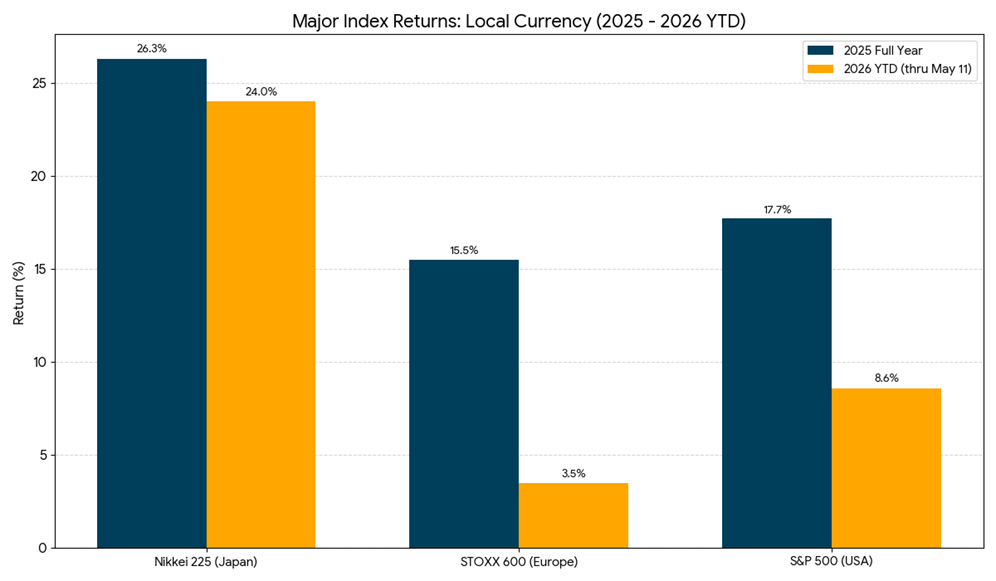
This rally is built on a multi-year overhaul of Japan’s economic engine. Following a long deflationary era, Prime Minister Sanae Takaichi is seen as ushering in a new age of fiscal support and strategic public-private investment. Simultaneously, the Tokyo Stock Exchange institutionalized reforms, sparking a wave of share buybacks and dividend hikes previously unthinkable in Tokyo. Technology is also a major driver. Japan is benefiting from early-cycle exposure to the AI revolution through names like SoftBank — frequently viewed as a publicly traded proxy for the OpenAI and Arm ecosystem.
Following the Flows
The institutional shift toward Japan is showing up in the ETF flow data. Institutional managers are aggressively reallocating capital toward Japan as an alternative to lofty U.S. valuations and sluggish growth in Europe.
| Japan ETFs: Flow Leaderboard (2026) | ||
| AUM ($MM) | Net Inflows ($MM) | |
| iShares MSCI Japan ETF (EWJ) | 20,413.24 | 3,737.36 |
| JPMorgan BetaBuilders Japan ETF (BBJP) | 16,151.59 | 1,238.00 |
| Franklin FTSE Japan ETF (FLIP) | 3,485.88 | 775.00 |
| WisdomTree Japan Hedged Equity Fund (DXJ) | 6,222.15 | 617.00 |
| iShares MSCI Japan Value ETF (EWJV) | 715.03 | 192.00 |
| iShares Currency Hedged MSCI Japan ETF (HEWJ) | 711.64 | 165.00 |
| WisdomTree Japan Opportunities Fund (OPPJ) | 278.40 | 130.00 |
A handful of ETFs have seen significant success with their specialized Japan offerings.
- The iShares MSCI Japan ETF (EWJ) remains the largest and most liquid Japan ETF, continuing to serve as the primary broad-market entry point for cap-weighted exposure.
- For direct exposure to the TOPIX, the JPMorgan BetaBuilders Japan ETF (BBJP) has become a heavy-volume tool for low-cost institutional re-weighting. The $16 billion fund is the second-most popular Japan play on a flows basis.
- The WisdomTree Japan Hedged Equity Fund (DXJ) remains a cornerstone for many, particularly those wanting to play the export-heavy nature of the Nikkei without the yen noise and volatility.
- The WisdomTree Japan Opportunities Fund (OPPJ) is up approximately 23% year-to-date, doubling the returns of the standard MSCI Japan Index and beating the S&P 500 by a margin of 4-to-1. As my colleague Todd Rosenbluth noted, foreign inflows are only just beginning to reach neutral weightings after two decades of being underweight Japan. This suggests significant gas in the tank for the trade.
While the U.S. grapples with a shifting Federal Reserve policy, Japan has found a Goldilocks balance – moderate inflation and a remarkably smooth exit from negative interest rates by the Bank of Japan. This stability has positioned Japan as a rare safe haven with growth, leading to the first collective global re-weighting to overweight in 20 years.
To Hedge or Not to Hedge?
For USD-based investors, the choice between currency-hedged and unhedged ETFs has been the difference between good and stellar returns. Historically, a weak yen was great for Japan’s exporters but bad for USD-based total returns. Currency-hedged ETFs like DXJ allow clients to capture local stock gains while neutralizing the yen’s slide. But as the BoJ began normalizing rates in late 2025, the yen started to stabilize. For advisors who believe the yen is now undervalued, unhedged ETFs, such as EWJ and BBJP, offer a double play — potential gains from rising stock prices and a recovering currency.
Heard on the Street
The chorus of bullish voices from major Wall Street firms has also grown louder.
Nomura has identified several “winning conditions” that suggest the rally has staying power — expecting a 14% gain in Japan’s TOPIX earnings in 2026, driven by corporate price hikes and resilient global growth. Record buybacks and double-digit earnings growth are also creating a highly favorable technical backdrop for investors. Goldman Sachs remains constructive on Japan for 2026. However, it forecasts a shift in returns toward domestic demand rather than just exports, the nation’s longstanding bread and butter.
Japan’s record-breaking run is built on corporate reform, political stability and favorable relative valuations. Whether through the precision of JPMorgan’s active ETFs or the currency-shielded approach of WisdomTree, investors are finding that Japan offers a unique combination of growth and resilience. Flows remain supportive, but the narrative is shifting toward a more balanced and broadening market, with leadership broadening out beyond exporters and megacap names.
For more news, information, and analysis, visit the Equity ETF Content Hub.