
Undoubtedly, 2025 has been the year of artificial intelligence (AI) dominating the financial news headlines. With the end of the year just around the bend, valuations appear questionable, but fixed income continues to look appealing.
Aside from the yield fixed income investors have been accustomed to the past few years, bonds continue to serve as a ballast for a portfolio. The recent market volatility due to potentially frothy market valuations served as a reminder to investors that bonds should remain a key staple in any portfolio.
“Tech companies’ earnings have been strong so far, but their valuations may have gotten ahead of themselves,” said Qian Wang, Vanguard global head of capital market research. “When expectations get too far out of whack, it is not surprising to see markets pull back.”
Looking ahead to 2026, Wang’s research team is expecting tempered growth with value slowly coming to the forefront. Also, Vanguard doesn’t see the Fed aggressively cutting interest rates in the new year given their projections for solid economic growth, sticky inflation, and a strong labor market.
“We expecting U.S. interest rates to remain higher than consensus and higher than the rate of inflation for longer,” Wang said. “So fixed income will remain attractive even beyond the important portfolio diversification benefits that it offers.”
With a favorable outlook for fixed income, Vanguard has a pair of options for core bond exposure.
2 Core Options for the New Year
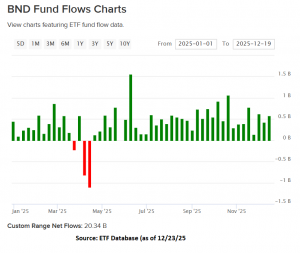
When it comes to getting indexed, broad-based bond exposure in the U.S., it’s hard to beat the Vanguard Total Bond Market ETF (BND). The fund is essentially the entire U.S. bond market (primarily investment-grade) with a low expense ratio of just three basis points. Through December 19, inflows into BND have reached just over $20 billion. Its breadth makes it an ideal option for investors who simply want to use the fund as their entire fixed income allocation.
New to the Vanguard fixed income ETF roster is the Vanguard Core-Plus Bond Index ETF (BNDP), which debuted earlier this month. Prospective investors still get broad-based, diversified U.S. taxable bond exposure, but with a more targeted focus on yield.
BNDP’s debut comes at a time when more investors are seeking additional higher income opportunities, especially after the Fed’s third rate cut of the year. BNDP tracks the Bloomberg U.S. Universal Float Adjusted Index that includes U.S. government and investment-grade corporate. However, it also adds securitized, high yield corporate, and emerging market debt for additional income opportunities.
For more news, information, and strategy, visit the Fixed Income Content Hub.
