
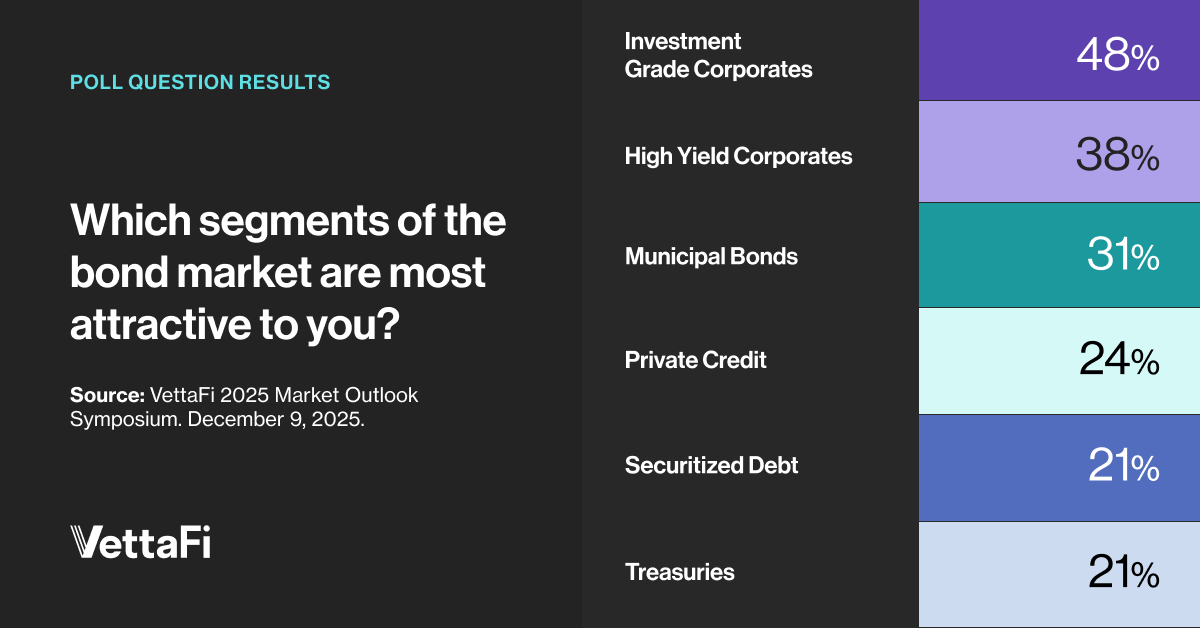
Many advisors and investors are contemplating or actively adjusting their portfolios for the new year. That’s why the insights gathered from attendees at last week’s VettaFi 2026 Market Outlook Symposium were so compelling. We heard from leading fixed income experts from firms like BondBloxx, Goldman Sachs, and PIMCO, but what really captured my attention was the prevailing sentiment toward different parts of the bond market. A poll of attendees revealed that investment grade corporate bonds (48%) and high-yield corporates (38%) were the most attractive segments, outpacing municipal bonds, private credit, securitized debt, and Treasuries.
Investment Grade: The Reliable Performer
The strong interest in investment-grade corporate bonds isn’t surprising. They are often favored for their consistent income and moderate risk profile. They have also delivered solid performance recently. For instance, the Vanguard Intermediate-Term Corporate Bond ETF (VCIT) was up 8.9% year-to-date through December 9, outperforming the iShares Core Aggregate Bond ETF (AGG), which gained 6.8%.
The $58 billion VCIT offers a 4.8% yield and an average duration of 6.0 years. The fund had its assets mostly split between A-rated (44%) and BBB-rated (50%) securities.
High-Yield: A Surge of Investor Confidence
The strong confidence advisors showed in high yield bonds was genuinely notable.
The iShares Broad USD High Yield Corporate Bond ETF (USHY) returned 8.0% for the year as of December 9 and sported an appealing 6.8% yield. This $25$ billion ETF primarily holds BB-rated (54%) and B-rated (34%) securities, with a relatively low average duration of 3.0 years. For index-based, low-cost options, investors can also look at the SPDR Portfolio High Yield Bond ETF (SPHY) and the Schwab High Yield Bond ETF (SCYB), both of which also have net expense ratios below 0.10%.
Samarth Sanghavi, Head of Fixed Income Products at TMX VettaFi, reinforced this positive view. “The December rate cut reinforces high yield’s appeal in a shifting monetary policy environment. The technical backdrop remains supportive, with credit quality across the BB and B spectrum holding firm and default rates tracking below long-term averages. The combination of attractive spreads and limited duration exposure creates a compelling opportunity for fixed income allocators.”
The Rise of Active High-Yield ETFs
While most high-yield ETF assets are currently in index-tracking funds, the supply of actively managed high-yield ETFs is growing. The JPMorgan Active High Yield ETF (JPHY), which launched with $2 billion from an institutional client in June 2025, now manages $2.1 billion. JPHY takes a slightly different approach than USHY, with modestly less BB and B exposure and 6% of assets in BBB-rated securities, and has a net expense ratio of 0.45%.
Another newcomer, the Vanguard High-Yield Active ETF (VGHY), which began trading in September, currently has $106 million in assets and may appeal to investors with its 0.22% fee.
At VettaFi, we have committed to educating the ETF community about the full range of fixed income strategies. Furthermore, we are dedicated to delivering precise, transparent benchmarks that make high-yield investing accessible and actionable for all investors.
For more news, information, and analysis, visit VettaFi | ETF Trends.
