After holding steady for much of 2025, the U.S. Federal Reserve finally instituted the first rate cut of 25 basis points, which could help jumpstart more mergers and acquisitions (M&A) activity. Likewise, this and further rate cuts could benefit exchange traded funds (ETFs) that provide exposure to M&A dealmaking.
A new presidential administration brought in a degree of uncertainty heading into 2025. With rising inflation, recessionary threats, and tariffs added to the mix, it swelled into a sizeable dose of angst for investors. That’s certainly the case for those operating in the M&A space.
Deal Value Rose in August
Nonetheless, the outlook is improving. As noted by an Ernst & Young report, deal value rose during the month of August versus the same period last year. The number of transactions was less than 2024, but the scale and size of the transactions was greater.
Despite macroeconomic headwinds, certain sectors are continuing to see strong M&A activity, such as technology, consumer products, retail, and telecommunications. AI remains a topic of interest, which should help proliferate M&A deals in the future.
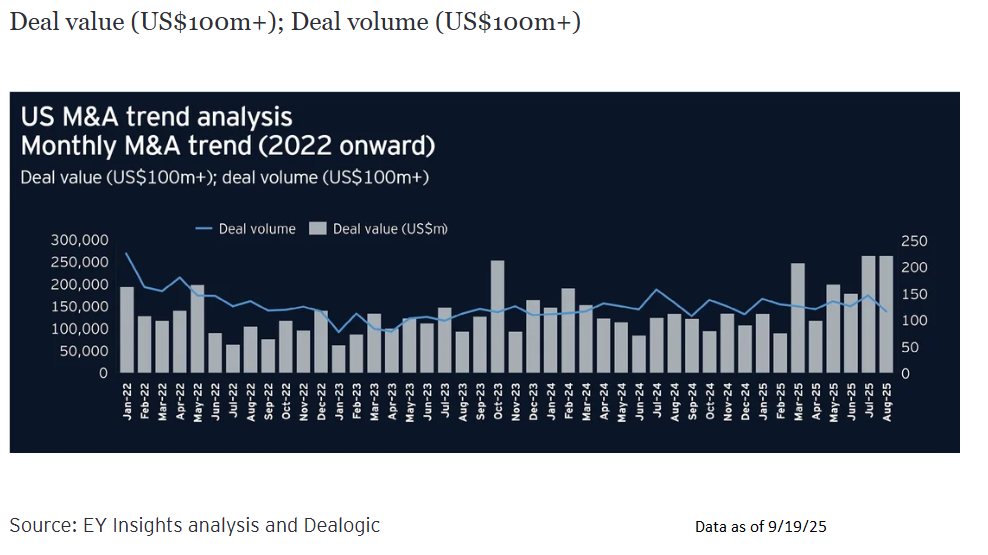
As mentioned, lower interest rates should also provide a catalyst for more deals. Less debt servicing costs opens the door for M&A investors to finance the deals they’ve been putting off while interest rates have been elevated.
“Interest rates play a significant role in M&A because most deals are financed using a combination of debt and equity,” a USC law article on the effect of interest rates on M&A noted. It added that in a high interest rate environment, the “increase in the cost of debt and the additional lending requirements placed on debtors make taking on debt significantly more expensive and time-consuming, which can cool the appetite of businesses looking to merge or acquire.”
The first rate cut doesn’t necessarily signal that further cuts will happen at an accelerated pace. Nonetheless, it’s a first step in the right direction.
“It’s a move in the direction that most dealmakers want to see,” said Joshua Galante, a Stradley Ronon Stevens & Young partner and vice chair for emerging companies and venture capital. “I guess it’s a question of, have they been anticipating that, and are they anticipating further rate cuts in future meetings?”
Indexed ETF Options
Adding M&A-focused ETFs can bring a niche growth component to a portfolio. ETFs that track an index can provide cost-effective solutions, and here are a few options to ponder:
- IQ Merger Arbitrage ETF (MNA): This fund tracks the NYLI Merger Arbitrage Index. Constituents include global companies in which a public announcement of a takeover by an acquirer has been made. The ultimate goal is to generate returns that are represent global merger arbitrage activity. To hedge against any market downside, the index also includes short exposure to global equities.
- AltShares Merger Arbitrage ETF (ARB): This fund tracks the Water Island Merger Arbitrage USD Hedged Index. Constituents in the index are chosen based on a pure-play, global merger arbitrage strategy. It invests in definitive, publicly announced mergers and acquisitions.
- Proshares Merger ETF (MRGR): MRGR tracks the performance of the S&P Merger Arbitrage Index. The index measures the performance of a risk arbitrage strategy exploiting commonly observed price changes related to publicly announced mergers, acquisitions, or other corporate reorganizations.
As mentioned in their fund descriptions, all three ETFs add global exposure, which adds a diversified component to capture upside in companies not just domiciled in the U.S., but also abroad.
An Active Option
Active ETFs provide a portal into flexible investing options. These funds give their portfolio managers the autonomy to adjust holdings as necessary to capture upside or mitigate downside risk. This is helpful in a market environment fraught with uncertainty like now and even more so when navigating the IPO market.
That said, an active option worth considering is the First Trust Merger Arbitrage ETF (MARB). The fund’s strategy involves a combination of long and short positions in the equity securities of companies that are involved in publicly-announced mergers or acquisitions.
The fund has a total expense ratio of 1.74%. Therefore, investors will need to pay a premium compared to its passive counterparts. But for the added flexibility in today’s uncertain market, it could be well worth the expense. Investors looking to compare costs will find MRGR to have the lowest expense ratio of 0.75% compared to the 77 basis points for MNA and 84 basis points for ARB.
Backdoor Plays on M&As
Investors aren’t relegated to just pure play M&A funds. They can get sector-specific exposure when a major merger or acquisition gets top billing in the financial news cycle. For example, Fifth Third Bancorp’s acquisition of Comerica can set up further trends in the industry. This opens up exposure to regional banking ETFs like the SPDR S&P Regional Banking ETF (KRE) or the iShares U.S. Regional Banks ETF (IAT). Google’s agreement to acquire cloud company Wiz earlier this year could provide a setup for cloud computing ETFs like the First Trust Cloud Computing ETF (SKYY) or the WisdomTree Cloud Computing Fund (WCLD).
This is further proof that ETFs can open doors to various opportunities in the market and position investors to capture upside from the latest business trends.
For more news, information, and strategy, visit ETF Trends.
