The ETF market is more crowded than ever. With well over 4,000 U.S.-listed ETFs — more funds than U.S. stocks — differentiation has become its own strategy. That is the context behind the rise of “superstar” ETFs. Some are truly star-powered — a well-known strategist or analyst putting their investment process directly into an ETF or underlying index. Others are star-inspired — funds that mimic public filings of one or more famous managers. The two ideas are similar, yet have differentiated appeals. Here’s what investors and advisors need to know.
Star Powered: Strategist/Analyst Directly Involved
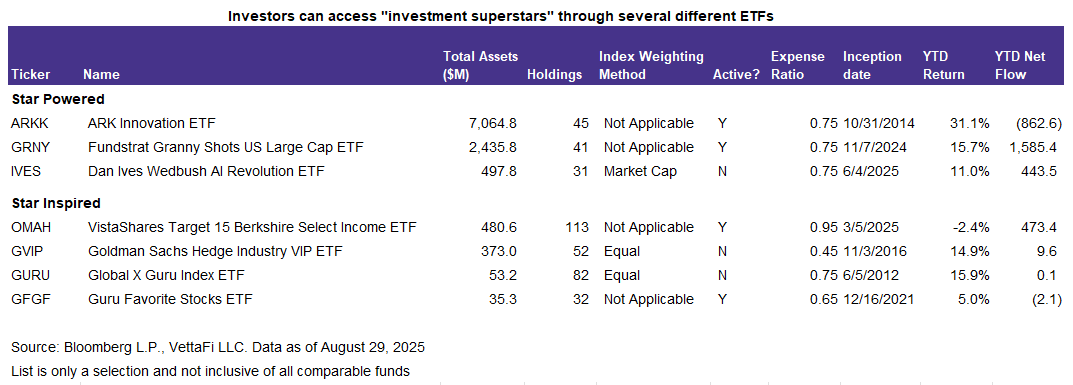
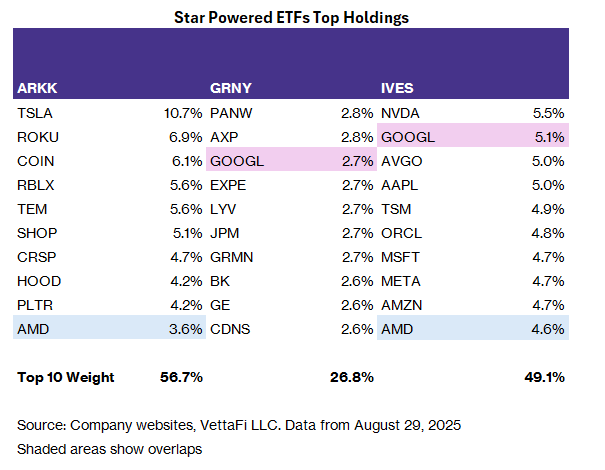
In direct strategist ETFs, the strategist is involved in the index or ETF. Cathie Wood was one of the early pioneers of this trend with her ARK ETFs, including the ARK Innovation ETF (ARKK). A mix of bold positions, daily transparency, and a successful 2020 put her and her ETFs at the center of the retail and advisor conversation. Her impact continues to stand today. Every time she makes a trade, it ends up a news headline. ARKK normalized the idea that a distinctive investment voice can earn flows.
Several funds have recently followed along a similar path. Tom Lee’s Fundstrat Granny Shots Large Cap ETF (GRNY) launched in November 2024. It has received significant investor attention. The fund currently sits around $2.3 billion as of mid-August. Tom Lee’s strategy combines a top-down fundamental research methodology with a bottom-up stock selection strategy. Stocks must align with at least two themes including both short-term themes (style tilt, seasonality, and PMI recovery) and long-term themes (energy/cyber security, Millennials, global labor suppliers, and easing financial conditions).
The Dan Ives Wedbush AI Revolution ETF (IVES) launched in early June and has quickly approached the half-billion mark. That’s a significant milestone among a highly competitive group of ETFs. IVES reflects AI stocks drawn from Dan Ives’ (a well-known technology analyst) published research.
Those are meaningful early assets for both funds (even with both funds charging 75 basis points). And they have broader implications. In a crowded marketplace, narrative and name recognition can do a lot of the early heavy lifting. The main advantage: The investor can access the manager’s live view rather than a quarterly echo based on public filings. That attention can offset certain headwinds (distribution, fees, and concentrated portfolios) long enough for the strategy to prove itself. Although these funds cost well above an S&P 500 ETF, it is arguably reasonable if you consider manager skill and if you’re intentionally adding these funds as a way to diversify return along the edges of a portfolio.
More is coming in the future. Fundstrat has filed for two more similar Granny Shots funds — a small/midcap fund and a large-cap income fund. And Ron Baron’s Baron Capital has also filed to bring their research into ETF form.
Star Inspired: Mimics One or More Strategists Using 13F Filings
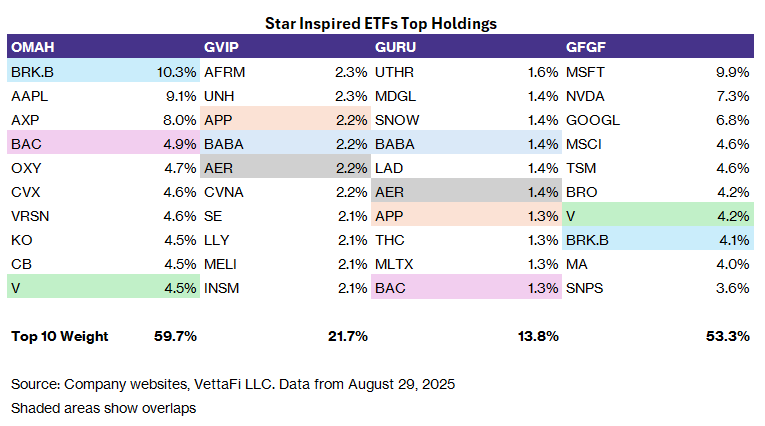
The second camp is the 13F mimic, where the star is inspirational rather than directly involved. The VistaShares Target 15 Berkshire Select Income ETF (OMAH), for example, aims to mirror Berkshire Hathaway’s (Warren Buffett) equities portfolio using 13F filings. OMAH also overlays a covered-call program to target a 15% annualized distribution paid monthly. That is a very different strategy from the above. But you still gain the comfort of a famous portfolio or manager as a starting point. These managers, however, often don’t offer retail products. So this is the closest a retail investor can typically get. But you have to accept a lag since 13F holdings are disclosed up to 45 days after quarter-end. And in this particular case, you cap some upside with the options overlay. VistaShares is in the process of launching several other funds with similar strategies targeting strategists like Bill Ackman and Michael Burry.
There are several similar products in the market that follow 13F filings (although not with a single specific strategist). Because these don’t focus on a specific strategist, they may appeal less to starstruck investors and appeal more to those who want to emulate returns from hedge funds and other nonretail-focused vehicles. The Goldman Sachs Hedge Industry VIP ETF (GVIP) tracks an index that follows stocks that frequently appear in the top 10 holdings of hedge fund managers.
Other funds include the Global X Guru Index ETF (GURU), an indexed ETF that represents top U.S. stock picks from leading hedge funds, and the Guru Favorite Stocks ETF (GFGF), an active ETF that uses proprietary screening methods to select from companies favored by a group of prominent long-term investors. Because these three ETFs use different methodologies, top holdings vary greatly.
Bottom line
So where do these funds fit? Not typically at the core. They’re best used as satellites — smaller exposures designed to express a view, align with a research process clients recognize, or energize a conversation about themes (e.g., artificial intelligence, large-cap quality, innovation) that complement core holdings.
Costs are higher, certain strategies may carry a lag, and the media headlines can swing both negative and positive. But in an era of product overload, a recognizable research voice can make it easier to own an ETF and stick with it through the highs and lows.
For more news, information, and analysis, visit VettaFi | ETF Trends.
