
What You’ll Learn:
Authorized in the U.S. by the SEC in January 2024—first with Bitcoin, followed by Ethereum in July—crypto ETFs have gained significant traction, with over $45 billion in net inflows since launch (as of June 3, 2025). While single-asset products have led the charge, the expected coming of crypto index ETFs could soon reshape how advisors can offer diversified, strategic exposure to the broader digital asset market.
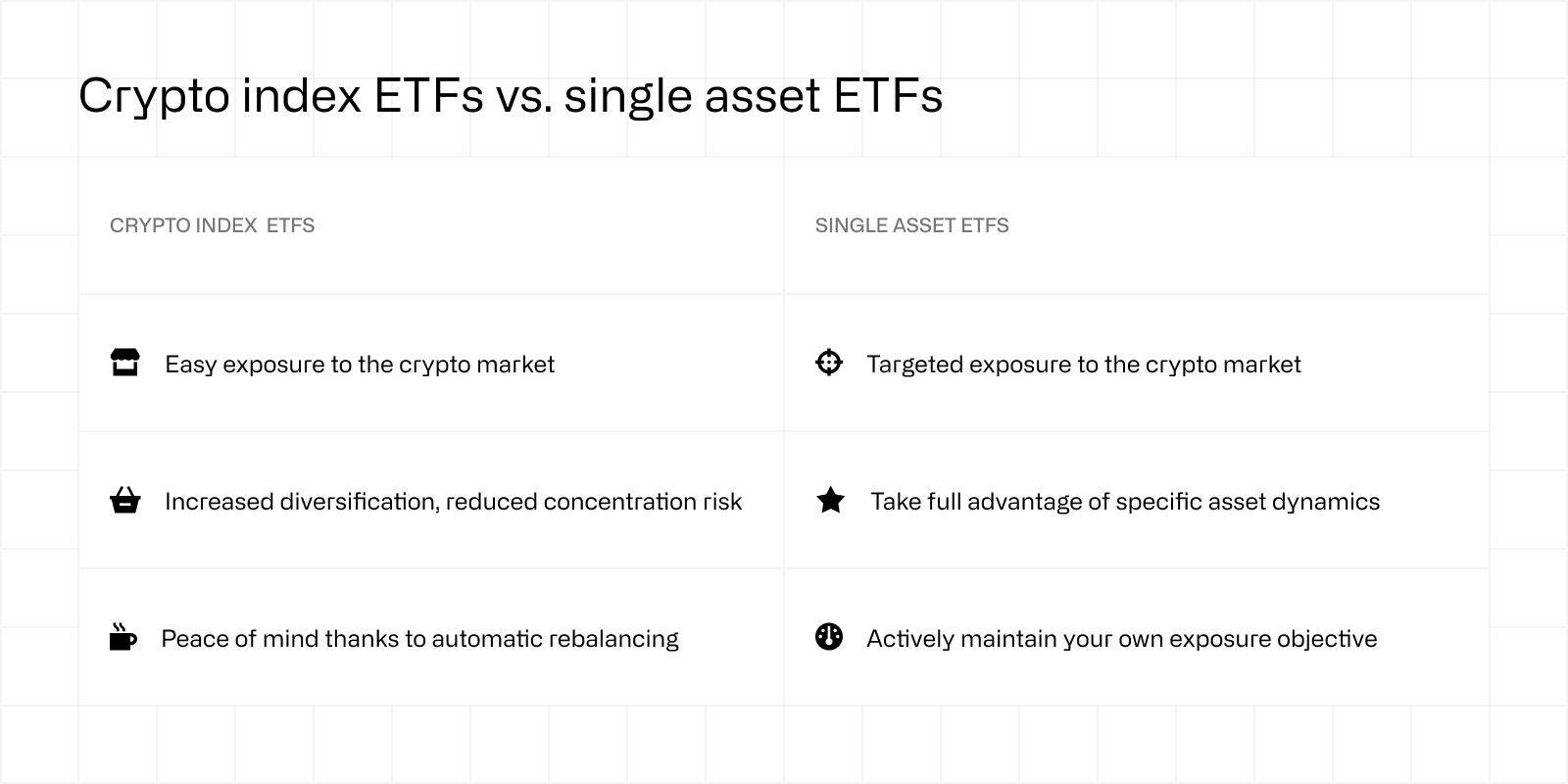
In this article, we’ll explore how crypto index ETFs are structured, how they differ from single-asset products, and how financial professionals can incorporate them into diversified portfolios with clear goals around sizing, suitability, and risk management.
Understanding the basics: What are crypto ETFs?
Crypto index ETFs are exchange-traded funds that track a basket of cryptocurrencies rather than a single asset like Bitcoin or Ethereum. These indices may follow market-cap-weighted strategies, sector themes (e.g., Layer 1s, DeFi, infrastructure), or risk-weighted allocations, offering broad-based exposure to the digital asset class.
Similar to traditional index ETFs, they offer a rules-based methodology, passive management, and daily liquidity. The key difference lies in the underlying assets: instead of equities or bonds, crypto index ETFs include a diversified set of cryptocurrencies, which may be rebalanced periodically.
For advisors, crypto index ETFs can reduce concentration risk and provide a more nuanced way to express a long-term view on the growth of the crypto economy.
Evaluating the benefits and risks
Benefits
- Diversification: Index-based exposure spreads risk across multiple digital assets, mitigating volatility driven by any one token.
- Efficient access: Advisors can gain broader exposure through a single product, simplifying compliance, custody, and execution.
- Rules-based structure: Index ETFs follow transparent, pre-defined methodologies—helping clients understand exactly what they own and why.
In a regulatory environment that is evolving rapidly, these products also fit more easily into existing advisor workflows, especially when physically backed.
Risks
Despite their advantages, crypto index ETFs are not without challenges:
- Index methodology risk: the construction and rebalancing logic can create bias, especially in fast-moving or illiquid markets.
- Asset selection and quality: not all index constituents may meet the standards of institutional investors in terms of security, liquidity, or regulatory clarity.
- Market volatility: while diversification helps, crypto markets remain volatile. Even a broad index may experience significant drawdowns.
What a crypto index would look like in a portfolio
Crypto index ETFs can serve as a thematic satellite allocation, offering clients exposure to long-term innovation trends without overcommitting to a single protocol or token. Because of their diversified nature, they may also play a role in a portfolio’s alternatives sleeve or as a hedge against fiat currency debasement.
Position sizing remains critical. Even a small allocation—typically 4% according to CoinShares—can provide exposure to the asset class while maintaining overall portfolio stability.
Advisors should consider:
- Client sophistication and goals
- Time horizon and risk tolerance
- Comfort with underlying asset liquidity and volatility
For clients seeking exposure to the crypto economy as a whole—rather than betting on Bitcoin or Ethereum alone—crypto index ETFs may offer a compelling entry point.
Why It Matters to Advisors
With growing demand for diversified, compliant access to crypto, financial advisors are being called to understand the next generation of investment vehicles. Crypto index ETFs bridge thematic investing, passive strategies, and blockchain innovation.
Understanding how these products work—and how they differ from single-asset ETFs—is essential for advisors who want to deliver informed, forward-thinking guidance to their clients. As index investing helped shape the modern portfolio, crypto index ETFs may help shape the future of it.
