
While crypto adoption will likely always be price-driven to some extent, regulatory and political tailwinds have driven a steady influx of launches throughout the year despite price volatility. We are not even halfway through 2025 and have already seen around 27 crypto ETF launches. With even more filings in the pipeline, we will likely see the number of launches this year surpass last year’s figure of around 41 launches (which includes the mass launches of both spot bitcoin and spot ether).
There has been a broad mix of products released this year, which proves several things: 1) there is at least some investor interest beyond traditional spot ETFs; 2) there is more interest in bitcoin as a portfolio tool; and 3) crypto is becoming further integrated into the financial markets. The following is a short summary of current crypto ETF sentiment along with my attempt to list all the crypto ETFs launched so far in 2025.

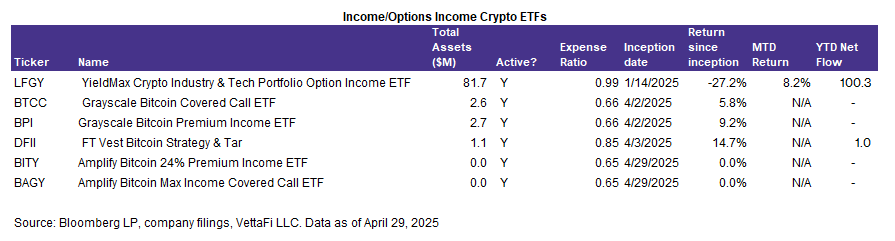
Income/Option Income Crypto ETFs
Previously, part of bitcoin’s mainstream appeal was the potential of large returns. Now more investors are interested in bitcoin itself — how it works and what its digital ecosystem entails. And now those investors are looking for how bitcoin (and other cryptocurrencies) can serve as a tool in their portfolios. One way has been using bitcoin’s volatility to generate income through options.
- The YieldMax Crypto Industry & Tech Portfolio Option Income ETF (LFGY) targets weekly income distributions by writing call options on its portfolio of 15-30 crypto companies.
- Grayscale released two bitcoin income products this year: the Grayscale Bitcoin Covered Call ETF (BTCC) and the Grayscale Bitcoin Premium Income ETF (BPI). BTCC provides regular income. It uses call options very close to the spot price. BPI also targets income, but additionally allows some participation in bitcoin’s upside potential by writing out-of-the-money calls.
- The FT Vest Bitcoin Strategy & Target Income ETF (DFII) uses options on bitcoin ETFs to target an annual income level of 15% above the annual income yield of one-month U.S. Treasuries.
- Amplify also freshly released two new income ETFs: the Amplify Bitcoin 24% Premium Income ETF (BITY) and the Amplify Bitcoin Max Income Covered Call ETF (BAGY). Both use a weekly call option strategy — BITY targets a 24% annual option premium income, while BAGY seeks 30%-60% annualized option premium in addition to bitcoin price exposure.
Structured Protection/Defined Outcome Crypto ETFs
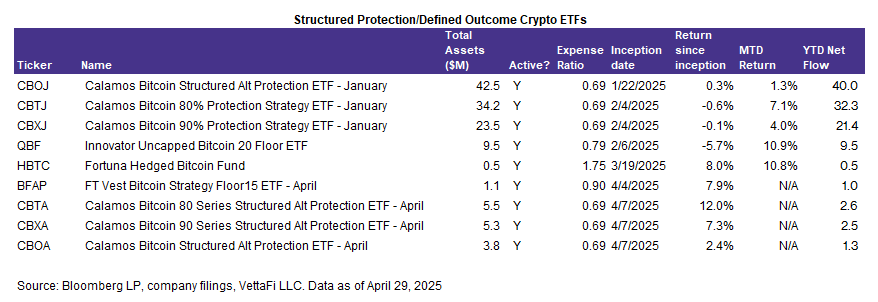
These ETFs provide exposure to bitcoin up to a cap, while protecting against a specified amount of losses. While this strategy has been around for a long time, it recently gained popularity over the past few years due to market uncertainty. It makes sense that the strategy has extended to bitcoin, where investors may be curious but not willing to fully commit to its volatility.
- The Calamos Bitcoin Structured Alt Protection ETF – April (CBOA) protects against 100% of losses over a one-year period while providing a cap of close to 11% at the start of the outcome period. It was released along with the Calamos Bitcoin 90 Series Structured Alt Protection ETF – April (CBXA), which has 90% protection and 29% cap, and the Calamos Bitcoin 80 Series Structured Alt Protection ETF – April CBTA, which has 80% protection and a cap near 52%. (Calamos also released a January series earlier this year with tickers CBOJ, CBXJ, and CBTJ, which provide 100%, 90%, and 80% protection, respectively.)
- The Innovator Uncapped Bitcoin 20 Floor ETF (QBF) provides a starting participation of 70% to bitcoin’s upside potential while capping max loss at 20%.
- The FT Vest Bitcoin Strategy Floor15 ETF April (BFAP) provides a cap of almost 35% and a max loss of 15%
- The Fortuna Hedged Bitcoin Fund (HBTC) also provides an options-hedged strategy to bitcoin that is intended to reduce its volatility.
Crypto Equities (And More) ETFs
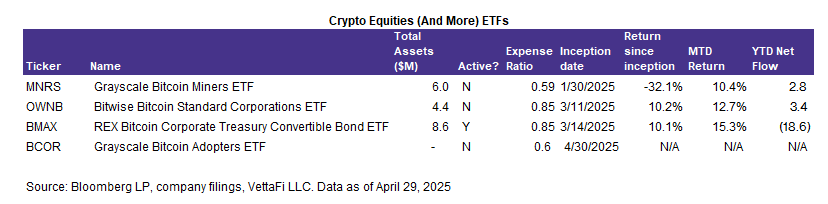
Historically, crypto equity ETFs (including mining ETFs) were popular as a proxy to bitcoin. But investor interest fizzled out in favor of more closely correlated products — first futures ETFs, then spot ETFs. Now they have started to rekindle some interest as investors grow more interested in the broader crypto ecosystem.
- Grayscale has revived the crypto mining space with the newly launched Grayscale Bitcoin Miners ETF (MNRS). Miners can exhibit wider price swings than bitcoin (miners are typically leveraged to the price of the underlying commodity), which can be attractive for investors who are long-term bullish in the space.
- An interesting angle to the equity story has been ETFs that hold corporations with bitcoin on their balance sheet. The Bitwise Bitcoin Standard Corporations ETF (OWNB) provides access to equities of corporations that hold at least 1,000 bitcoin on their balance sheet and embrace bitcoin as a strategic reserve asset. Holdings include many crypto miners in addition to Strategy (MSTR), Coinbase (COIN), and Tesla (TSLA).
- Similarly, the REX Bitcoin Corporate Treasury Convertible Bond ETF (BMAX) invests in convertible bonds issued by companies that hold at least 15% of assets (or derive 15% of income) from bitcoin.
- Grayscale also recently launched the Grayscale Bitcoin Adopters ETF (BCOR), which will contain companies with at least 100 btcoin.
Stacked Crypto ETFs
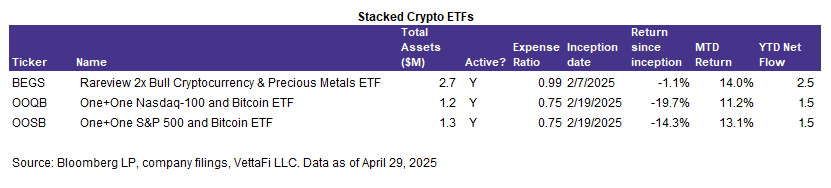
Several of these “stacked” ETFs emerged last year, which use derivatives/leverage to turn $1 investment into $1 in investment A and $1 in investment B. This allows investors to more effectively invest in a 1:1 core versus bitcoin strategy.
- The Rareview 2x Bull Cryptocurrency & Precious Metals ETF (BEGS) provides dual exposure to cryptocurrencies and precious metals through the use of leverage. It has around 75% of its crypto asset weight in bitcoin and 25% in ether. Likewise, it has around 75% of its precious metals weight in gold and 25% in silver.
- VolatilityShares’ One+One Nasdaq-100 and Bitcoin ETF (OOQB) provides dual exposure to the Nasdaq-100 and bitcoin futures.
- The One+One S&P 500 and Bitcoin ETF (OOSB) similarly provides dual exposure to the S&P 500 and bitcoin futures.
Indexing/Basket Crypto ETFs
With both spot bitcoin and ether products currently available (and the potential for more spot ETF approvals), a popular strategy issuers are exploring is to create an indexed fund with multiple spot exposures. This would provide investors with a single diversified crypto ETF rather than investing separately in multiple products.
- The Hashdex Nasdaq Crypto Index US ETF (NCIQ) and the Franklin Crypto Index ETF (EZPZ) both provide investors access to a basket containing bitcoin and ether (currently around 90% bitcoin and 10% ether). While both products are similar, NCIQ seemed to have a first-mover advantage — launching less than one week prior — with $102 million assets relative to EZPZ’s $4 million in assets. Out of the 26 products launched so far this year, NCIQ is currently the largest.
- Several other adjacent products are in the potential conversion pipeline — the Grayscale Digital Large Cap Fund and the Bitwise 10 Crypto Index — which are filing to convert to an ETF structure.

Altcoins (ex-Ether) ETFs
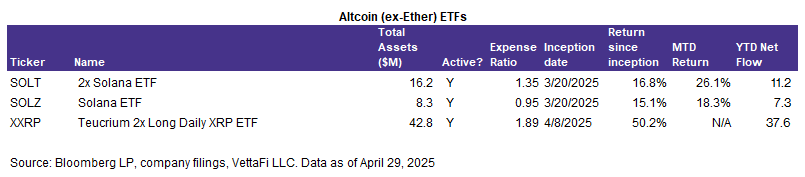
One of the most interesting (but technically less practical) subcategories is alt coins. There is not a lot of demand for cryptocurrencies outside of bitcoin and ether among mainstream retail investors. But the launch of spot products creates the potential for an expanded basket of cryptocurrencies mentioned above. While we have not yet seen more spot products launched (although several have filed with the SEC), we recently saw the first derivatves-based Solana and XRP products.
- The Solana ETF (SOLZ) and the 2x Solana ETF (SOLT) were both recently launched by Volatility Shares. SOLZ uses futures to provide access to Solana, while SOLT provides a 2x leveraged option.
- Despite an initial suspected lack of demand, the Teucrium 2x Long Daily XRP ETF (XXRP) has already attracted $43 million in assets after launching less than a month ago on April 8. It’s possible that XXRP is riding the wave of leveraged ETFs (discussed here).
Bottom Line:
The spot bitcoin ETF launch set a high bar for the future of crypto ETFs. The iShares Bitcoin Trust (IBIT) currently has $57 billion in assets. It continues to see net inflows YTD (about $3.9 billion) despite an uncertain market. But there is still room (and demand) for more crypto ETFs products. That can help investors make tactical moves, potentially enhance portfolio return, and more easily explore the benefits of an exciting, emerging asset class.
For more news, information, and strategy, visit the Crypto Channel.
