• Expert Insights
  • Content Hubs
        • Themes
          • Active ETFs
          • Free Cash Flow
          • Alternatives
          • Future ETFs
          • Artificial Intelligence
          • Innovative ETFs
          • China Insights
          • Institutional Income Strategies
          • CoinShares
          • Leveraged & Inverse
          • Core Strategies
          • Market Insights
          • Crypto
          • Market Outlooks
          • Disruptive Technology
          • Modern Alpha
          • Energy Infrastructure
          • Nuclear Energy
          • ETF Building Blocks
          • Portfolio Strategies
          • ETF Investing
          • Sector Investing
          • ETF Strategist
          • Tax Efficient Income
          • Financial Literacy
          • Thematic Investing
          • Fixed Income
        • Asset Class
          • Equity
            • Emerging Market Equities
            • Int'l Developed
            • U.S. Equity
          • Fixed Income
            • High Yield Corporates
            • Int'l Fixed Income
            • Investment Grade Corporates
            • US Treasuries & TIPS
          • Alternatives
            • Gold/Silver/Critical Materials
            • Cryptocurrency
            • Currency
            • Volatility
        • ETF Ecosystem
        • ETFs in Canada
        • Market Outlook
        • Exchange
        • CoinShares
  • Webcasts
  • Popular ETFs
    • SPY – SPDR S&P 500 ETF
    • VOO – Vanguard S&P 500 ETF
    • QQQ – Invesco QQQ ETF
    • GLD – SPDR Gold Shares ETF
    • IVV – iShares Core S&P 500 ETF
    • EFA - iShares MSCI EAFE ETF
    • IEMG – iShares Core MSCI Emerging Markets ETF
    • EEM – iShares MSCI Emerging Markets ETF
    • VTI – Vanguard Total Stock Market ETF
    • GDX - VanEck Vectors Gold Miners ETF
    • XLF - Financial Select Sector SPDR Fund
    • VEA – Vanguard FTSE Developed Markets ETF
    • VTV - Vanguard Value ETF
    • Top Gold ETFs
    • Top Oil ETFs
    • Top Commodity ETFs
    • Top Hedge Fund ETFs
    • Top Financials ETFs
    • Top Inverse Equities ETFs
    • Top High Yield Bond ETFs
  • Education & Media
    • Newsletter
    • New ETFs
    • Education Central
    • Videos
    • ETF of the Week Podcast
    • ETF Prime Podcast
    • Gaining Perspective
    • ETF 360 Video Series
  • Sectors
    • Sector Investing Content Hub
    • Sector Power Rankings
    • XLK
    • XLE
    • XLI
    • XLC
    • XLU
    • XLF
    • XLY
    • XLV
    • XLP
    • XLB
    • XLRE
  • Events
    • Asset Allocation Summit
    • Midyear Market Outlook
    • 2027 Market Outlook
    • Q2 Market Outlook
    • Winter Symposium
  • Company
    • About VettaFi
Smart Beta Content Hub

Five Methods for Intangible Asset Valuation

Validea's Guru Investor Blog March 7, 2019

An article in CFA Institute argues that intangible assets (non-physical assets such as trademarks, patents, etc.) are “increasingly critical to corporate value, yet current accounting standards make it difficult to capture them in financial statements.”

As investment in intangible assets has grown (the article reports that it now represents 33.4% of total U.S. gross domestic investment in 2018), “the value of those assets as drivers of enterprise value becomes ever more essential.”

The article outlines five common methodologies that “build on historical and prospective financial information within the framework of current accounting standards” and explains how they can be used to ascertain a firm’s competitive standing:

  1. Relief from Royalty Method (RRM)— is based on the hypothetical royalty payments that would be saved by owning the asset rather than licensing it. This method is often used to value intangibles that can be tied to a specific revenue stream and where “data on royalty and license fees from other market transactions are available.”
  2. Multiperiod Excess Earnings Method (MPEEM)– -is a “variation of discounted cash-flow analysis.” MPEEM isolates those cash flows associated with a single intangible asset and measures fair value by discounting them to present value. This method is used primarily when one asset is the primary driver of a firm’s value.
  3. With and Without Method (WWM)—estimates an intangible asset’s value by calculating the difference between two discounted cash-flow models: one based on the “status quo” for the business with the asset, and the other without it. This method is often used to value noncompete agreements.
  4. Real Option Pricing—is used mostly for assets that have the potential to generate cash flow in the future but are not doing so now, such as undeveloped patents and/or undeveloped natural resource options. “As with stock options,” the article notes, “a key challenge in the valuation of real options is assessing the underlying volatility.”
  5. Replacement Cost Method Less Obsolescence—requires an assessment of the replacement cost for the intangible asset, which is then adjusted for an obsolescence factor relative to the intangible asset.

The following chart summarized the models:
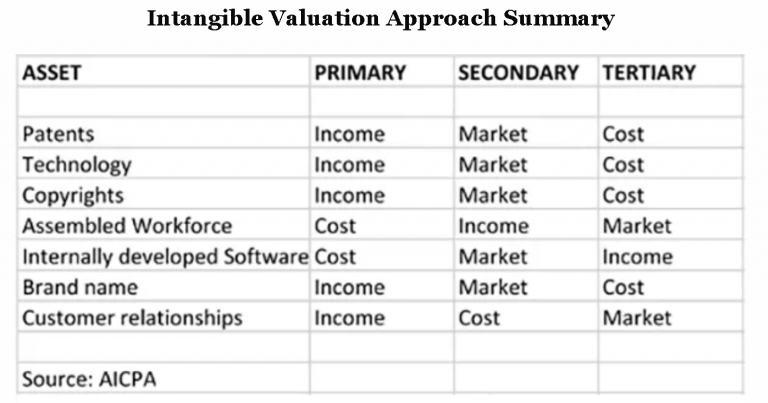
The article concludes: “In today’s economy, the value provided by intangible assets must be captured in enterprise valuation. Analysts have to expand the range of data sources and techniques they use in valuation and develop methodologies that are suitable to the intangible asset being valued for more reliable valuation results.”

For more market trends, visit ETF Trends.

RELATED TOPICS
ETF - Exchange Traded FundsETPflowssmart beta

Earn free CE credits and discover new strategies

X