• Expert Insights
  • Content Hubs
        • Themes
          • Active ETFs
          • Free Cash Flow
          • Alternatives
          • Future ETFs
          • Artificial Intelligence
          • Innovative ETFs
          • China Insights
          • Institutional Income Strategies
          • CoinShares
          • Leveraged & Inverse
          • Core Strategies
          • Market Insights
          • Crypto
          • Market Outlooks
          • Disruptive Technology
          • Modern Alpha
          • Energy Infrastructure
          • Nuclear Energy
          • ETF Building Blocks
          • Portfolio Strategies
          • ETF Investing
          • Sector Investing
          • ETF Strategist
          • Tax Efficient Income
          • Financial Literacy
          • Thematic Investing
          • Fixed Income
        • Asset Class
          • Equity
            • Emerging Market Equities
            • Int'l Developed
            • U.S. Equity
          • Fixed Income
            • High Yield Corporates
            • Int'l Fixed Income
            • Investment Grade Corporates
            • US Treasuries & TIPS
          • Alternatives
            • Gold/Silver/Critical Materials
            • Cryptocurrency
            • Currency
            • Volatility
        • ETF Ecosystem
        • ETFs in Canada
        • Exchange
        • CoinShares
  • Webcasts
  • Popular ETFs
    • SPY – SPDR S&P 500 ETF
    • VOO – Vanguard S&P 500 ETF
    • QQQ – Invesco QQQ ETF
    • GLD – SPDR Gold Shares ETF
    • IVV – iShares Core S&P 500 ETF
    • EFA - iShares MSCI EAFE ETF
    • IEMG – iShares Core MSCI Emerging Markets ETF
    • EEM – iShares MSCI Emerging Markets ETF
    • VTI – Vanguard Total Stock Market ETF
    • GDX - VanEck Vectors Gold Miners ETF
    • XLF - Financial Select Sector SPDR Fund
    • VEA – Vanguard FTSE Developed Markets ETF
    • VTV - Vanguard Value ETF
    • Top Gold ETFs
    • Top Oil ETFs
    • Top Commodity ETFs
    • Top Hedge Fund ETFs
    • Top Financials ETFs
    • Top Inverse Equities ETFs
    • Top High Yield Bond ETFs
  • Education & Media
    • Newsletter
    • New ETFs
    • Education Central
    • Videos
    • ETF of the Week Podcast
    • ETF Prime Podcast
    • Gaining Perspective
    • ETF 360 Video Series
  • Sectors
    • Sector Investing Content Hub
    • Sector Power Rankings
    • XLK
    • XLE
    • XLI
    • XLC
    • XLU
    • XLF
    • XLY
    • XLV
    • XLP
    • XLB
    • XLRE
  • Events
    • Asset Allocation Summit
    • 2027 Market Outlook
    • Q2 Market Outlook
    • Winter Symposium
    • Midyear Market Outlook
  • Company
    • About VettaFi
Advisor Solutions Content Hub

Moody’s: Schools Suffer As Unfunded Pension Liabilities Grow

ValueWalk October 30, 2018

by Rupert Hargreaves, ValueWalk

At the end of September, the Board of Governors of the Federal Reserve System pegged unfunded pension liabilities of US state and local governments at more than $4 trillion, a significant increase on the previous figure of $2 trillion.

The new number is the reflection of an accounting change in the way that the Fed considers expectations of future salary growth.

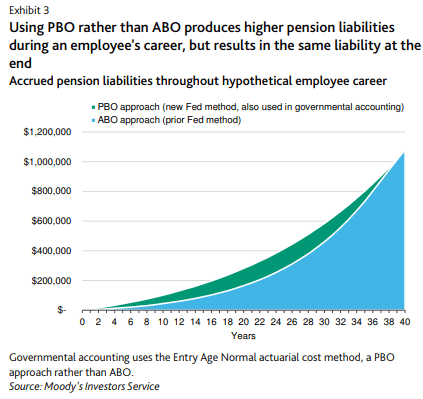
Under the previous model, the Fed relied on an “accrued benefit obligation,” or “ABO,” approach to measuring liabilities. This method used salary growth once it had already occurred, rather than projected salary growth. As pension benefit formulas are typically based on higher average salaries, which tend to occur towards the end of an employees career, ABO accounting can give somewhat of a misleading estimate of future pension obligations.


Instead, the Fed has now adopted a “projected benefit obligation,” or “PBO,” approach. This method of accounting recognizes assumed future salary growth, which gives a more accurate reflection of the ultimate pension liability that will arise for each employee.

Accounting change

The most significant difference between ABO and PBO accounting is that the former tends to understate the ultimate pension obligations for each employee throughout their career while PBO accounting gives a smoother, more realistic and less volatile prediction, as the chart from credit rating agency Moody’s below shows.
Unfunded Pension Liabilities

Continue Reading »
RELATED TOPICS
IRSpersonal financetaxtax returnTaxes

Earn free CE credits and discover new strategies

X