Sector investing has long been a popular approach with many investors, and thanks to ETF product innovation, it’s hardly a one-size fits all effort. Aligning access to sectors with personal risk tolerance is easily done these days with different ETFs.
During earnings season, many conversations around sector exposures gain momentum as varying earnings results lead to disparity in sector performances. This time around, with over a third of S&P 500 companies having already reported, results are a mixed bag, according to FactSet data.
On one side, the S&P 500 is on path to see its fifth consecutive quarter of double-digit net profit margins, which remain above year-on-year and five-year average results. On the flip side, the current reading above 12% would also equate to the first quarter-over-quarter decline since late 2023, FactSet data shows.
Earnings tell a similar story. About 80% of the companies that have already reported have beat earnings estimates. But the blended YOY earnings growth rate for the S&P 500, currently trending toward 6.4%, would be the benchmark’s lowest growth rate since early 2024.
“At the sector level, only three sectors are reporting a year-over-year increase in their net profit margins in Q2 2025 compared to Q2 2024,” FactSet reported. “Communication Services (14.2% vs. 11.6%), Information Technology (24.8% vs, 24.0%), and Financials (19.6 vs. 18.8%).”
The other eight are currently tallying a YOY decrease. All of this translates to disparity in performance. Year-to-date, there’s roughly 19 percentage points between the best performing S&P 500 sector (industrials) and the worst (healthcare). If you look back 12 months, that disparity exceeds 37 percentage points.
Owning specific sectors or rotating sector exposure can take many forms with ETFs. Consider three unique index-based approaches as an example.
The SPDRs
State Street Investment Management first democratized access to sectors with the launch of the Select Sector SPDRs back in 1998. Each fund in the lineup is aligned to an S&P 500 sector as classified by GICS.
The SPDRs have long been the sector proxies, as market-cap beta, and popular building blocks across sector portfolios. They are highly liquid, tradable, and low cost. They are easy to use.
The Technology Select Sector SPDR (XLK) is the largest of the group, with $83 billion in assets. The Financials Select Sector SPDR (XLF) comes second, at $51 billion. Together, the 11 ETFs boast more than $312 billion in combined assets.
The SPDRs are the industry’s benchmark for sectors, but there are other interesting approaches if traditional market-cap-weighted beta isn’t what you are looking for.
The Equal Weight-ers
If the top-heaviness of the market is on your mind, and you are looking to mitigate concentration risk, an equal-weighted approach is a compelling alternative to sector exposure.
Invesco is a leader in this category. The firm behind the first and largest S&P 500 equal-weight ETF, the Invesco S&P 500 Equal Weight ETF (RSP), also offers a lineup of sector portfolios that assign equal weight to each underlying security.
The lineup includes funds like the Invesco S&P 500 Equal Weight Technology ETF (RSPT), the Invesco S&P 500 Equal Weight Communication Services ETF (RSPC), the Invesco S&P 500 Equal Weight Consumer Discretionary ETF (RSPD), and the Invesco S&P 500 Equal Weight Financials ETF (RSPF) among others.
Equal weighting tackles the problem of portfolio concentration triggered by market capitalization head-on. Each security in these ETFs carries the same weight in the portfolio as the next one.
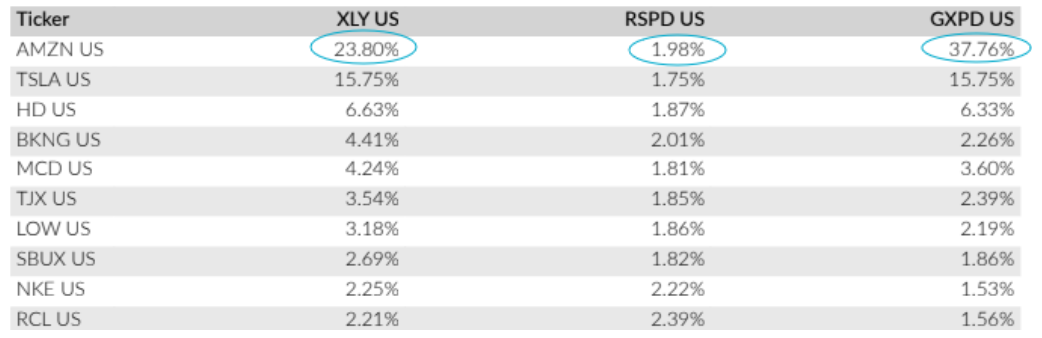
For example, consider the consumer discretionary sector as measured by the Consumer Discretionary Select Sector SPDR Fund (XLY). Under the hood, a look at top 10 holdings shows Amazon currently leading allocation with a 23.8% weight. Almost a quarter of the fund is tied to that single stock. Roughly 40% of XLY sits in just two names: Amazon and Tesla.
Investors looking to diversify some of that concentration among top holdings can find a solution in Invesco’s RSPD where holdings currently represent about 2% of the fund. Amazon plus Tesla snag a 4% slice of the portfolio.
Global X PureCap
At the other end of the concentration-risk spectrum is a new approach to sector investing, launched this summer by Global X. Named the “PureCap” funds, these sector ETFs allow for even more concentration than traditional market-cap SPDRs would.
The funds work around regulated investment company (RIC) diversification rules under Sector 851 of the Internal Revenue Code, which call for single-stock exposure to be capped at 25% of a fund’s total assets. The rules also stipulate that positions representing at least 5% can’t exceed 50% of the fund when combined.
There are some exceptions, such as U.S. government securities, cash, and other RICs, which is exactly what Global X leans into to let concentration run as the market dictates. (You can read more about the inner workings of the strategy here.)
The current lineup, fresh off the launchpad, include only five sectors — the ones where the firm saw the most opportunity to capitalize on concentration. They are:
- Global X PureCapSM MSCI Consumer Discretionary ETF (GXPD)
- Global X PureCapSM MSCI Communication Services ETF (GXPC)
- Global X PureCapSM MSCI Information Technology ETF (GXPT)
- Global X PureCapSM MSCI Consumer Staples ETF (GXPS)
- Global X PureCapSM MSCI Energy ETF (GXPE)
Side-By-Side
If you were to consider these three different sector approaches, the differences in underlying exposure — and ultimately returns — can be significant.
As an example, look at the Consumer Discretionary sector through what we’ll call the traditional XLY, the concentration-averse RSPD, or the concentration-friendly GXPD. Amazon is the top holding in that sector, but it snags a much different slice of each fund’s total assets.
Source: VettaFi PRO
Here are some ETF basket statistics, side by side:

Source: VettaFi PRO
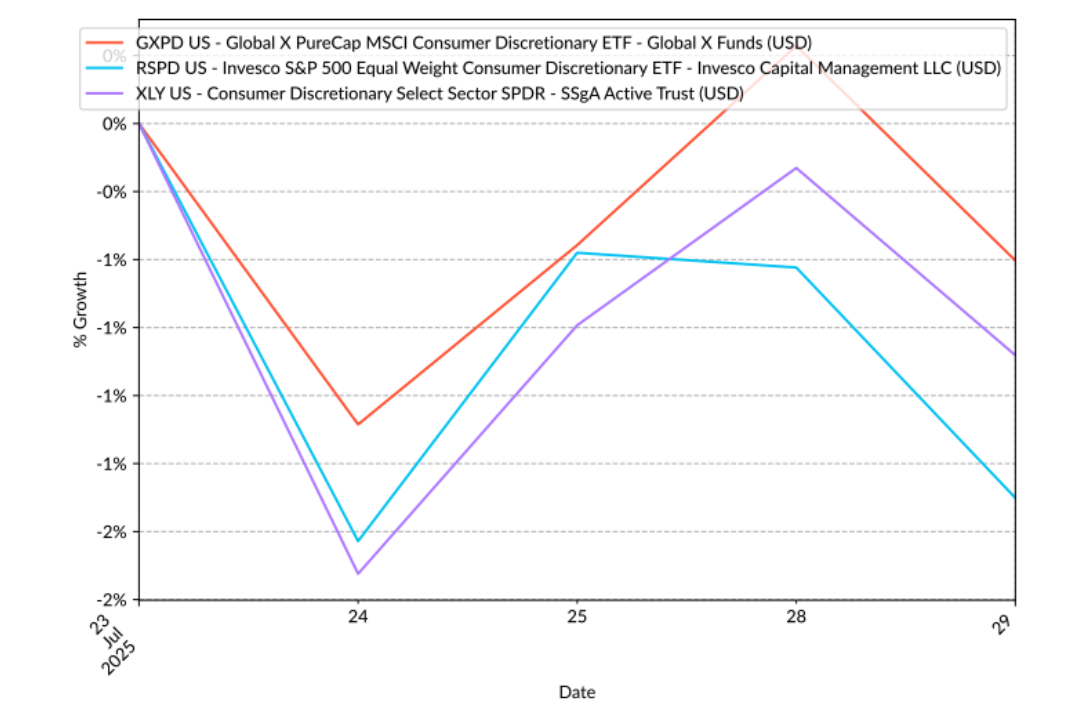
While live performance data is very limited for the Global X suite of funds since they just launched in late July, we can already get a glimpse at the different in results for each strategy depending on the breadth of market leadership. Concentration can work in your favor or against it.
Data source: VettaFi PRO
More ETF Approaches to Choose From
These three sector approaches — traditional, equal-weighted, or PureCap — are just a sample of the many ways you can access sectors with ETFs. Just this week, State Street launched an options-based take on sector SPDRs for income seekers. (My colleague Todd Rosenbluth covered the launch here.)
Sector investing is a well-tested investment approach, with many ways to be implemented. What’s more, product innovation continues to sharpen the tools for sector investing. Head to ETFdb.com to dig deeper into these funds.
For more news, information, and analysis, visit VettaFi | ETF Trends.
