
By Brian Manby, CFA.
Key Takeaways
- The 2024 rebalance of the WisdomTree Global Dividend Index (WTGDIV) introduces new dividend payers like Meta and Alphabet while eliminating riskier names like BMW and Mercedes-Benz due to stringent screening criteria.
- Non-U.S. companies, particularly in Europe and Japan, continue to dominate global dividend contributions despite being underrepresented in market cap-weighted indexes.
- The WisdomTree Global High Dividend Index (WTGDHY) has a 4.6% dividend yield, significantly higher than MSCI ACWI’s 1.8%, making it an attractive option for income-seeking investors amid potentially declining global interest rates.
We recently conducted the annual rebalance for the WisdomTree Global Dividend Index (WTGDIV).
During this year’s reconstitution, there were 5,660 selected companies eligible for inclusion from the U.S. and nearly 40 other developed and emerging market countries.
Constituents are then weighted based on their contribution to the global Dividend Stream®, which represents the aggregate pool of dividends paid among eligible companies within eligible countries. Consistent with the 2023 rebalance, the largest dividend payer during this year’s screening was still Microsoft, which pays about $21 billion in annual dividends (as of September 30) and received more than 1.3% weight in the Index.
Some of the most notable changes at the constituent level this year include:
- Meta Platforms – Earlier this year, Meta initiated a dividend, which immediately made it eligible for inclusion within WisdomTree Indexes with a dividend-payment mandate. Though it’s not one of the largest global payers to date, it was one of the largest additions to our Global Dividend Index from the 2024 rebalance.
- Alphabet Inc. – Not one to be outdone from within the Communication Services sector, Alphabet also began paying a dividend on both its Class A and Class C shares earlier this year. Like Meta, this made both share classes eligible for inclusion in our dividend indexes, and they received about 50 basis points of total weight in WTGDIV.
- German automakers – Both Bayerische Motoren Werke AG (BMW) and Mercedes-Benz Group AG (MBG) were dropped from the Index this year due to failing our composite risk screening (CRS) parameters, which intend to avoid the riskiest dividend payers that would otherwise be eligible. The duo represented about 60 basis points in total weight when they were dropped.
Assessing the Global Dividend Stream in 2024
The global equity market currently pays about $1.6 trillion worth of dividends, up from roughly $1.5 trillion this time last year.
About 55% of all dividends are paid outside the U.S., which is about 15% greater than the total non-U.S. weight in market cap-weighted indexes. Conversely, the 44% dividend contribution provided by U.S. companies is much less than its 63% share of the global market capitalization. That inherently means that non-U.S. countries are over-weighted in dividend-focused indexes, while U.S. exposure is significantly reduced. European countries, for example, contribute about one-quarter of all global dividend payments, which is 10% greater than their proportion of the global market cap.
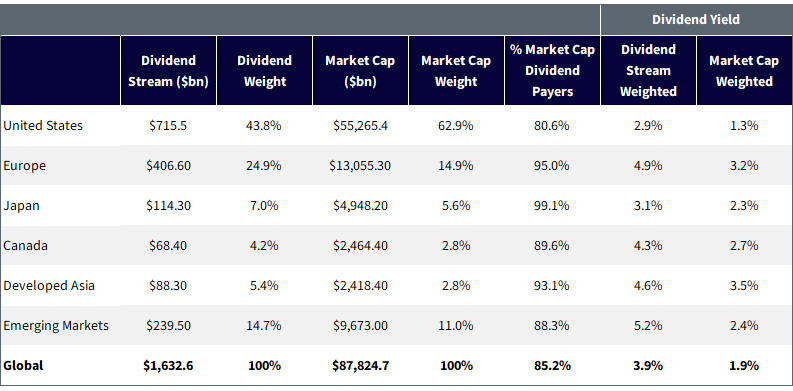
Sources: WisdomTree, MSCI, as of 9/30/24. Universe is MSCI ACWI IMI. Israel included in Europe. Developed Asia includes Singapore, Australia, Hong Kong and New Zealand. U.S. dividends are indicated. International dividends are trailing. Dividend Stream and Market Cap totals are adjusted for investability factors. You cannot invest directly in an index. Past performance is not indicative of future results.
Changes to WTGDIV
Despite the turnover among some of the most recognizable names in global markets, the Index’s sector exposures did not vary much between its pre- and post-rebalance iterations. Information Technology was slightly over-weighted (+1.3%) versus its prior exposure, while Communication Services had the largest absolute change, under-weighted by 2.1%.
Sector Comparison Post-Rebalance
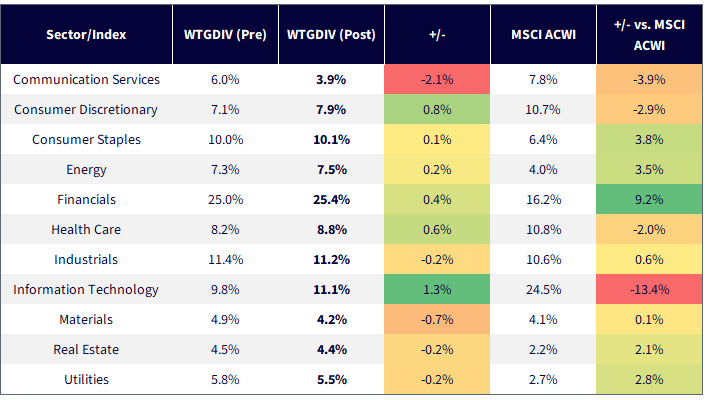
Sources: WisdomTree, MSCI, as of 10/16/24. You cannot invest directly in an index.
However, compared to the MSCI AC World Index (ACWI), the sector differences are more pronounced due to our dividend focus. The under-weight in Communication Services approaches 4%, while Information Technology is roughly half that of global, market cap-weighted indexes.
The dividend-weighted methodology naturally introduces a tilt to traditionally cyclical and dividend-heavy sectors, which results in a 9.2% over-weight in Financials and a 3.5% overweight in Energy. Exposures to certain defensive sectors, such as Consumer Staples and Utilities, are also over-weighted by their dividend-heavy tendencies.
From a country standpoint, there was virtually no change between the pre- and post-rebalance geographic exposures.
Relative to MSCI ACWI, however, we see some consistent themes when differentiating between dividend- and market cap-weighted global indexes. Naturally, WTGDIV is heavily under-weight in the United States versus ACWI since many of the largest companies that comprise the latter, particularly within the Information Technology space, do not pay a dividend. That results in over-weights to other countries where a larger proportion of the local equity does. Japan and many of the other European countries shown below are good examples of this since the non-U.S. region has a greater preference for dividend payments. Nearly 100% of the Japanese and European equity market caps pay a dividend.
WTGDIV Weights Post-Rebalance and Over/Underweights vs. MSCI ACWI
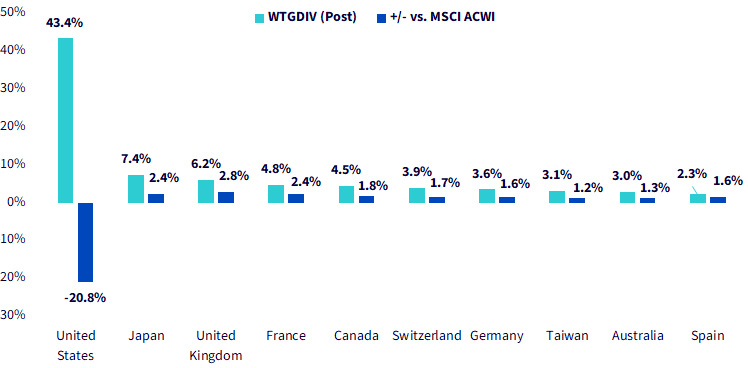
Sources: WisdomTree, MSCI, as of 10/16/24. MSCI ACWI weights as of 9/30/24. You cannot invest directly in an index.
Changes to the WisdomTree Global High Dividend Index (WTGDHY)
One of the subsets of the Global Dividend Index is the WisdomTree Global High Dividend Index, which selects the top 30% of companies by dividend yield from the global dividend-paying equity universe. It applies an adjustment factor so that the weights of each region (i.e., the U.S., developed and emerging markets) in our stock basket are equal to the regional weights by float-adjusted market capitalization of the entire global equity market rather than exclusively dividend payers.
As the name suggests, the Index targets the segment of the global equity market that has the highest dividend yield. A higher-yielding equity basket could be advantageous in today’s market environment, where global rates could continue falling, as the dividend yield potential may help supplement diminished cash flows from traditional income-producing investments, like bonds. Meanwhile, investors maintain potential equity upside if the bull market continues, as well.
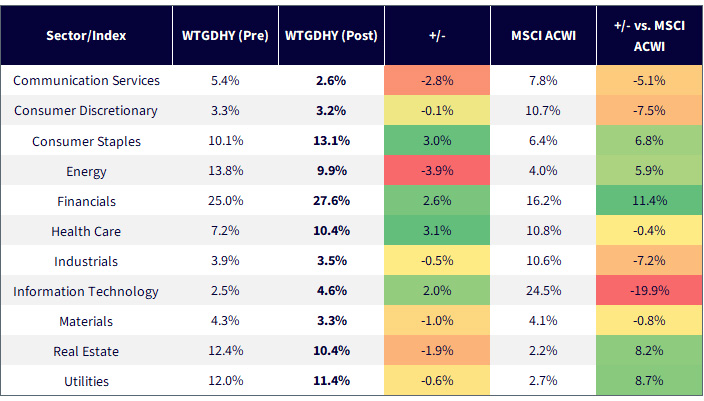
Post-rebalance, the Index offers a dividend yield of more than 4.6%, while the yield on MSCI ACWI is about 1.8%, as of September 30. The potential 280-basis-point (bp) yield pickup could be attractive for income-oriented investors.
Since it’s essentially “region” neutral, the sector composition is a greater consideration as the rebalance tends to have more pronounced effects.
Relative to its pre-rebalance iteration, the reconstituted Index features roughly 3% over-weights in Consumer Staples, Financials and Health Care, while Communication Services and Real Estate are under-weighted by about 2%–3%. Notably, there’s a slightly larger pickup in Information Technology exposure by about 2%.
Unsurprisingly, we see greater tilts than in MSCI ACWI. Once again, Information Technology is a significant, double-digit under-weight, while greater Financials exposure offsets some of that gap. Other value-oriented sectors, like Energy, Real Estate and Utilities, steer the Index away from growth heavyweights, such as Communication Services and Consumer Discretionary.
Sector Comparison Post-Rebalance
For investors considering a global equity solution with a high dividend yield, the WisdomTree Global High Dividend Fund (DEW) seeks to track the price and yield performance, before fees and expenses, of the WisdomTree Global High Dividend Index.
This article originally appeared on WisdomTree’s website and is reprinted on VettaFi | ETF Trends with permission from the author. For more information, please visit WisdomTree.com.
For more news, information, and strategy, visit the Modern Alpha Channel.
Important Risks Related to this Article
For current holdings of DEW, please click here. Holdings are subject to risk and change.
There are risks associated with investing, including possible loss of principal. Foreign investing involves special risks, such as risk of loss from currency fluctuation or political or economic uncertainty. Funds focusing their investments on certain sectors increase their vulnerability to any single economic or regulatory development. This may result in greater share price volatility. Please read the Fund’s prospectus for specific details regarding the Fund’s risk profile.
