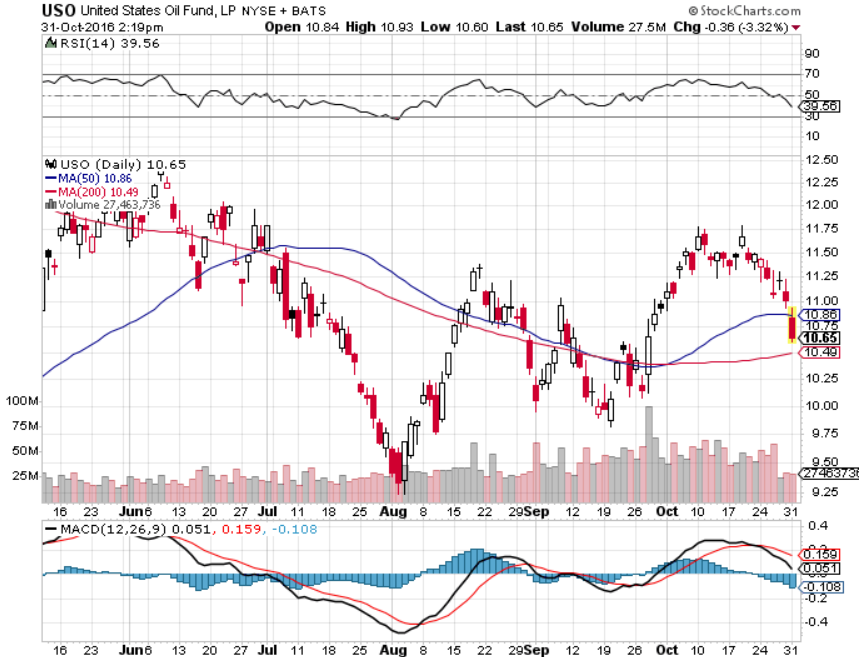
Although some oil forecasts are increasingly optimistic, implying significant upside from current levels, the United States Oil Fund (NYSEArca: USO), which tracks West Texas Intermediate crude oil futures, is off more than 4% over the past week.
That decline does not mean oil and USO are headed for another bear market, but it could be a sign that crude futures are set to plateau over the near-term. Looking ahead, the Organization of Petroleum Exporting Countries will consider agreeing on output cuts for most members when the group’s energy ministers meet on November 30.
SEE MORE: Energy ETFs Rally as Russia Joins OPEC in Considering Supply Limits
OPEC plans to diminish output to a range of 32.5 to 33.0 million barrels per day from its current estimated output of 33.24 million barrels per day. While Saudi Arabia, OPEC’s biggest producer, has agreed to reduce output, Iran, Libya and Nigeria might not follow suit.
Obviously, production is a key element in the decision-making process regarding energy investments.
Currently, oil investors face conflicting reports regarding output. For example, Venezuela’s crude output is plunging to multi-year lows while Algeria is looking to boost production.
Related: A Factor that Could Hinder Oil ETF Investing
“However, talk has recently proven to be cheap—if not worthless—with the cartel. Crude traders doubt OPEC will be able to stick to its plans of a production cut, which helped send prices down last week,” reports CNBC. “The global head of energy analysis for the Oil Price Information Service (OPIS) highlighted that issues would arise in any agreement because a freeze would be occurring at record production levels.”
[related_stories]Other oil traders believe 2017 will be fertile ground for an oil rally. While production has declined in the U.S., recently rebounding oil prices are encouraging exploration and production companies to revisit spending plans with some increasing capital expenditures. That has some oil market observers concerned about a rising rig count and the subsequent impact on crude prices.
“Meanwhile, another issue could arise from OPEC member Nigeria, if the nation floods the market with oil. The country’s production recently came back online following war-related outages,” according to CNBC.
For more information on the oil market, visit our oil category.
United States Oil Fund