On Tuesday, oil prices and the corresponding exchange traded products climbed for the fourth straight day as traders speculate on the likelihood of production cuts to stabilize the market and a weakening U.S. dollar helped support prices.
Crude oil prices have been rallying as investors anticipated oil producers will take action to rein in the ongoing supply glut after Saudi Energy Minister Khalid al-Falih said the kingdom would work with other major producers to stabilize markets, reports Libby George for Reuters.
SEE MORE: Oil ETFs Jump on Saudi Speculation, IEA Demand Comments
Investors can play that theme with equity-based sector ETFs, including the Vanguard Energy ETF (NYSEArca: VDE). VDE is one of the least expensive energy sector ETFs on the market, charging just 0.1% per year. That makes it less expensive 93% of rival funds, according to Vanguard data.
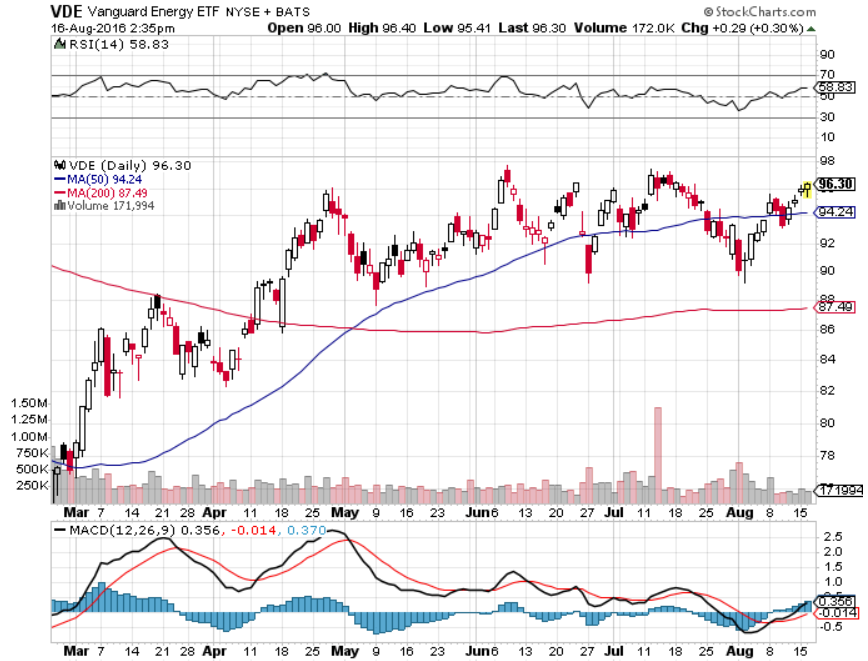
VDE’s technical outlook is improving.
“We see that VDE confirmed a reversal from a low in January on a very high-volume day of buying. The longer-term uptrend is further supported by a golden cross in May and a run to the resistance line at $96 to $98. Triple buy signals from my proprietary internal indicator, the Collins-Bollinger Reversal (CBR), mark a bullish reversal from a consolidation at the 20-day moving average at $88,” according to InvestorPlace.
The third quarter is historically unkind to the energy sector, but some industry observers believe the recent pullback in crude prices is not a cause for alarm and that there is still upside available with some of the big-name integrated oil companies held by ETFs like VDE.
VDE and comparable cap-weighted energy ETFs allocate hefty portions of their lineups to the largest oil companies, including Dow components Exxon Mobil (NYSE: XOM) and Chevron (NYSE: CVX) along with Schlumberger (NYSE: SLB), the largest oilfield services provider. In some cases Exxon Mobil and Chevron, the two largest U.S. oil companies, combine for up to a third of these ETFs’ weights.
SEE MORE: Why Investors are Bearish on Oil ETFs
Integrated oil stocks have refining exposure, a segment that benefits when oil prices are low due to improved margins. That can help steady diversified energy ETFs like XLE because these are not dedicated exploration and production funds.
“Traders should attempt to purchase shares of VDE at $96 with an objective of $110 for a potential return of nearly 15%. Investors can also add this ETF to their long-term portfolios as a cornerstone investment in the energy group. VDE is rated a four-star fund by Morningstar and has a yield of 2.4%,” adds InvestorPlace.
For more information on the Energy ETF market, visit our Energy category.
Vanguard Energy ETF