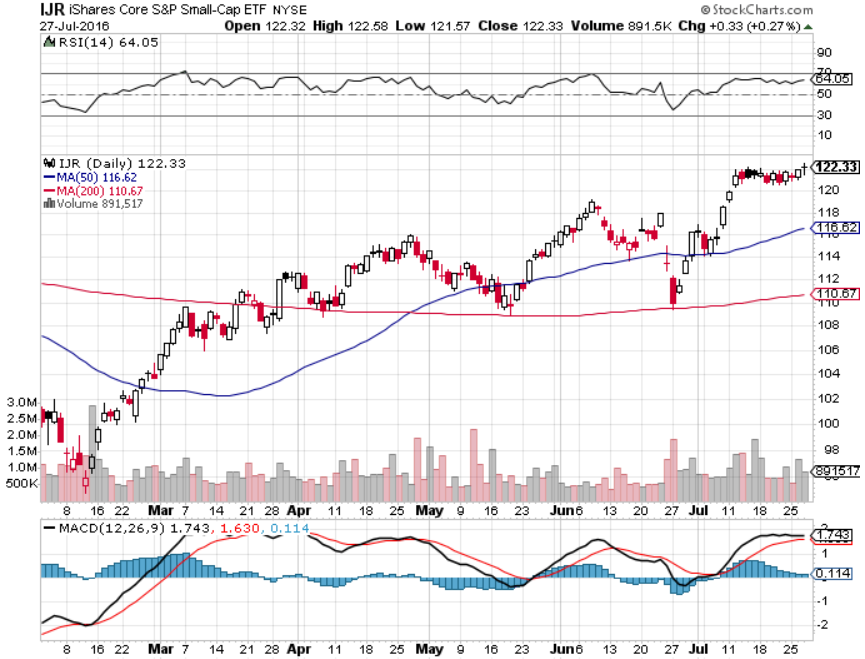
The iShares Russell 2000 ETF (NYSEArca: IWM), the largest exchange traded fund tracking smaller stocks, and the rival iShares Core S&P Small-Cap ETF (NYSEArca: IJR), which follows the S&P SmallCap 600 Index, have been durable performers through a good part of this year. Good news: Some market observers see more upside coming, particularly in the case of IJR.
While investors have been favoring large caps and low volatility stocks for the bulk of this year, some important small-cap benchmarks have recently displayed notable technical strength, indicating risk appetite could creep back into the market in the coming weeks.
Small-caps, though, can still navigate through a slowly rising rate environment. Smaller companies, which focus on U.S. markets, are less exposed to a stronger U.S. dollar as rates rise, which would more negatively affect larger corporations with a global footprint. Additionally, periods of rising rates also coincide with expanding economies, which often benefit smaller companies.
“Compared with the more popular Russell 2000 index, the S&P 600 “has more highly profitable companies in it, some higher quality companies and it’s done better as well,” said Ari Wald, Oppenheimer’s head of technical analysis on Tuesday on CNBC’s “Power Lunch.”
Small-caps are also focused on the domestic economy and have less direct exposure to global geopolitical uncertainty and currency risks, as opposed to large-cap companies that have an international footprint, which may be affected by overseas risks and a strengthening U.S. dollar.
Related: A Post-Brexit Opportunity With Small Cap ETFs
Moreover, merger and acquisition activity can continue to pick up ahead, with larger companies seeking to expand by purchasing smaller businesses to complement or expand their markets. Larger firms may be more apt to engage in M&A activity now, especially with interest rates and financing costs near historical lows.
Other strong small-cap performers include the PowerShares Russell 2000 Equal Weight Portfolio (NYSEArca: EQWS) and the Schwab U.S. Small-Cap ETF (NYSEArca: SCHA).
EQWS takes an equal-weight position on the Russell 2000. Compared to the benchmark Russell 2000, the equal-weight methodology has a much lower financial tilt at 10.9% and smaller information technology position at 13.3%. The indexing methodology also makes the fund overweight micro-caps at 62.7% of the portfolio.
Related: ETFs In 2016: Large Cap vs. Small Cap
IJR’s “look pretty favorable for the S&P 600, Wald added. Looking at a chart of the S&P SmallCap 600 index compared to the advance-decline line, Wald points out that more stocks within the index are rising than falling,” reports CNBC.
iShares Core S&P Small-Cap ETF