In what has been another rough year for emerging markets stocks and exchange traded funds, India ETFs have been among the better BRIC performers. That is to say ETFs such as the WisdomTree India Earnings Fund (NYSEArca: EPI) and the PowerShares India Portfolio (NYSEArca: PIN), two of the largest India exchange traded funds, along with the iShares India 50 ETF (NasdaqGM: INDY), a proxy for India’s CNX Nifty Index, which is home to India’s 50 largest stocks, have been less bad than Brazil and China equivalents.
Earlier this year, Indian stocks and ETFs were helped by a controversial update to India’s official GDP-estimation methodology, which could have bolstered recent readings by over two percentage points. Slack earnings and uncertainty regarding taxes on foreign investors are among the issues that have recently hindered Indian stocks. [Living Large With a Leveraged India ETF]
Last year, Indian equities and the aforementioned ETFs were buoyed by the landslide victory for Hindu nationalist Narendra Modi in the country’s national elections. In 2015, other factors are supporting India ETFs, including low oil prices (India is a net importer of crude) and accomodative monetary policy from the Reserve Bank of India.
Heading to 2016, investors should consider a patient approach to India, Asia’s third-largest economy behind China and Japan.
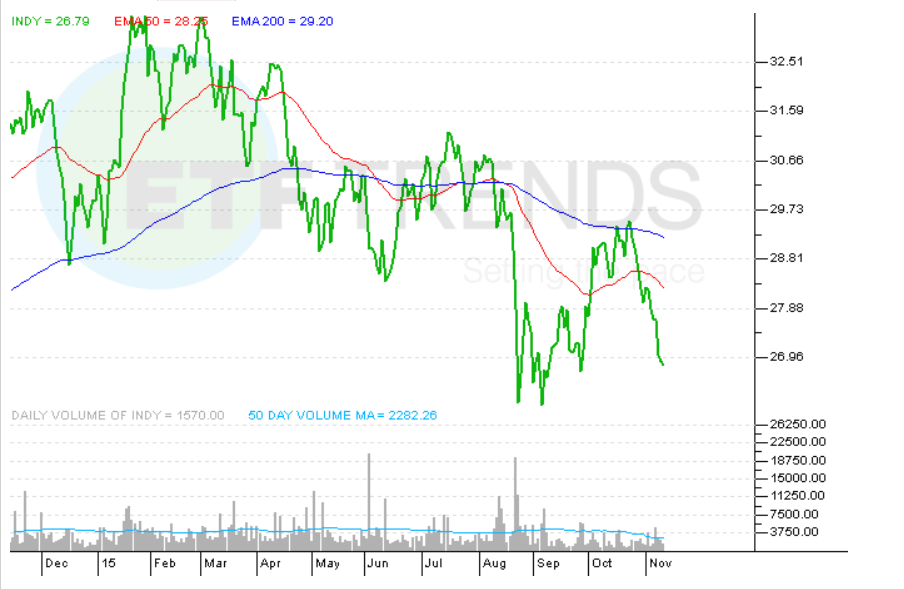
Looking at INDY’s two-year chart, “two-year chart, you can see that it is trading within a defined downtrend. Notice how the descending trendline and its 200-day moving average (red line) have consistently acted as levels of resistance when the bulls tried to push prices higher (shown by the red arrows). This chart is also a great example of how a strong level of support such as the 200-day moving average can reverse its role and become resistance,” according to Investopedia.
The bottom line is that compared to other emerging markets ETFs, particularly the other members of the BRIC group, India funds have been decent-by-comparison this year and that strength could translate to some legitimate upside for patient investors.
Enticing money managers, India’s economy is expected to expand faster than its BRIC – Brazil, Russia, India and China – counterparts. India’s trade imbalances are also diminishing and the country’s currency and stocks have held up, or at least haven’t sold off as rapidly
“Predictable behavior at key levels such as trendlines and moving averages tend to create obvious pivot points and provide strategic traders who use technical indicators an opportunity to time their entry. Based on this chart, bullish traders looking for exposure to India will likely want to remain on the sidelines until the bulls are able to overcome some of the nearby resistance and take control of the momentum,” adds Investopedia.
iShares India 50 ETF