“I can understand that but it’s hard to be too short a market where more than half of the companies are trading below book value,” Darby said in the article.
Japan country-specific ETFs are trading at cheap valuations relative to U.S. stocks. For instance, EWJ shows a price-to-earnings ratio of 14.7 and a price-to-book of 1.1, DXJ has a 13.2 P/E and a 1.1 P/B, and DBJP has a 14.7 P/E and a 1.1 P/B. In comparison, the S&P 500 index is trading at a 17.1 P/E and a 2.4 P/B. [Japan ETFs Try to Rally]
Looking ahead, John Vail, chief global strategist at Nikko Asset Management Co., argues that corporate profits could continue to surprise on the upside and further support market gains. Naeimi points to the weakening Japanese yen as a major factor in the improved corporate earnings outlook. The weaker yen could have bolstered export growth and overseas revenue over the third quarter.
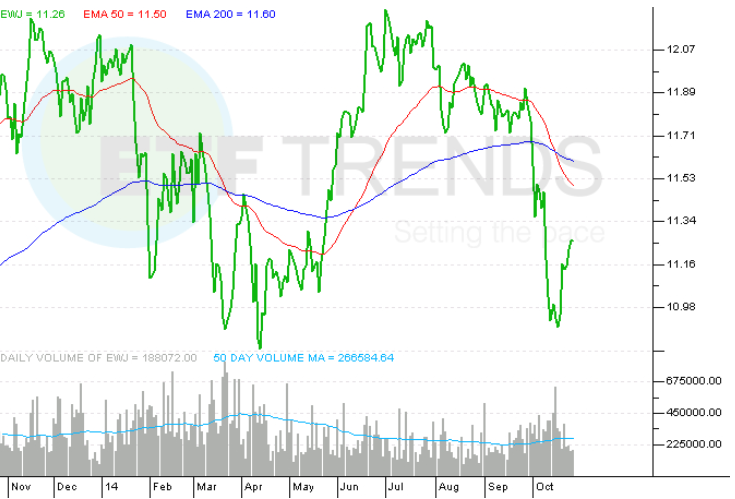
iShares MSCI Japan ETF
For more information on Japan, visit our Japan category.
Max Chen contributed to this article.
