The Global X FTSE Portugal 20 ETF (NYSEArca: PGAL) is trading higher today, but following concerns regarding the health of Espirito Santo Financial Group, the country’s largest bank, a more conservative approach to European equities and the relevant exchange traded funds may be warranted.
That sentiment could prove true particularly in the case of single-country ETFs. Not only is PGAL headed for a steep weekly loss, but concerns over the health of Portugal’s banking system have weighed on other PIIGS single-country ETFs as well. For example, the iShares MSCI Spain Capped ETF (NYSEArca: EWP) and the iShares MSCI Italy Capped ETF (NYSEArca: EWI) look poised to close the week with losses of about 3%. [Problems for Europe Bank ETF]
“Disparate attempts by some Euro-18 leaders to coax Brussels into relaxing fiscal deficit- and national
debt-to-nominal GDP targets required by the Maastricht Treaty might eventually meet with some success. Yet, any compromise would risk undermining the credit standing of those states opting to pump-prime their economies and likely prove disappointing as a measure for inducing domestic demand in view of what little benefit America derived from having widened its budget shortfall since the onset of the Great Recession. Given the foregoing and the looser direction of European Central Bank (ECB) policy, investors should focus on sovereign debt, rather than stocks, of fiscally responsible economies,” said S&P Capital IQ in a new research note.
For investors looking to maintain Eurozone equity exposure, the right prescription may be to do so with Germany, the region’s largest economy. Although the defensive nature of German stocks relative to peripheral Eurozone markets might imply higher valuations, that is not the case. [Preference for Germany ETFs]
“Trading at a meager 1.4 point discount to the eurozone market, Germany’s positive-adjusted, one-year forward price-earnings multiple of 13.7x is low, compared with its historical average (17.9x) and record high (40.0x) and is just 5.3 points above its all-time low. Moreover, German stocks are inexpensive when measured in relation to their eurozone bellwether, trading at a 0.13 point discount. Likewise, composite currency bloc shares appear cheap too, given the fact that the eurozone’s positive-adjusted, one-year forward price-earnings ratio of 15.1x falls 16.2 points below its record high of 31.3x and is 1.3 points less than its 16.4x historical average, not to mention that – in relative terms – EMU equities are trading at a 0.16 point discount to their benchmark, the S&P Europe 350 index,” according to S&P Capital IQ.
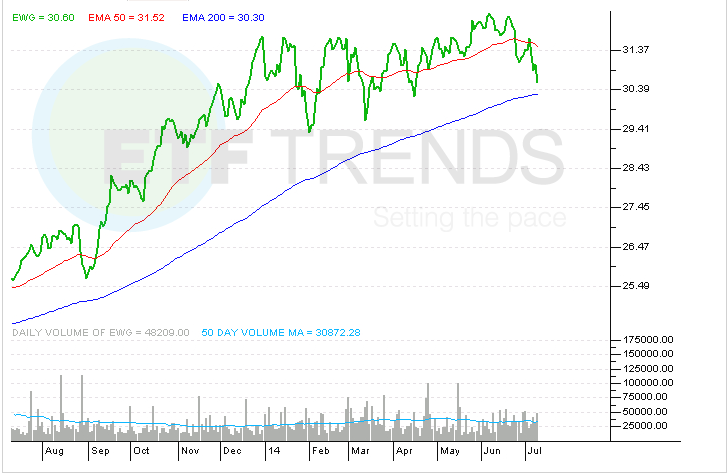
The iShares MSCI Germany ETF (NYSEArca: EWG), the largest Germany ETF, has traded modestly lower this year. S&P Capital IQ rates EWG marketweight.
Following the European Central Bank’s efforts to weaken the euro, investors may want to consider other ways of tapping German equities, many of which are positively correlated to a weaker common currency due to the export-driven nature of Germany’s economy.
The db X-trackers MSCI Germany Hedged Equity Fund (NYSEArca: DBGR), the WisdomTree Germany Hedged Equity Fund (NasdaqGM: DXGE) have delivered both outperformed EWG this year with DXGE posting a 3.5% gain, tops among large-cap Germany ETFs. Notably, DBGR has doubled in size as investors bet on ECB easing. The iShares Currency Hedged MSCI Germany ETF (NYSEArca: HEWG), which debuted in February, already has $49.4 million in assets under management. [Other ETF Options for Germany]
“German equities continue to merit high exposure because, in addition to auspicious absolute and relative valuation measures, its superior economic strength should proceed to power the eurozone’s revival,” added S&P Capital IQ.
iShares MSCI Germany ETF